Bioplastic, part 1

1

This post is part of our definitions series on “eco-lingo” and technical terms.

– – –
photo credit: Tecknor Apex

Bioplastic :

The term “bioplastic”  generally refers to plastic made in whole or in part from plant-derived renewable resources and/or compounds that are subject to degradation from microbial action.

The “and/or” is key and this is where the confusion comes in. “Bioplastic” is a catch-all term that refers to several different classes of plastics. For example, some petroleum based plastics (non-renewable resource) can be made in such a way that they biodegrade over time, leaving behind a toxic residue. And some “bioplastics” made from renewable resources will not biodegrade.

While not a very new technology,  bioplastics have only recently begun to take off in the U.S.  There have been many new products hitting the shelves with claims that they are a cleaner and greener option. But not all of these products are interchangable with each other, or with the conventional plastics that they would replace.

To help you sort your plastics, here is the difference between “degradable”, biodegradable”, and “compostable”:

Degradable plastics are essentially meant to address the “lingering” characteristic of traditional plastics that can take decades or longer to break down, persisting as litter or consuming valuable landfill space. Degradable plastics are those that are engineered to break down into fragments, particles or residue more rapidly than conventional plastics, but “degradable” does not itself define what the constituent materials are.

Biodegradable plastics are typically a hybrid of sythetic polymers and biomass or starch-based plastics. Like degradable plastics, they break down to a point, but are not 100% biodegradable unless they are marked “compostable”…

Compostable plastics are able to fully biodegrade without leaving toxic elements behind (made completely without the use of synthetic polymers); however, compostable plastics are not instantly ‘back to nature’.  Although composed of biomass, most compostable plastics break down very slowly and often need the assistance of a commercial composting facility. The unfortunate misconception here is that one can toss a soy-plastic fork in a meadow after a picninc or in the backyard pile, and it will dissolve quickly. “Compostable” plastics can thus lead to litter and perhaps irresponsible consumer behaviors.

In part 2 of this post, I will discuss the recycling and end-of-use considerations of bioplastics.

– – –

What exactly does “sustainability” mean? How about “green”, “eco” or “environmentally friendly”? The truth is that these terms are just vague enough to mean many different things to many different people. With the staggering array of “green” products, ‘lifestyles’ and concepts being promoted by marketers and environmentalists alike (as well as the necessary coining of new terms to match new ideas) our definition series aims to make sense of the rising tide of “eco-lingo” and technical terms.

San Francisco’s Smart Water Meters

1
                                                                                          water supply leak, Free Foto.com

San Francisco began to roll out its new ‘smart’ water meters to city residences this month. The new devices can accurately track water usage in real-time and the San Francisco Public Utilities Commission (SFPUC) plans to make personal water use data available to customers online. Other benefits include the streamlining of operations- meters communicate wirelessly, eliminating the need for house-to-house readings- and the early detection of system leaks and unusual usage surges.

The SFPUC will replace over 175,000 meters beginning with 5,000 this spring/summer,with an estimated install completion for the full number by 2012. The expectation is that the new meters will be able to assist individual and system-wide conservation efforts, increase response time for problems, and allow for a more accurate and refined fee structure.

California, as a drought-prone state, can stand to benefit greatly from increased water use data collection. As it stands today, water use is not uniformly tracked in all homes and businesses, nor is there any correlation between regional water scarcity and water service rates. While agriculture, industry and conveyance also play leading roles in the general water picture in the state, having accurate home and commercial usage data is a step forward, and can only be a benefit in creating sound management policies for this precious and scarce resource.

Environmental Impacts of the World Cup

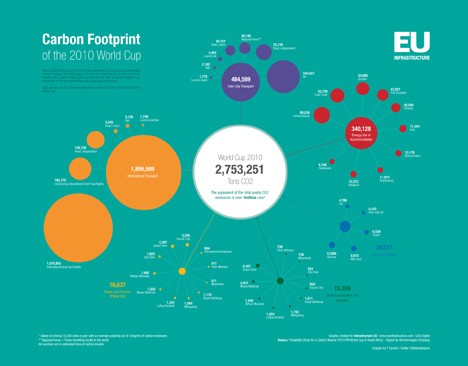
 Infographic by EU Infrastructure

As far as major international sporting events go, short of the Olympics, it doesn’t get much bigger than the World Cup. Massive international travel, infrastructure upgrades to accommodate the influx of visitors, building or renovation of stadiums, and the large amounts of waste generated by spectators are all part of the preparation and running of such a massive event.

This got us thinking, just how big is the carbon footprint of something like the World Cup? And what sorts of mitigation strategies are already in practice?

The answer to the carbon footprint question is: BIG. According to a pre-event study estimate by the South African Department of Environmental Affairs and Tourism in conjunction with the area Norwegian embassy, the carbon footprint for the event is 2.8 million tons. To quote Mike Berners-Lee, posting on the UK Guardian’s Green Living blog, “(that) is roughly equivalent to 6,000 space shuttle fights, three quiet years for Mount Etna, or 20 cheeseburgers for every man, woman and child in the UK.”

Levity aside, it is important to note that estimates of the impact vary widely, and what is important is to look at the overall pattern. Without question, the lion’s share of emissions are associated with athlete and spectator travel. This can make it hard for a more remote locale such as South Africa to remain competitively “green” compared to an event such as Germany’s 2006  World Cup event, which drew many of its participants via Europe’s centralized rail systems.

To the second question we posed, what are the best practices already in place for mega sporting events?

It is heartening to note that the problem of lessening impacts of major international sporting events is being taken seriously as a factor in weighing bids to host events. The bar was set by the the Local Organizing Committee (LOC) for the Lillehammer winter Olympic games in 1994, which incorporated sustainability dimensions in its planning. Incorporating sustainability concerns was then supported formally the International Olympic Committee (IOC) and has been a consideration of LOC’s at all subsequent Olympic games (Sebake & Gibberd, 2007). The bar was raised for the World Cup event by Germany’s 2006 LOC in partnership with the World Wildlife Fund and the Oko-Institut, who together developed a “Green Goal Initiative”.

Read More

World Cup 2010 Fun Fact:

SABMiller and Crown developed a full aperture beer can for the event that allows the patron to fully remove the lid and use the can as a drinking cup. This will cut down on the waste from plastic concession cups.

Finding Data – The Greendex

1

photo link

For the third year running National Geographic has teamed up with Globe Scan to provide the Greendex, an annual survey designed “to develop an international research approach to measure and monitor consumer progress towards environmentally sustainable consumption.”  Specifically, the Greendex is a tool to help consumers worldwide to both understand their consumption patterns and to be able to view them within context to others.

The Greendex survey questions were designed to capture the participant’s knowledge, behavior and views on environmental issues and consumer habits ranging from transportation to food choices. The study is based on a sample of 17,000 individuals in 17 countries (14 in 2008). So, while perhaps not a truly  “definitive” study on a global scale, the Greendex survey countries represent the heaviest hitters in terms of resource consumption, and the Greendex 2010 Report provides some interesting insights.

Some notables from the study:

– Respondents from 10 of the 17 countries polled showed an increase in “environmentally friendly consumer behavior” between this year and last.

– Consumers with the highest rankings for “green” choices are in developing nations. Top scores go to India, Brazil and China (in that order).

– Uh-oh USA … we’re showing slight improvement relative to ourselves last year, but we’re still at the bottom of the heap.

– The strongest changes in personal behavior that made positive impacts were in the Housing category (home energy efficiency).

Read the highlights report here.

Calculate your own personal “Greendex” here.

And finally, how reliable are self-reported behavior surveys anyway? Separate the fact from fiction with the Market Basket report.

Noelle’s Links – Bay Area Edition

1

Interesting tidbits from my web travels…

The SF Chronicle’s Chip Johnson weighs in on a promising Oakland streetcar proposal from Stanford student Daniel Jacobsen. The proposed line would link Piedmont to the Jack London waterfront, creating a focused amenity for downtown Oakland. Jacobsen’s careful and well-researched proposal which he gave to the city as a gift, is based on a similar street car system in Portland. Jacobsen includes feasibility analyses, job creation projections and a funding strategy.

East Bay Local Alert: The Beehive Market, a brand new sustainable-focus community market kicked off on Saturday, June 12 in West Berkeley. The Beehive features local food and produce vendors, eco-fashion, home, and personal care, and even features local bands, and speaker/educational events. What better way to start the weekend?

Berkeley’s recent intimations that it will begin collecting a fee for curbside recycling has been receiving a fair amount of press lately. While it may seem like an ecological dis-incentive, it is important to celebrate the success that Berkeley’s recycling program has had and its influence on the creation of recycling programs around the country. It is actually good news that recycling in Berkeley can no longer be funded solely on fees for landfill garbage collection. As municipalities start to make progress toward their waste diversion targets, it is time to start making headway on new models for funding mechanisms; be prepared- it may take a few tries to get it right.

The Red Vic Movie House in SF will be screening the new documentary “Oceans” on Sunday June 20, and Monday June 21st. With all of the harrowing events still unfolding in the BP Gulf oil spill, now seems to be an especially important time to raise our awareness of the ocean and its inhabitants. The documentary provides extensive underwater imagery captured with state-of-the-art techniques, and also discusses the human impacts on the ocean’s vital ecosystems.

Extended Producer Responsibility (EPR)

6

This post is part of our definitions series on “eco-lingo” and technical terms.

photo by Ian Britton, FreeFoto.com

Extended Producer Responsibility refers to the concept that manufacturers have an obligation to take a more active role in the entire life-cycle of their products in order to reduce the burden of recycling and disposal currently borne by local governments and taxpayers. The approaches to EPR may vary, from optimized manufacturing processes that allow a product to be dismantled and recycled more easily thereby reducing the amount of waste and/or toxic materials sent to landfill, to “take back” programs that allow consumers to return an end-of-life product back to the manufacturer for recycling or disposal.

EPR is often achieved through mandates from local  and state governments. Besides “take back” programs, strategies may include:

–Additional fees or taxes for producers and consumers of certain products to recover disposal costs;

–“Environmentally preferable purchasing” guidelines for manufacturers that may, among other things, ensure less waste by setting recycled-content requirements for new products; and

–Design requirements that reduce the unnecessary packaging waste, extend the life of products, etc.

One common application of EPR programs and/or mandates is in regard to electronics waste, or “e-waste”.

Related term:

Product Stewardship is often used as another term  for extended producer responsibility, but can also incorporate actions that do not directly target manufacturing practices. Product stewardship may examine the entire structure of production and consumption including all stakeholders: manufacturers, vendors, consumers, and government, with the emphasis on shared responsibility for the end-of-life-cycle of products. Product stewardship, as EPR, may be achieved through any combination of legislation, mandates, incentives, collaborative processes, voluntary action from manufacturers and education and outreach to producers and/or consumers.

What exactly does “sustainability” mean? How about “green”, “eco” or “environmentally friendly”? The truth is that these terms are just vague enough to mean many different things to many different people. With the staggering array of “green” products, ‘lifestyles’ and concepts being promoted by marketers and environmentalists alike (as well as the necessary coining of new terms to match new ideas) our definition series aims to make sense of the rising tide of “eco-lingo” and technical terms.
Curitiba Brazil’s Green Exchange

Curitiba Brazil has a number of innovative waste management programs. Follow this link to view a short video that features Curitiba’s Green Exchange Program. The program operates by exchanging fresh food for recyclable items that residents collect and bring to a transfer station.

Also see information here on the documentary A Convenient Truth, a film that chronicles how this typical South American city is transforming itself  through innovative, sustainable community initiatives.  Curitiba’s ideas and expertise are being exported to other cities around the world. I haven’t seen the doc yet, but it appears to be worth a look.

Noelle’s Links – 6/3/10

Interesting tidbits from my web travels…

The Green Products Innovation Institute is a non-profit that kicked off in May that provides guidance on the manufacture of safer products. The group offers the new “Cradle to Cradle” certification. Read Triplepundit‘s coverage of the launch.

Visit the Green Product Innovation Institute’s site here.

Read about Jerry Glover, Agroecologist, working towards the establishment of perennial crops that could be the next agricultural revolution, at National Geographic.

In case you haven’t seen one of the many tech blogs buzzing about this one yet, check out the Prepeat Printer as covered byGeek.com. The Prepeat is a rewritable printer from Japan’s Sanwa Newtec that uses special plastic sheets that can be written and erased up to a thousand times each. The machine is prohibitively expensive at $US 5,500 and a set of sheets will set you back thousands more. A laudable achievement, but plastic sheets? Discuss…

Current Events – AC Transit Cuts, part 2

2

Here is an update on the ongoing cuts to AC Transit service that I first reported on last week:

AC Transit is in trouble. Dire financial straits have forced the agency to consider enacting additional service cuts and the possible declaration of a fiscal emergency. Already adjusting to the 7 percent service cuts that went into effect at the end of March of this year, August is likely to bring an additional 8 percent less service, with more cuts in the pipeline if new funding sources are not found.

On May 26th, AC Transit held two public hearings, at 2 p.m. and 6 p.m. to solicit comments on three possible scenarios that could be rolled out in August.

Proposal one is to operate only trunk and major corridor services on the weekends;

Proposal two is to modify All Nighter and late-night services;

Proposal three is to distribute the reductions across all weekday, late-night and weekend services.

However, it is unlikely that any one scenario will be enacted in full, but rather some sort of amalgamation of the proposed cuts.

I attended the 6 p.m. public hearing and tensions were running high among those who came to speak out against the cuts. Time and again, concerned residents spoke of their fears about losing accessible transit. Many stated that they could not afford cars, or were seniors or disabled and could not walk or bike as an alternative. Some had moved to their residences specifically because they were accessible to bus routes- routes that are threatened under the new scenarios, either by reduction of service resulting in unreasonable wait times, or loss of service areas altogether.

While some expressed frustration with the board of directors, in truth these are deep and painful cuts that nobody wants to make and that will result in the continued erosion of the ridership base, further driving down revenues.

What can we, as informed and concerned citizens, do to try to recover the essential functions of the public service on which so many depend? we need to speak up if we want to keep our transit systems intact (or expanded). Transit is often at the bottom of the list because public outcry is greater on other issues; perhaps transit is seen as so fundamental that we take it as a given. What AC Transit is showing us, is that publicly funded transit is far from a given.

Contact your State Senator.

The Key System

2
Since  the decline of  bus service in the East Bay has been on my mind lately, this installment of Looking Back asks the question: What was AC Transit before AC Transit?
Image of a historic Key System map housed in UC Berkeley’s Earth Science and Map Library
The Key System, a privately held company, provided transit in the East Bay from 1903 until being sold to the public entity AC Transit in 1960.
The first cable car appeared in the East Bay in 1886  on the arterial road, San Pablo. Electric street cars followed in 1891, knitting togther Berkeley and Oakland with intercity rail lines. By 1893, the street cars were being consolidated into the Key System by Francis Marion “Borax” Smith. Although the conglomeration of tracks already served the East Bay from Richmond to San Leandro, Smith furthered the service by building a pier that pulled a track out into the bay, with the final 3 mile leg of the transbay service being completed by ferry. This jutting feature into the bay along with the maze of tracks on land resembled an old fashioned key in plan view, thus giving the Key System its name.
This image was originally posted to Flickr by jaycross at http://flickr.com/photos/66151780@N00/220773099.
By 1924 the Key System had reached a peak of 18 million riders and was typical of integral rail systems in cities across America. However, by the 1930s street cars were already losing major ground to automobiles. The transbay bridge was primed for car and truck crossing in 1936, but did not accomodate rail for another two years. Locals already calibrating to the speed of the auto era, were abandoning the leisurely street car-and-ferry crossing. In another blow to the Key System, tolls at bridge crossings dropped drastically, further driving up competition from auto commuters.
Although the lean war years did temporarily provide a second wind for the mass transit system, the system was beginning to age and infrastructural funds were not ready at hand. With the suburban boom that followed the end of WWII, transit began to decentralize. National City Lines backed by oil and tire companies began to buy up ailing rails across the country and replace them with bus service. In the East Bay, all electric street car lines, save the transbay route had been replaced by buses by 1948.
In 1956 voters approved the establishment of the publicly run Alameda Contra Costa Transit District. AC Transit bought out the nearly bankrupt Key System in 1960.
Credits: All information was gathered from the AC Transit website, and “The Rise and Fall of the Key System“, a slideshow presented at AC Transit Transbay Taskforce November 10, 2009 by Will Sparger.
For a good source of online historical photos of the Key System, click here. Take a trip across the historic Key System rails in a video here.