The Energy-Water Nexus

1

This post is part of our definitions series on “eco-lingo” and technical terms.

– – –

We have been hearing with increasing frequency about “the energy-water nexus” in California as we face potential changes to our climate and our water supply. But what is it?

Basically, water and energy supplies are fundamentally linked together. Producing energy requires a huge volume of water (even for renewables). Treating and distributing water requires a consistent supply of energy. Therefore, serious challenges to the supply of one threatens the reliability of the other.

According to Sandia National Laboratory, producing electricity from just fossil fuels and nuclear energy requires 190 billion gallons of water each day, which accounts for 39% of all U.S. freshwater use. Each kWh generated from coal necessitates 25 gallons of water (source here). Also, since the energy needed to treat and distribute water can account for up to 80% of the water’s final cost, a reduction in the amount of available, inexpensive energy will have a direct impact on the cost and supply of water.

– – –

What exactly does “sustainability” mean? How about “green”, “eco” or “environmentally friendly”? The truth is that these terms are just vague enough to mean many different things to many different people. With the staggering array of “green” products, ‘lifestyles’ and concepts being promoted by marketers and environmentalists alike (as well as the necessary coining of new terms to match new ideas) our definition series aims to make sense of the rising tide of “eco-lingo” and technical terms.

Noelle’s Links – Bay Area Edition

1

Interesting tidbits from my web travels…

The SF Chronicle’s Chip Johnson weighs in on a promising Oakland streetcar proposal from Stanford student Daniel Jacobsen. The proposed line would link Piedmont to the Jack London waterfront, creating a focused amenity for downtown Oakland. Jacobsen’s careful and well-researched proposal which he gave to the city as a gift, is based on a similar street car system in Portland. Jacobsen includes feasibility analyses, job creation projections and a funding strategy.

East Bay Local Alert: The Beehive Market, a brand new sustainable-focus community market kicked off on Saturday, June 12 in West Berkeley. The Beehive features local food and produce vendors, eco-fashion, home, and personal care, and even features local bands, and speaker/educational events. What better way to start the weekend?

Berkeley’s recent intimations that it will begin collecting a fee for curbside recycling has been receiving a fair amount of press lately. While it may seem like an ecological dis-incentive, it is important to celebrate the success that Berkeley’s recycling program has had and its influence on the creation of recycling programs around the country. It is actually good news that recycling in Berkeley can no longer be funded solely on fees for landfill garbage collection. As municipalities start to make progress toward their waste diversion targets, it is time to start making headway on new models for funding mechanisms; be prepared- it may take a few tries to get it right.

The Red Vic Movie House in SF will be screening the new documentary “Oceans” on Sunday June 20, and Monday June 21st. With all of the harrowing events still unfolding in the BP Gulf oil spill, now seems to be an especially important time to raise our awareness of the ocean and its inhabitants. The documentary provides extensive underwater imagery captured with state-of-the-art techniques, and also discusses the human impacts on the ocean’s vital ecosystems.

Virtual Water

1

This post is part of our definitions series on “eco-lingo” and technical terms.

– – –

Virtual water (also referred to as embodied water) is the volume of fresh water used to produce a product at the location of production. This concept of virtual water applies to everything we use or buy, such as clothes, electronics, food, and building materials. For example, the average virtual water associated with 1 egg would be 53 gallons.

(For those familiar with energy issues, this is similar to embodied energy.)

The creator of the virtual water concept, Professor John Anthony Allan, was initially researching agricultural water issues in the Middle East and concluded that the region could survive with scarce water because it was importing large amounts of “virtual water” embedded in its food imports.

You can hear a podcast of Professor Allan’s seminar on virtual water here.

– –

What exactly does “sustainability” mean? How about “green”, “eco” or “environmentally friendly”? The truth is that these terms are just vague enough to mean many different things to many different people. With the staggering array of “green” products, ‘lifestyles’ and concepts being promoted by marketers and environmentalists alike (as well as the necessary coining of new terms to match new ideas) our definition series aims to make sense of the rising tide of “eco-lingo” and technical terms.

Photo – A Geyser in Downtown Berkeley

1

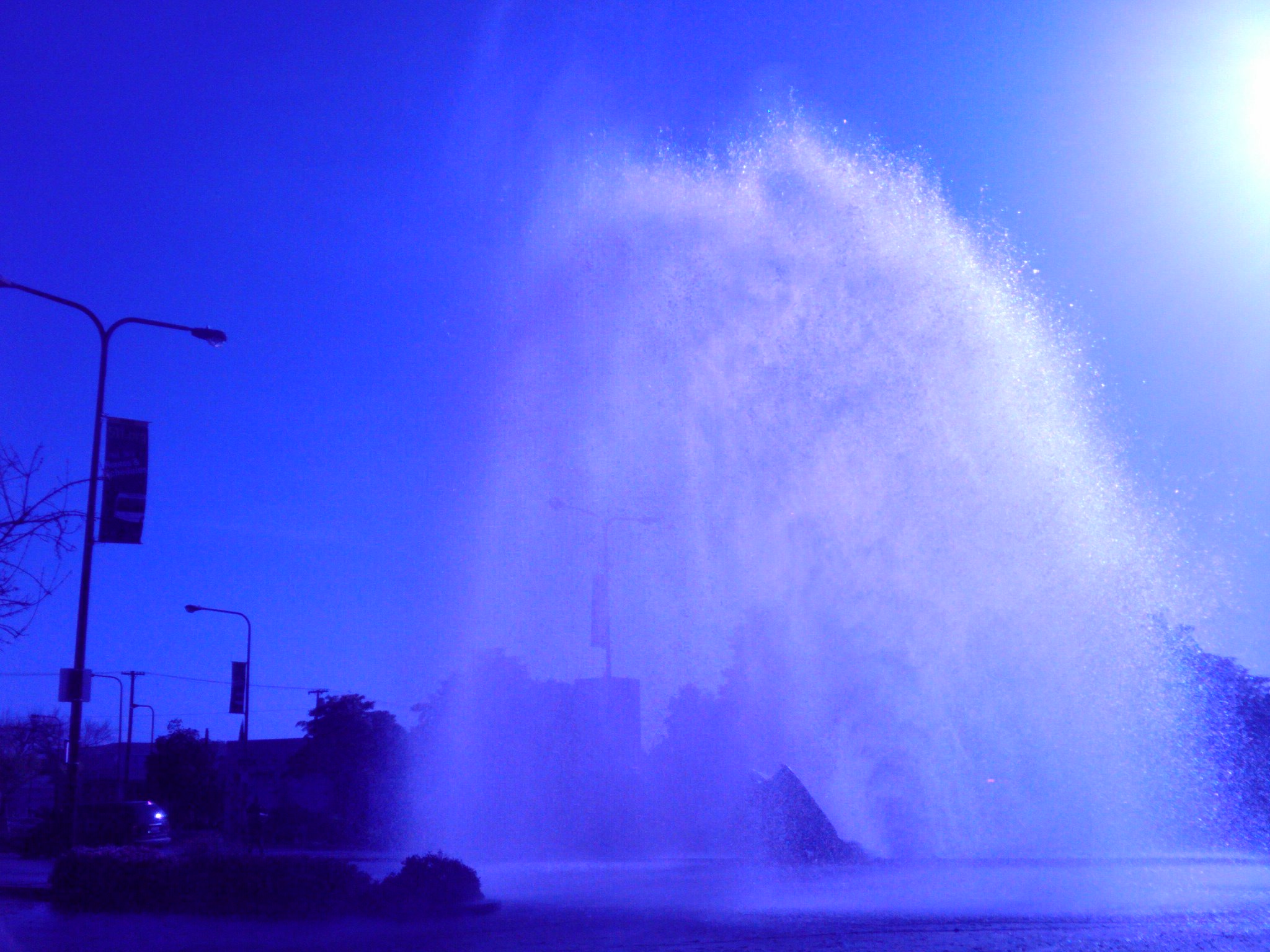
A huge geyser was caused when a car hit a fire hydrant in the center of Shattuck Ave on April 16th.

(And apparently, it’s not the first time this has happened in Berkeley, CA.)

Finding Data – Watershed Mapping

1

Pictured above is the U.S. EPA 'Surf your Watershed' site’s display of the six watersheds of Alameda County.

‘Surf your Watershed’ is an excellent tool from the U.S. Environmental Protection Agency that helps you find basic data on all the watersheds in your county. The site includes U.S. Geologic Survey data, water quality information, and links to local citizen’s groups working on water stewarship, clean up and other  issues (39 in Alameda County!)

Check it out

Finding Data – The Water Intensity of Food

3

Many of us have heard that we should eat locally grown food to reduce the energy needed to transport and preserve the food between the source and our table. Many of us have also heard that we should reduce our meat consumption to reduce the amount of land and other resources needed to support our diets and lifestyles. Another metric to consider is how much water is needed to produce different foods.

Based on values from the Water Footprint Network, I compiled a chart of how much water is needed to produce certain foods. This is obviously not an inclusive list of all foods, but gives an idea of the range of values for different kinds of foods. These values will also differ in different countries and regions. As noted by the director of the Water Footprint Network, Arjen Y. Hoekstra, “Water problems are often closely tied to the structure of the global economy. Many countries have significantly externalised their water footprint, importing water-intensive goods from elsewhere. This puts pressure on the water resources in the exporting regions, where too often mechanisms for wise water governance and conservation are lacking.”

In the table on the left, values are generally for liters per kilogram unless otherwise noted. In the table on the right, values are generally for gallons per pound unless otherwise noted.

You can calculate your own water footprint with this calculator for an estimate of which parts of your diet and lifestyle are most water intensive.

Ixtoc I and ESI Maps

2

News sources and commentators have been comparing the size of the current oil spill in the Gulf to that of the Exxon Valdez spill in 1989. There are of course numerous differences between the spills – the Exxon Valdez spill was in an isolated area in Alaska, for example, and the maximum volume of the spill was known at the beginning of the crisis. The boat could only spill as much oil as it could hold. And the Exxon Valdez spill occurred at the surface – oil was not rising from the bottom of the ocean, becoming emulsified and harder to clean up.

A better comparison for the current Gulf spill might be the Ixtoc I spill of 1979, the worst offshore spill in North American history.

After the well blowout on June 3, 1979, it took more than nine months to cap the well. Nine months. During that time, the well was spewing roughly 10,000 to 30,000 barrels of oil a day into the Bay of Campeche in the Gulf of Mexico. 3 million barrels of oil wound up in the Gulf.

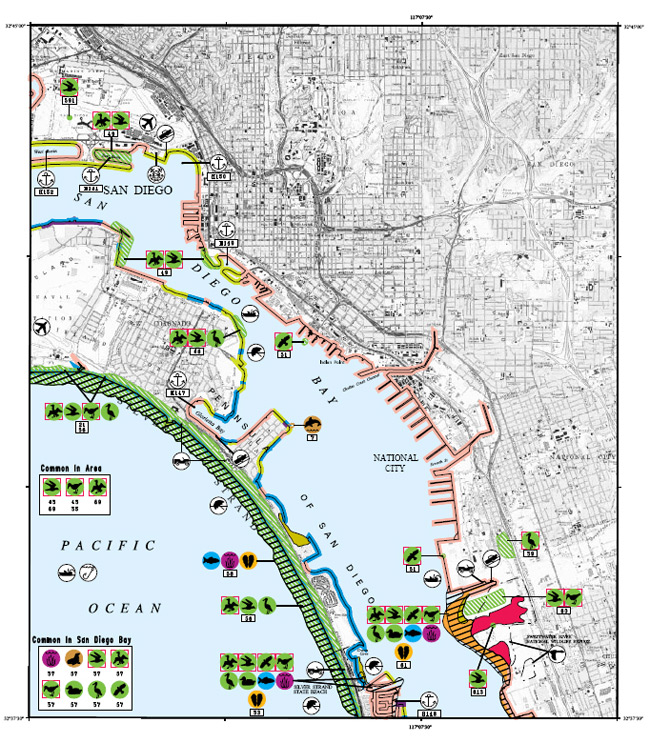
As a result of this major spill, new procedures were instituted, existing procedures were revised, and new information was gathered. The National Oceanographic and Atmospheric Administration (NOAA) Office of Response and Restoration (OR&R) developed Environmental Sensitivity Index (ESI) sensitivity maps, which plot information about the shoreline and biological and human-use resources. This helps responders identify risks and develop priorities quickly. An example  of an ESI map of San Diego Bay (from NOAA’s website) is below.

An overview of the “anatomy” of ESI maps can be found here. ESI maps can be downloaded here.

Anna’s Links – 5/26/10

A round-up of interesting (and depressing) analysis of the recent oil rig explosion and oil spill…

A “live” feed of the BP oil spill is now posted online (though traffic has been so high that it’s not always possible to view) – U.S. Energy and Commerce Committee.

Experts examining a previous video of the oil leak released by BP estimate that the size of the oil spill is much larger than official estimates – NPR.

Scientists fault the government for “failing to conduct an adequate scientific analysis of the damage and of allowing BP to obscure the spill’s true scope” – New York Times.

Some experts are starting to say that the oil leaks could last for years because “we don’t have any idea how to stop this” – National Geographic.

Aerial photos of the Gulf oil spill show its vast size – NASA Earth Observatory.

A scientist at Lawrence Berkeley National Lab notes that some of the detergents used to clean up spill sites can be more toxic that the oil itself – Lawrence Berkeley National Lab.

– – –

Other interesting tidbits from the web…

Two campuses of the University of California system, Berkeley and Davis, have been given  MacArthur grants to launch a new master’s degree program in sustainable development practice – UC Berkeley and MacArthur Foundation.

Developers in Las Vegas are cranking up their sales pitches for brand new homes again, even though the city has 9,500 empty houses and another 5,600 that were repossessed in the first quarter of 2010 – New York Times.

Las Vegas as a whole has been very dependent on growth and construction – the recent drop in new construction had a major impact on municipal funding – Aguanomics and Bloomberg.

Federal officials want public input on a proposal to revise policies for managing urban water shortages in the Central Valley – meetings will be held in Sacramento on May 26, June 23, July 20, and August 19 – The Sacramento Bee.

Special Report on Water in the Economist

This week’s edition of the Economist magazine has a special report on water. This report can currently be downloaded for free here.

Nina Maritz

2

This post is part of our series exploring the ways people and communities reuse, recycle and dispose of waste around the world.

– – –

I saw a presentation by Nina Maritz in San Francisco in 2006, and I have continued to think about her approach periodically over the years.

Nina Maritz is a Namibian architect whose work reflects local building strategies and is built with local labor.

One project that showcases her work is the Habitat Research and Development Center in Windhoek, Namibia. Among many goals and activities listed for the center are “promote sustainable and environmentally appropriate housing” and “develop local skills in sustainable housing construction methods.” The completed project is site appropriate, made from local materials, and uses a number of passive cooling methods to keep the occupants comfortable. Each design decision addresses a number of design challenges (for example, by using poles from invasive species, she could abstain from using rare local hardwood).

What I found particularly striking about Nina Maritz’s work, and what I keep returning to, is the careful reuse of materials throughout the project.

(Photos on Flickr and in ArchitectureWeek)

Wherever possible, it seems, the architect worked with local workers and artisans to reuse materials such as corrugated metal, storage drums, cans, and tires, in both functional and decorative ways. While this approach is difficult in many places because of stringent building code and the expense of labor, it evokes an entirely different way of looking at the world, where every object holds potential not just for its intended use but also for future uses.