The Difference Between the CEC and CPUC

3

I know what you’re thinking – a really exciting topic. But this question has actually come up in conversation a remarkable number of times in the last couple of weeks. This is not intended to be a definitive guide, but just to start the delineation between the organizations.

– – –

Photo Credit: Wikimedia Commons

The Basics

The CEC is California’s primary energy policy and planning agency.

The CPUC regulates privately owned electric, natural gas, telecommunications, water, railroad, rail transit, and passenger transportation companies.

This post will focus only on the energy aspects of the CPUC’s role.

– – –

The California Energy Commission (CEC)

The five CEC commissioners are appointed by the California governor and must be approved by the Senate. Terms are five years. Commissioners must represent the following specific areas of expertise: law, environment, economics, science/engineering, and the public at large.

The CEC’s responsibilities include:

  • Forecasting future energy needs and keeping historical energy data.
  • Licensing thermal power plants 50 megawatts or larger.
  • Promoting energy efficiency by setting the state’s appliance and building efficiency standards and working with local government to enforce those standards.
  • Supporting public interest energy research that advances energy science and technology through research, development, and demonstration programs.
  • Supporting renewable energy by providing market support to existing, new, and emerging renewable technologies; providing incentives for small wind and fuel cell electricity systems; and providing incentives for solar electricity systems in new home construction.
  • Developing and implementing the state Alternative and Renewable Fuel and Vehicle Technology Program to reduce the state’s petroleum dependency and help attain the state climate change policies.
  • Administering more than $300 million in American Reinvestment and Recovery Act funding through the state energy program, the energy efficiency conservation and block grant program; the energy efficiency appliance rebate program and the energy assurance and emergency program.
  • Planning for and directing state response to energy emergencies.

The CEC is located in Sacramento, CA.

– – –

The California Public Utilities Commission (CPUC)

The five CPUC commissioners are also appointed by the California governor and must be approved by the Senate. Terms are six years.

The CPUC regulates investor owned utilities (IOUs) that distribute electricity and natural gas, including Pacific Gas & Electric Company (PG&E), Southern California Edison (SCE), San Diego Gas & Electric Company (SDG&E) and Southern California Gas Company.

The CPUC does not regulate municipal utilities, such as the Sacramento Municipal Utility District (SMUD).

The CPUC’s mission is the following:

  • The California Public Utilities Commission serves the public interest by protecting consumers and ensuring the provision of safe, reliable utility service and infrastructure at reasonable rates, with a commitment to environmental enhancement and a healthy California economy.  We regulate utility services, stimulate innovation, and promote competitive markets, where possible, in the communications, energy, transportation, and water industries.

The CPUC has a number of different divisions; the Energy Division assists Commission activities in the electricity, natural gas, steam, and petroleum pipeline industries. Energy Division handles the regulation and Commission approval of official rates and terms of service for energy IOUs.

Because the regulated California utilities are so large, and their programs reach so many customers, CPUC energy policy decisions and goals have wide influence in California. The CPUC touches programs in energy efficiency, demand response, low-income assistance, distributed generation, and self-generation, among others. It has a role in California climate policy. It is overseeing the CA utilities’ switch to Smart Grid technologies. The CPUC regulated electric generation and procurement, electric rates and markets, gas policy and rates, and electric transmission and distribution.

CPUC headquarters are in San Francisco, CA.

– – –

Assorted Links

The Navy and Marine Corps plan to have bases be zero net energy in a decade.

The Sierra Club lists the greenest campuses.

St. Paul, Minnesota, experiments with bicycle-based compost collection.

Auburn University students design housing with non-recyclable cardboard.

The zero waste effort is starting to reach the fashion industry.

– – –

End Use

1

This post is part of our definitions series on “eco-lingo” and technical terms.

– – –

Studies frequently segment energy or water use by “end use”,  or the reason the energy was consumed, in order to better understand how the resource is used. For both energy and water, consumption is often first broken down by sector (commercial, residential, industrial) and then by end use (lighting, heating, etc.)

The first graph below is of California electricity use by sector. The second graph below is of California electricity use by sector AND by end use.

The end use categorizations in the graphs above are still pretty broad categories – some analyses break them down even further. The original data in the graphs comes from a CEC staff report. I used the same aggregate categories as Flex Your Power:

  • The Commercial Misc. category includes refrigeration, hot water, cooking, and office equipment.
  • The Residential Other category includes water heating, cooking, pool/spa, clothes washers, dishwashers, and freezers.
  • Industrial Process includes process fans, heating, pumping, and refrigeration.
  • Industrial Other includes material handling and processing.
  • The “Other” category includes street lighting and other government end uses.

– – –

What exactly does “sustainability” mean? How about “green”, “eco” or “environmentally friendly”? The truth is that these terms are just vague enough to mean many different things to many different people. With the staggering array of “green” products, ‘lifestyles’ and concepts being promoted by marketers and environmentalists alike (as well as the necessary coining of new terms to match new ideas) our definition series aims to make sense of the rising tide of “eco-lingo” and technical terms.

– – –

San Francisco Finds a New Landfill?

1

Image credit: Wikimedia Commons

By 2015, San Francisco officials are hoping to send waste to a landfill in Yuba County, near the town of Wheatland, CA.

According to the San Francisco Chronicle, the garbage will be taken by truck to Oakland, loaded onto trains, and shipped 130 miles to a 236-acre landfill.

The city is currently under contract to ship garbage to the Altamont Landfill in Livermore.

The proposed landfill in Yuba County is owned by Recology (formerly Norcal Waste Systems) and currently receives about 750 tons of trash each day. It is expected that San Francisco would send more than 1000 additional tons of trash to the landfill each day.

Details of the plan are still being negotiated, and the San Francisco Board of Supervisors will have to approve any final proposal.

– – –

On a side note, Recology has a blog with lots of info about waste and recycling in the Bay Area. I’ve just started reading through some of the archives.

– – –

Major Appliance Efficiency Agreement

1

Image credit: Wikimedia Commons

A few days ago, appliance manufacturers and energy efficiency advocates announced an agreement to call for new national minimum efficiency standards to improve energy and water efficiency standards for refrigerators, freezers, clothes washers, clothes dryers, dishwashers, and room air conditioners. The coalition of major appliance manufacturers, their trade union, and the energy efficiency advocates propose that the new national minimum efficiency standards and tax credits be instituted through action by the Department of Energy and by Congress.

According to the press release, the recommended standards and tax credits would save more than 9 quads of energy over 30 years. The recommended water efficiency standards and tax credits for clothes washers and dishwashers would save about 5 trillion gallons of water over 30 years.

Below, I’ve put together a rough timeline of how the proposed standards would take effect:

  • January 2013 – dishwashers would see 14% energy savings and 23% water savings
  • January 2014 – new refrigerator and freezer energy reduced up to 30%
  • June 2014 – room air conditioners would increase in efficiency 10-15%
  • 2015 – top loading clothes washers would have 26% energy savings and 16% water saving compared to current standards
  • 2015 – front loading clothes washers would have 43% energy savings and 52% water savings compared to current standards
  • 2015 – clothes dryers will increase in efficiency 5%
  • 2018 – top loading clothes washers would have 37% energy and water saving compared to current standards

An overview of the agreement is here.

The agreement was signed by major appliance manufacturing members of the Association of Home Appliance Manufacturers (AHAM) and by major energy and water efficiency organizations, consumer groups and environmental organizations including the American Council for an Energy-Efficient Economy, Alliance for Water Efficiency, Alliance to Save Energy, Appliance Standards Awareness Project, Consumer Federation of America, National Consumer Law Center, Natural Resources Defense Council, Northwest Power and Conservation Council, and Northeast Energy Efficiency Partnerships.

Houses – Small, Reused, and Prefab

4

A number of interesting house-related tidbits came my way this week, and I wanted to share a few favorites…

– – –

NPR featured a story (with photos!) about incredibly tiny Japanese houses designed to fit on slivers of land. Every function and element has to be carefully considered.

– – –

Mother Earth News featured a story about how some folks are reusing round, metal grain bins (also called grain silos) as houses. One architect, Mark Clipsham, specializes in putting one bin inside another (with a crane) and then filling the space with foam insulation to improve thermal performance – there are photos of his work here.

– – –

And Treehugger featured a story about Michelle Kaufmann’s new “Zero” series of prefabricated homes. Her company is based in the Bay Area. Her website goes into more detail about the homes, and lists the “lessons learned” from her previous ventures into prefab, which are incorporated into this venture:

  1. Minimize button up work / maximize what is done off-site
  2. Have a system that can offer both efficiencies with repetition in module types, but designed to offer a great variety of overall configurations so each home can be uniquely composed for the specific site conditions and client goals.
  3. Use materials and systems that have been researched and tested for the optimal balance of beauty, longevity, sustainability and cost
  4. Maximize efficiencies in dimensions of materials by designing to construction and shipping “sweet spots” to reduce waste and costs

– – –

Vampire and Phantom Loads

1

This post is part of our definitions series on “eco-lingo” and technical terms.

– – –

We all know that we should switch off appliances and gadgets when they are not in use. But many appliances and gadgets continue to use a significant amount of power even when turned off – these gadgets are called vampire loads or phantom loads, using what’s called standby power.

According to the International Energy Agency, standby power accounts for 5-10% of residential electricity demand (in part because of the proliferation of gadgets such as iPods, netbooks, Wii systems, and Tivo, among many others).

Why do we have all these vampires?

One very common reason is power adaptors. Power adaptors (those little boxes that make up most of the charger or power cord for your gadgets) convert high-voltage alternating (AC) current from the socket into low-voltage direct current for your gadget. The Economist estimates that as of the end of 2009, there were about 5 billion power adaptors around the world. They don’t come with off switches and will continue to consume power while plugged in even if no device is being charged. Many folks in the energy-efficiency field call power adaptors wall warts because of their “ugliness” in terms of energy efficiency.

Vampire loads also occur because many gadgets have features that don’t turn off even if the device is not in use (like the clock on a microwave), and many devices have “instant on” functions that wait for remote control signals.

– – –

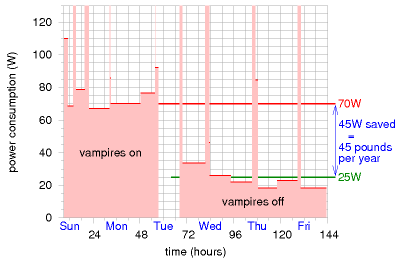
In his book “Sustainable Energy – Without the Hot Air”, David MacKay shows the results of an experiment he conducted to measure the electricity savings from turning off vampire loads.

Image credit: David MacKay

From the book (which is free and available online here), his description of the experiment (with British units):

I measured the electricity savings from switching off vampires during a week when I was away at work most of each day, so both days and nights were almost devoid of useful activity, except for the fridge. THe brief little blips of consumption are caused by the microwave, toaster, washing machine, or vacuum cleaner. On the Tuesday I switched off most of my vampires: two stereos, a DVD player, a cable modem, a wireless router, and an answering machine. The red line shows the trend of “nobody-at-home” consumption before, and the green line shows the “nobody-at-home” consumption after this change. Consumption fell by 45W, or 1.1 kWh per day.

– – –

What exactly does “sustainability” mean? How about “green”, “eco” or “environmentally friendly”? The truth is that these terms are just vague enough to mean many different things to many different people. With the staggering array of “green” products, ‘lifestyles’ and concepts being promoted by marketers and environmentalists alike (as well as the necessary coining of new terms to match new ideas) our definition series aims to make sense of the rising tide of “eco-lingo” and technical terms.

– – –

California Proposition 23

Proposition 23 is the result of an initiative launched by Texas oil giants Valero Energy Inc. and Tesoro Corporation to postpone enforcement  of AB 32. The ballot initiative would delay enforcement until unemployment in California stays under 5.5% for an entire year. California unemployment is currently at about 12%.

Image source: Google Public Data

– – –

How do Californians feel about Prop 23?

The public: A poll by the Public Policy Institute of America this month indicates that 67% of California residents support AB 32 (via LA Times).

Governor Arnold Schwarzenegger:  “This initiative sponsored by greedy Texas oil companies would cripple California’s fastest-growing economic sector, reverse our renewable energy policy and decimate our environmental progress for the benefit of these oil companies’ profit margins” (via LA Times).

Republican Gubernatorial Candidate Meg Whitman: Whitman has not taken a formal stand on Prop 23. However, AB 32 authorizes a governor to delay some of the provisions for up to a year in the event of “threat of significant economic harm.” While campaigning for the Republican primary, Whitman stated that we would suspend AB 32 on her first day in office (via SF Chronicle).

Democratic Gubernatorial Candidate Jerry Brown: “Addressing  climate change is one of the great challenges of our time, something that California has been a leader on,” said Sterling Clifford, Brown’s campaign spokesman (via SF Chronicle).

– – –

The full text of Prop 23 is available here.

– – –

The Yes on Prop 23 campaign has filed suit against Attorney General Jerry Brown over the language that will go on the ballot to describe the proposition. The ballots of be printed in mid-August will say that the measure “Suspends Air Pollution Control Laws Requiring Major Polluters to Report and Reduce Greenhouse Gas Emissions That Cause Global Warming Until Unemployment Drops Below Specified Level for Full Year.” More information in the LA Times.

– – –

New Water Magazine from Johns Hopkins

Johns Hopkins University’s Global Water Program has published its first issue of Global Water Magazine, which is available online here.

The magazine will focus the editorial pieces around six main themes: Water & Energy, Water & Food, Water & Health, Water in the Environment, Water Infrastructure, and Water Policy.

In the first issue, there are several articles that I think would be of interest to readers of this blog, listed below.

– – –

Imperatives for Urban Water Professionals on the Pathway to 2050 by Paul Reiter

Abstract: Looking forward to 2050, the challenges of adding 2 billion more people to an already resource-constrained planet will require major changes in the resources efficiency, energy efficiency and cost of urban water systems of the future. A step change including the integration of city planning and urban water system design will be required to optimize the efficiency and resilience of urban water systems in addition to the development of physical and institutional linkages between agricultural, energy and urban water uses.

– – –

The First Stop on the Road to Corporate Water Reporting: Measurement by Eva Zabey

Abstract: External demands on companies to report on their water use and impacts are intensifying. But before reporting, business needs to measure, and many groups are developing approaches to do just that.

– – –

The Energy-Water Nexus: Finding Solutions in the Balance by Jan Dell and Kathy Freas

Abstract: With uncertainties associated to climate change projections, companies and public utilities face a convergence of energy, water and carbon issues that are impacting their operations and planned projects in sectors and geographical regions.

– – –

NRDC Report on Climate Change, Water and Risk

Image: NRDC

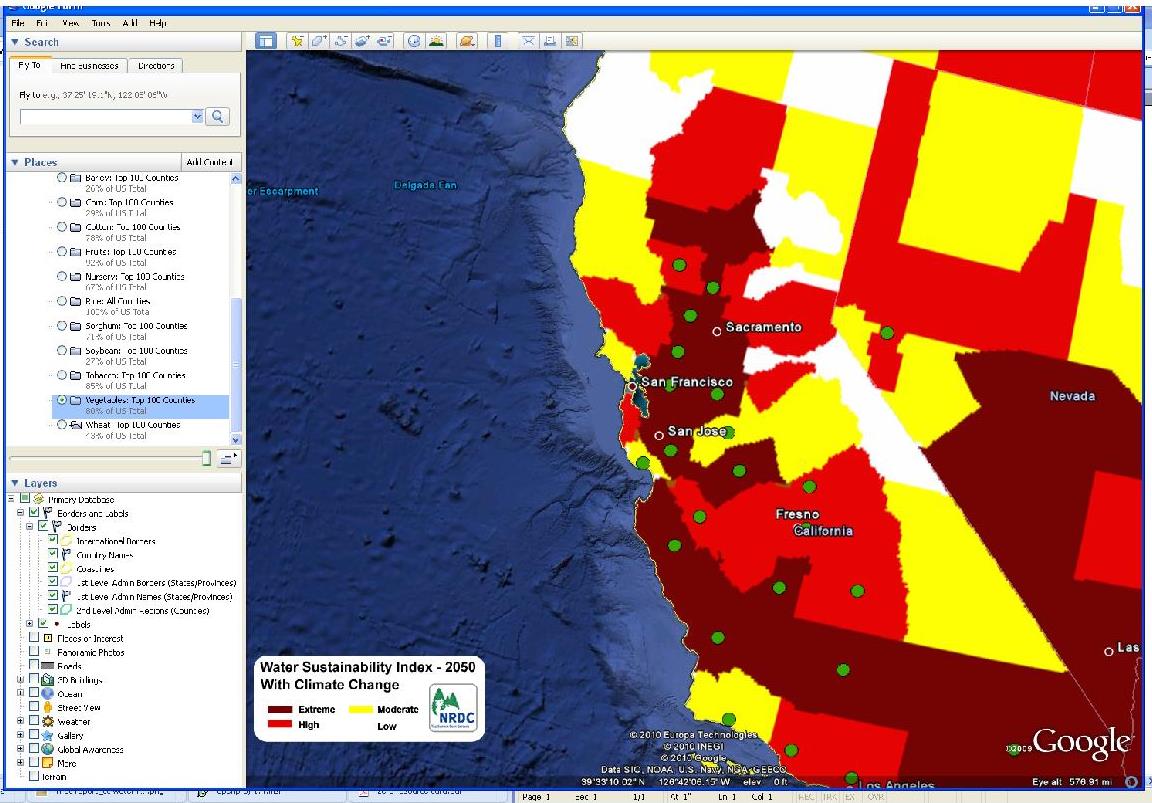
The Natural Resource Defense Council (NRDC) has released a study, conducted on their behalf by Tetra Tech, which examined the effects of climate change on probable future water supply and demand in the United States. One of the main findings of the study is that one-third of the U.S. counties (> 1,100 counties) will likely face water shortages by 2050.

The full report is available as a PDF here.

The Water Supply Sustainbility Index developed by Tetra Tech for the report can be viewed interactively in Google Earth – a link to the data can be found on the NRDC’s website here. You can also turn on and off markers for which counties are top producers of different crops to get a sense of the potential impact of the water shortages. It looks like this (the green dots indicate that the county is one of the top 100 counties for producing vegetables):

The NRDC also released a one-page overview of water shortage risk and crop value in at-risk counties by state (as a PDF here). According to the overview of California’s risk due to climate change:

Percent of CA counties at risk of water shortages: 83%

Total number of CA counties at risk: 48

Total number of CA counties at extreme risk: 19

Total number of CA counties at high risk: 17

Total number of CA counties at moderate risk: 12

The value of all the crops being producing in at-risk CA counties (in $1,000s): $21,585,354

– – –