Earth From Space

1

Earth | Time Lapse View from Space, Fly Over | NASA, ISS from Michael König on Vimeo.

This video is striking for a number of reasons. Earth is so small. And yet you can see city lights all over the place, a sign of how much of an impact we have had on the planet. You can also see flickers of lightning through the clouds.

THIS POST IS PART OF OUR FRIDAY VIDEO SERIES.

Snippets – Zero Net Energy

The International Living Future Institute (ILFI), owner of the Living Building Challenge, is going where no certification program has gone before with a new Net Zero Energy Building Certification program (BuildingGreen.com).  You can read the International Living Future Institute press release on the NZE Building Certification program here There is a zero net energy gas station in Beaverton, Oregon (OregonLive.com).  KB Home, one of the largest homebuilders in the U.S., has developed ZeroHouse 2.0, a house designed to achieve net-zero energy. The home is currently available in Tampa, Florida, and in San Antonio and Austin, Texas, but the company plans to expand the availability of net-zero options to other cities throughout 2012 (BuildingGreen.com).

Energy-Related Recovery Act Money

1

 I’ve been having quite a bit of fun investigating where some of the energy-related recovery act money has gone via the interactive map here. If you zoom in to look at the Bay Area, you can hover your mouse over each circle to see who received the money and how much. For example, the City of Berkeley received $118,155 for a renewable energy project, and Fremont received $1,891,200 for energy efficiency.

Thermographic Infrared Maps

1

A program in Belgium is using aerial thermographic infrared maps of neighborhoods to give folks a contextual sense of their home’s heat loss. On the image above, the blue homes are losing much less heat than the red ones and are better insulated. Viewing this kind of map gives folks a sense of how their home’s insulation levels compare to that of their neighbor’s home.

You can click the image above to watch the video (it will take you to another page), or watch it here. Unfortunately, you will have to watch a brief ad before you can see the video clip.

This post is part of our Friday video series.

Snippets

 GE Energy Financial Services and several other funders have invested $22 million in Project Frog, a San Francisco company that provides climate-sensitive design and fabrication of modular high-performance buildings (BuildingGreen.com). Beacon Power, a Massachusetts company that received a $43 million federal loan guarantee, has filed for bankruptcy. The failure of the company, which develops energy storage systems, is likely to add to criticism of the federal government’s green energy initiatives (New York Times Green Blog). According to the Harcourt Brown & Carey blog, Sagewell, Inc., based in Boston, has developed the first mass-scale building envelope heat-loss imaging and analysis system.  Sagewell can image hundreds of properties per day (actual images are taken in the evening when people are more likely to be home) and their analysis can be used to rank order the heat loss of homes (and commercial buildings) so promoters of energy efficiency can market to the best candidates and motivate property owners to adopt energy efficiency. One of the stranger bills to be considered by Congress passed by a voice vote on Monday evening. Officially named the European Union Emissions Trading Scheme Prohibition Act of 2011, it essentially tells American airline carriers that it is illegal for them to participate in the European Union’s cap and trade system, which charges companies for producing emissions beyond their allotted limit (New York Times Green Blog).

Tiny “Spite” Houses

2

Continuing my interest in tiny houses, here’s a post about tiny “spite” houses.

– – –

I came across this blog post about spite houses, which are

A building constructed or modified to irritate neighbors or other parties with land stakes. Spite houses often serve as obstructions, blocking out light or access to neighboring buildings, or as flamboyant symbols of defiance. Because long-term occupation is at best a secondary consideration, spite houses frequently sport strange and impractical structures.

A couple of the highlighted spite houses are tiny!

– – –

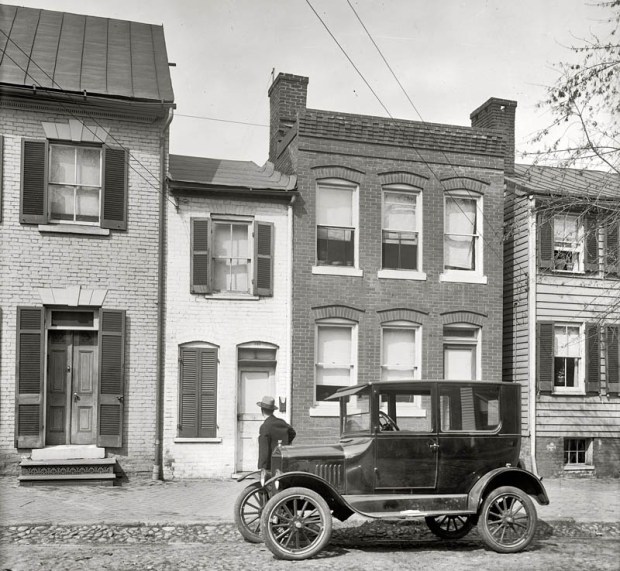
The Hollensbury Spite House:
John Hollensbury vs Horse-drawn Wagons in Alexandria, Virginia 1830

More info here.

– – –

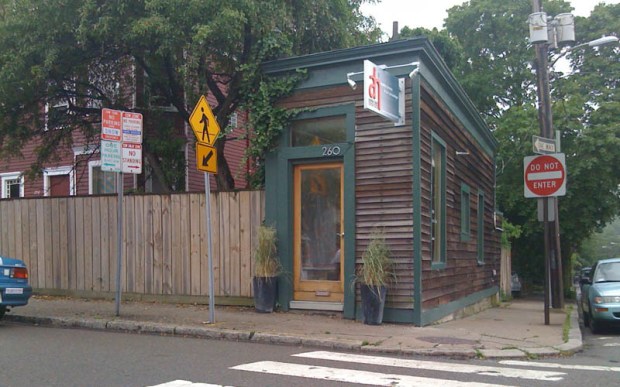
The Skinny House: Sibling Rivalry in Boston, Massachusetts 1874

More info here.

– – –

The Alameda Spite House:
Charles Froling vs Neighbour & the City of Alameda, California 1900s

More info here.

– – –

The O’Reilly Spite House:
Francis O’Reilly vs Neighbour West Cambridge, Massachusetts 1908

More info here.

– – –

The Montlake Spite House:
Typical Neighbourly Clash in Seattle, Washington 1925

More info here.

– – –

ZETA Communities on NPR

1

As I was listening to the radio this morning, I heard a story about Bay Area company ZETA Communities…

– – –

As Population, Consumption Rise, Builder Goes Small

The planet may not feel any different today, but there are now 7 billion people on it, according to the United Nations.

That number will continue to rise, of course, and global incomes are likely to rise as well. That means more cars and computers, and bigger homes: the kinds of things Americans take for granted. It’s that rise in consumption that has population experts worried…

In an industrial park outside of Sacramento, Calif., there’s a factory inside what looks like an old airplane hangar.

Zeta Communities builds modular homes here. Project manager Scott Wade says they’re not like “stick-built” homes — “stick-built meaning they build it one piece at a time,” Wade says, “whereas we build it an assembly at a time.”

In cities, modules can be stacked to make a new generation of efficient buildings. At Zeta headquarters, architect Taeka Takagi rolls out a blueprints with one of Zeta’s prototypes.

“It is a micro studio,” she says. “The units are under 300 square feet.”

You can read or listen to the entire story on the NPR website.

– – –

You can also watch videos of a unit being built in the ZETA factory and a unit being installed on our website here.

– – –

 

2011 State Energy Efficiency Scorecard

– – –

The American Council for an Energy Efficient Economy (ACEEE) has posted its 2011 State Energy Efficiency Scorecard. California is ranked #2, behind Massachusetts.

You can see the California information here.

The full scorecard ranking can be found online here.