Free Event 11/9 in SF – Energy Modeling

2
– – –
The SF AIA Committee on the Environment (COTE) presents:

Energy Modeling for the Small and Midsize Architecture Firm

November 9, 2010 –  6:00 – 8:00 pm

AIA San Francisco, 130 Sutter Street, Suite 600

With the development of LEED and other energy efficiency standards, energy simulation has developed tremendously over the last decade. It is becoming imperative that architects better understand the available tools so that they can make informed decisions throughout the design process. Given the complexity of energy modeling, this session will focus on how architects in small and mid-size firm can best use energy simulation. What types of questions should be answered with energy models? What types of energy modeling information is most useful, and when during design should it be used? What simulation tools are favored among small and mid-size firms? How do they develop expertise within their design teams and address budgetary constraints? A panel of Bay Area architects and designers, all of whom are noted for advances in sustainable design, will address these questions. Following the panel discussion, the presenters will be available for an extended question-and-answer session.

MODERATOR:

Claire Maxfield

PANELISTS:

Philip Banta, Charlie Stott, David Scheer, & Stet Sanborn

For more information and moderator and panelist bios, see the AIA SF event site, here.

This is a FREE event.

– – –

Prop. 26 and the Environment

2

The November 2 midterm elections are over and the returns are in.  And while Californians handily defeated Prop. 23, an attempt by non-California based oil companies to delay and effectively repeal California’s landmark climate legislation AB 32, another proposition with a group of oil, tobacco, alcohol and other business backers managed to fly under the radar.

Prop. 26 re-frames the practice of charging regulatory fees for certain harmful or polluting corporate and industrial activities as levying a “tax”, and will now require a 2/3 vote  for implementation of such “taxes” rather than the simple majority required to implement a fee.

Prop. 26 directly challenges the ability of the state legislature to hold polluters accountable and instead may create a climate of political gridlock as the high bar of a 2/3 majority can paralyze necessary actions toward the implementation of Prop. 23.

Prop. 26 is also a strong step away from the concept of “extended producer responsibility”  that has been gaining support across the country, and will likely result in a loss of revenue for the state.

– – –

See Anna’s  post on Prop. 23 and Prop. 26 funders.

See my  post on Extended Producer Responsibility.

– – –

Regional Bike Sharing in the Bay Area

2

photo: a bike sharing system in the St. Etienne metro region wikimedia commons

Regional transit authorities have recently announced that they will go ahead with a new bike sharing program slated to start next year and  attributed as the first of-its-kind regional effort at a comprehensive bike sharing program in the nation.

The pilot program will put 1,000 new bikes on the road, and up to 100 kiosks around the Bay Area, with approximately half the amount being placed within the City of  San Francisco, and the other half being placed along the peninsula transportation corridor that includes Redwood City, Mountain View, Palo Alto and San Jose.

With transportation accounting for more than half of the air pollution in the Bay Area (SFMTA), the bike share project aims to reduce the number of vehicle miles traveled by encouraging people to increase bike travel for short trips in dense urban and downtown areas.

The Metropolitan Transit Commission (MTC) has approved an initial $4.29 million grant for the estimated $7 million project, that will be managed by the Bay Area Air Quality Management District (BAAQMD) and facilitated by a regional partnership between BAAQMD, SFMTA, SamTrans, Santa Clara Valley Transit Authority, San Mateo County and Redwood City. The participating jurisdictions and transit agencies will also contribute to the funding of the program.

When rolled out, the bike system will require users to buy a yearlong subscription and will utilize smart cards, GPS tracking and wireless technologies.

Read more:

San Francisco Bike Sharing Moves Ahead with Regional Plan and Funding: MTC grant to area partnership moves SFMTA plan forward, San Francisco Metropolitan Transit Authority(SFMTA) press release

Bike sharing project expected to begin next year, SF Chronicle

Bay Area maps out bike sharing effort, New York Times Green blog

Election Day 2010 – Go Vote!

3

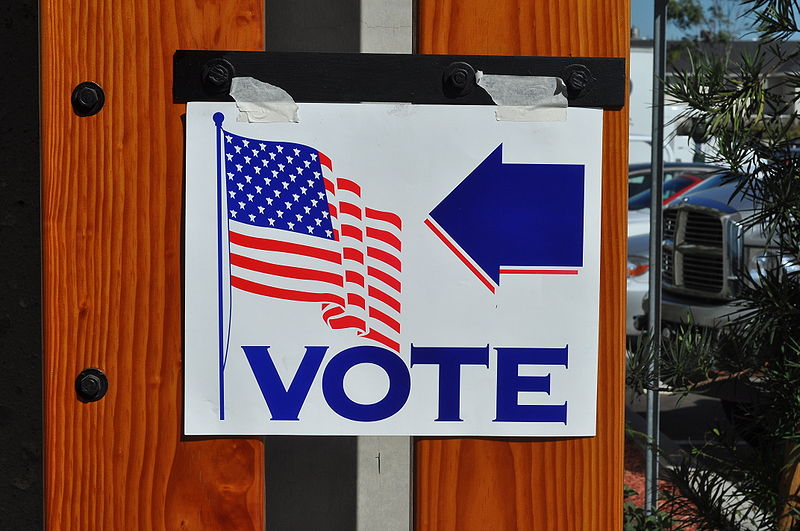
So… it’s finally Election Day 2010. There are a couple propositions on the California ballot – Prop 23 and Prop 26 – that have implications for energy and transportation policy. Statewide ballot measures just need a majority to pass.

Image credit: Wikimedia Commons

– – –

Proposition 23

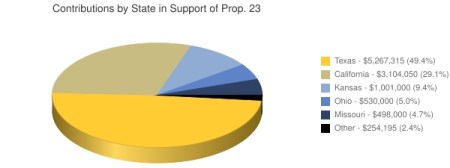
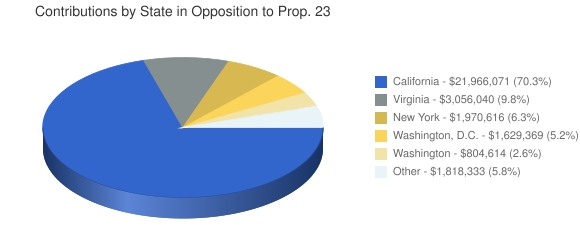
Who is funding Prop 23?

According to MapLight.org:

Total Contributions in Support of Prop 23: $10,654,560

Total Contributions in Opposition to Prop 23: $31,245,543

Top Contributors in Support of Prop 23:

Valero Services, Inc. $5,075,315
Tesoro Companies $2,040,637
Flint Hills Resources $1,000,000
Marathon Petroleum Company LLC $500,000
Adam Smith Foundation $498,000
Occidental Petroleum Corp. $300,000
Tower Energy Group $200,000
CVR Energy Inc. $150,000
Howard Jarvis Taxpayers Assoc. $102,568
National Petrochemical & Refiners Assoc. $100,000
World Oil Corp. $100,000

Image credit: MapLight.org

Top Contributors in Opposition to Prop 23:

Thomas Steyer & Kathryn Taylor $5,099,000
National Wildlife Federation $3,000,000
L. John & Ann Doerr $2,100,000
The League of Conservation Voters $1,250,000
Vinod Khosla $1,037,267
Gordon Moore $1,000,000
James Cameron $1,000,000
Robert J. Fisher $1,000,000
ClimateWorks Foundation $900,000
Sierra Club $855,890
The Nature Conservancy $800,000
Bill Gates $700,000
Claire Perry $500,000
Green Tech Action Fund $500,000
John P. Morgridge $500,000
Julian H. Robertson Jr. $500,000
Pacific Gas & Electric $500,000
Wendy Schmidt $500,000

Image credit: MapLight.org

What is Prop 23?

From the Official Voter Information Guide:

SUSPENDS IMPLEMENTATION OF AIR POLLUTION CONTROL LAW (AB 32) REQUIRING MAJOR SOURCES OF EMISSIONS TO REPORT AND REDUCE GREENHOUSE GAS EMISSIONS THAT CAUSE GLOBAL WARMING, UNTIL UNEMPLOYMENT DROPS TO 5.5 PERCENT OR LESS FOR FULL YEAR. INITIATIVE STATUTE.

  • Suspends State law that requires greenhouse gas emissions be reduced to 1990 levels by 2020, until California’s unemployment drops to 5.5 percent or less for four consecutive quarters.
  • Suspends comprehensive greenhouse-gas-reduction program that includes increased renewable energy and cleaner fuel requirements, and mandatory emissions reporting and fee requirements for major emissions sources such as power plants and oil refineries.

Summary of Legislative Analyst’s Estimate of Net State and Local Government Fiscal Impact:

  • The suspension of AB 32 could result in a modest net increase in overall economic activity in the state. In this event, there would be an unknown but potentially significant net increase in state and local government revenues.
  • Potential loss of a new source of state revenues from the auctioning of emission allowances by state government to certain businesses that would pay for these allowances, by suspending the future implementation of cap-and-trade regulations.
  • Lower energy costs for state and local governments than otherwise.

Why does Prop 23 matter?

According to the Natural Resources Defense Council:

Proposition 23 would stop progress on curbing global warming emissions and transitioning to clean energy by “suspending” California’s landmark law, AB 32, until unemployment is below 5.5 percent for four consecutive quarters.  This unemployment threshold has only been reached 3 times in the past forty years.  Prop 23 would pull the rug out from the one sector of our economy that is actually growing – clean technology and clean energy – and create loads of uncertainty for businesses that have already made investments and are looking to expand.

According to the supporters of Prop 23:

We all want to do our part for global warming, but implementing our current plan is not the way to go. Families and businesses simply cannot afford to pay fifty percent or more in higher electricity and utility costs, and even more at the gas pump. A Yes vote on Proposition 23 temporarily postpones a new, costly program until our economy stabilizes and people are back to work, making it easier for families to make ends meet.New rules, regulations, and fines are about to take effect under California’s Global Warming Solutions Act (AB 32), which will increase energy costs by billions of dollars and destroy more than a million jobs. Proposition 23 would suspend those new rules until the economy improves and unemployment drops.

– – –

Proposition 26

Who is funding Prop 26?

According to MapLight.org:

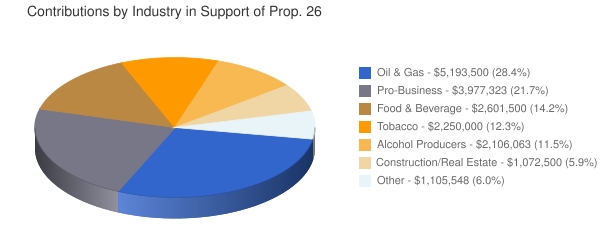
Total Contributions in Support of Prop 26: $18,306,433

Total Contributions in Opposition to Prop 26: $6,547,122

Top Contributors in Support of Prop 26:

California Chamber of Commerce $3,937,323
Chevron Corporation $3,750,000
American Beverage Association $2,450,000
Philip Morris USA Inc. * $2,250,000
Anheuser-Busch Companies, Inc. * $925,000
ConocoPhillips $525,000
Cypress Management Company, Inc. * $500,000
Howard Jarvis Taxpayers Association $432,948
Wine Institute * $381,093
Aera Energy LLC $350,000
MillerCoors $350,000

* Includes contributions from the Small Business Action Committee

Image credit: MapLight.org

Top Contributors in Opposition to Prop 26:

Democratic State Central Committee of California $1,326,674
Thomas F. Steyer $1,000,000
League of Conservation Voters (Prop. 23 Committee) $900,000
California Teachers Association $505,050
California State Council of Service Employees $500,000
John Doerr $400,000
Ella Baker Center $350,000
SCOPE S.I. $250,000
A.L.L.E.R.T. $200,000
California Public Securities Association $150,000
State Building and Construction Trades Council of California $150,000

Image credit: MapLight.org

What is Prop 26?

From the Official Voter Information Guide:

REQUIRES THAT CERTAIN STATE AND LOCAL FEES BE APPROVED BY TWO-THIRDS VOTE.FEES INCLUDE THOSE THAT ADDRESS ADVERSE IMPACTS ON SOCIETY OR THE ENVIRONMENTCAUSED BY THE FEE-PAYER’S BUSINESS. INITIATIVE CONSTITUTIONAL AMENDMENT.

  • Requires that certain state fees be approved by two-thirds vote of Legislature and certain local fees be approved by two-thirds of voters.
  • Increases legislative vote requirement to two-thirds for certain tax measures, including those that do not result in a net increase in revenue, currently subject to majority vote.

Summary of Legislative Analyst’s Estimate of Net State and Local Government Fiscal Impact:

  • Decreased state and local government revenues and spending due to the higher approval requirements for new revenues. The amount of the decrease would depend on future decisions by governing bodies and voters, but over time could total up to billions of dollars annually.
  • Additional state fiscal effects from repealing recent fee and tax laws: (1) increased transportation program spending and increased General Fund costs of $1 billion annually, and (2) unknown potential decrease in state revenues.

Why does Prop 26 matter?

According to the Natural Resources Defense Council:

Proposition 26 is another disastrous measure for California’s environment, public health and local communities.  It would eliminate the ability of a majority of the legislature to enact fees on industries that pollute our air and water and endanger our health.  Currently, a simple majority vote can enact a fee (used to remedy a specific harm), but a tax (used for general purposes) requires a two-thirds vote.  Prop 26 would make it much harder to ensure that polluters are held accountable for the harm caused by their activity.  But Prop 26 goes farther – it also dictates what local governments should do by requiring cities and counties to run costly elections and reach a 2/3 majority to enact a fee.  Prop 26 would make it nearly impossible for local communities to deal with issues like traffic and public safety for large events and would shift the burden to taxpayers for cleaning up hazardous waste and other pollution.  A broad coalition of environmental and health groups, local governments, civic organizations and public safety professionals have come together to defeat this initiative.

According to the supporters of Prop 26:

State and local politicians routinely circumvent the state Constitution’s requirements by disguising taxes as fees because fees are easier to pass than tax increases.  At the state level, the Legislature calls many taxes “fees” so they can pass or increase the tax with a bare majority vote – not the two-thirds vote required for taxes.  At the local level, politicians call taxes “fees” so they can avoid voters and our Constitutional right to vote on most tax increases… Prop. 26 will give voters more control to stop the politicians from using gimmicks to impose hidden taxes on California families just by calling them fees.  No longer will the politicians be able to hide new or higher taxes under the name of a “fee” to try to get more taxpayer money with a bare majority vote of the Legislature – or without any public vote at all at the local level.

– – –

AC Transit Cuts Take Effect Today

1

Significant adjustments to nearly 70 transit lines took effect today. According to the AC Transit website:

Significant changes include:

  • Reducing frequency on 28 lines
  • Starting service later in the morning and/or ending earlier in the evening  on 18 lines
  • Eliminating or operating shorter routes on weekends on four lines
  • Reconfiguring service in some areas, including West Oakland/Emeryville, Lakeshore Ave./Grand Ave. in Oakland, Bay Farm Island in Alameda, and San Leandro
  • Discontinuing service to Orinda BART and along Broadway Terrace in Oakland
  • Adding extensions to two lines to replace limited service in Piedmont, and service between Alameda and the Oakland Airport

All changes are listed in detail on the AC Transit website here.

– – –

$274 Million for Water & Sewer Upgrades

2

The Fresno Bee reports that the EPA is awarding $127 million to California’s Department of Public Health and another $147 million to the State Water Resources Control Board.

The agency said at least 20 percent of the money must be used to fun so-called “green” infrastructure projects that improve water conservation, energy efficiency and environmental projects.

The two agencies will be responsible for awarding dozens of grants or low-interest loans to cities throughout the state for new sewers and drinking water facility upgrades.

Read the entire story here.

– – –

A Gift to Fight Proposition 23

Via the New York Times:

Citing figures from the California secretary of state, Maplight.org reports that Bill Gates has donated $700,000 to the campaign against Proposition 23, the ballot measure that would repeal a California law related to reining in global warming. According to Maplight’s list, that would make him the 11th-biggest contributor to the opposition effort to date.

The story is here.

– – –

Substandard Workmanship in Weatherization

2

The New York Times Green blog reports on a recent audit by the Department of Energy’s inspector general:

An audit by the inspector general focused on some work done by the Community and Economic Development Association of Cook County, one of 35 agencies in Illinois that are expected to share $91 million over three years. The audit looked at 15 homes and found that 12 failed final inspection “because of substandard workmanship.” In some cases, technicians who tuned up gas-fired heating systems did so improperly, so that they emitted carbon monoxide “at higher than acceptable levels.”

In eight cases, initial assessments of the houses and apartments called for “inappropriate weatherization measures.” In one case an inspector called for more attic insulation but ignored leaks in the roof, which would have ruined the insulation, the audit said. And for 10 homes, “contractors billed for labor charges that had not been incurred and for materials that had not been installed.’’

You can read the entire story here.

– – –

L.A.’s Electric Vehicle/ Mass Transit Experiment

2

photo: Wikimedia Commons

The County Metropolitan Transit Authority (Metro) of  the City of Los Angeles is partnering with EV Connect to bring a large scale roll out of electric vehicle charging stations at strategic locations throughout the city’s transit network.

The pilot program will assess the viability and appeal of integrating electric vehicle charging into a mass transit network. Patrons will be able to leave an electric vehicle at a charging station, and then continue their commute on transit. The partnership will monitor and study the program to create benchmarks for a potential “charge and ride” transportation industry.

The pilot will help Metro move toward its sustainability goals for regional transit. See other environmental initiatives of Metro here.

Read a full story from the Kansas Star on the new program here.

33% of California Energy Renewable by 2020

2

photo credit: Wikimedia Commons

Last month the California Air Resources Board (CARB) announced new standards to increase renewable energy sources into the California energy mix. CARB has unanimously passed a new standard for the state- to increase renewable source energy in California to 33% of energy usage by 2020.

CARB’s press release states that, “The standard will promote green jobs to construct and run renewable facilities in California, reduce hundreds of tons of harmful air pollution, insulate California’s economy from the shock of volatile natural gas prices and help establish the state as a global leader in the research, development and manufacturing of clean, renewable energy sources.”

The new standard is also a significant push toward the fulfillment of the state’s landmark climate bill, AB 32,  coming at a time when AB 32 is under threat via proposition 23 in the November elections.

The new standard is a product of collaboration between CARB, the California Public Utilities Commission (CPUC), the California Energy Commission (CEC), and the California Independent System Operator (CA ISO).

– – –