L.A.’s Electric Vehicle/ Mass Transit Experiment

2

photo: Wikimedia Commons

The County Metropolitan Transit Authority (Metro) of  the City of Los Angeles is partnering with EV Connect to bring a large scale roll out of electric vehicle charging stations at strategic locations throughout the city’s transit network.

The pilot program will assess the viability and appeal of integrating electric vehicle charging into a mass transit network. Patrons will be able to leave an electric vehicle at a charging station, and then continue their commute on transit. The partnership will monitor and study the program to create benchmarks for a potential “charge and ride” transportation industry.

The pilot will help Metro move toward its sustainability goals for regional transit. See other environmental initiatives of Metro here.

Read a full story from the Kansas Star on the new program here.

Cool Pavements – Melvin Pomerantz

5

In Berkeley, we are fortunate to have such events as Science at the Theater, where Lawrence Berkeley National Lab researchers give talks on their work at the Berkeley Repertory Theatre. The lectures are free and get a pretty sizeable audience.

On Monday, October 11, I was in the audience as researchers from Lawrence Berkeley National Laboratory (and the beloved Art Rosenfeld) gave a presentation titled “Cool Roofs, Cool Cities.” The post below consists of Part 3 of my record of the presentation – Melvin Pomerantz gives an overview of cool pavements. All portions are included in chronological order.

An ellipsis (…) indicates that I was not able to capture the words or thoughts skipped. The presentation is transcribed as accurately as possible – punctuation choices are mine. I also added any images.

– – –

Now we’re talking about cool pavements … because they are a significant fraction of a city … including the streets, parking lots, driveways, and sidewalks.

We need to understands that they are a composite material … they are aggregate, an array rocks of different sizes … We then have to hold them together. So we have to glue the rocks and sand together by coating each rock with a  binder of some sort. For “asphalt”, the binder is asphalt, which is a petroleum product …  We can also bind the rocks together with cement, which is a mineral product, and we call that concrete … The key thing is that because you’re coating the aggregate, you mostly see the color of the binding … Our target is the binder.

Of the third of the city that is covered with pavements of various kinds, 50% is streets, 40% are exposed parking, and about 10% are sidewalks … Because it covers about 90% of the paved city streets, our target is the asphalt concrete.

Image credit: Wikimedia Commons

Start with fresh asphalt concrete … which is very black and has a solar reflectance of about 5%. As it ages, sunlight breaks it downs … Typically, its solar reflectance goes up to about 15% … The question is can we do any better … If you use a light-colored aggregate, it will show as the binder wears off … can use seashells, or porcelain … For old pavement, which required resurfacing periodically … we can put on a layer of asphalt emulsion, and put light-colored aggregate on top. That is called a “chip seal” … One issue is that aggregate is heavy, so it’s expensive to ship. So we want to use rock that’s nearby, and it may not be white … If the road stay cool, it doesn’t deform as much …

An example is from San Jose … They happen to have a quarry nearby that has white rock, and they’ve used a chip seal …

The other type of road, a little less common, is cement concrete … Fresh cement has a solar reflectance of about 35% … as it ages, it gets darker and reflectance drops to about 20% … The fine aggregate tends to float to the top … If you have light-colored fine aggregate, you can get an initial solar reflectance of about 40% …

– – –

Part 1 is posted here. Part 2 is posted here. Part 4 is posted here.

– – –

Cool Roofs – Ronnen Levinson

5

In Berkeley, we are fortunate to have such events as Science at the Theater, where Lawrence Berkeley National Lab researchers give talks on their work at the Berkeley Repertory Theatre. The lectures are free and get a pretty sizeable audience.

On Monday, October 11, I was in the audience as researchers from Lawrence Berkeley National Laboratory (and the beloved Art Rosenfeld) gave a presentation titled “Cool Roofs, Cool Cities.” The post below consists of Part 2 of my record of the presentation – Ronnen Levinson gives an overview of cool roofs. All portions are included in chronological order.

An ellipsis (…) indicates that I was not able to capture the words or thoughts skipped. The presentation is transcribed as accurately as possible – punctuation choices are mine. I also added any images.

– – –

In North America, we have cool roofs, usually white roofs – and we have them on commercial buildings, because the roof can’t be seen from the street … In some other parts of the world, you might see white roofs on pitched surfaces, like in Bermuda … In North America, you might also see cool colored roofs … With a commercial roof, without much insulation, and with extended operating hours, might save about 15% on AC bill by adding a white roof …

What if you put white roofs on about 80% of commercial roofs in the United States? … We assume they get soiled … What we found is that each year you would save about $735 million dollars, and save the equivalent carbon of taking 1.2 million cars off the road … The lifetime energy savings has a present value of about $11 billion … and there is no extra cost to choosing a white roof – so this is free money. Everyone likes free money …

But we don’t like to see white roofs from the street – except in Florida, which we’ll look at more later. So what can we do for roofs we can see from the street? … Near infrared makes up about half of the energy in sunlight, but you can’t see it … so maybe we make the surface reflect normally in the visible spectrum, but we try to make the surface reflect as much of the invisible infrared part of sunlight as possible … …

Let me tell you about some of the cool colored roofs you might find … you can get cool concrete tiles … and you can get cool clay tile. You can get cool metal (often used on fast food places) … We’ll do a little show and tell … …

[ A graduate student named Pablo shows off asphalt shingles, metal shingles, clay tiles, concrete tiles, and some white roofing membrane.]

One of the interesting cases is fiberglass asphalt shingle – it goes on many houses in North America because it’s not expensive … It’s black, and another problem is that it tends to crack …There’s crushed rock on the surface. Any rough surface is less reflecting than any smooth surface … Also, these little bits of crushed rock cause the surface to have a thin coating … These are the 800-lb gorilla of the residential market … Typical shingles on your home now might reflect 10% of sunlight … … We now have a different process of applying colors to the granules. A lot will reflect up to 35% of sunlight, and if you’re willing to go with a bright white shingle … can reflect 62% of sunlight. These are still in development in the lab, but we’ve been working with manufacturers, and in the next few years, we hope to bring these to market.

Asphalt shingle failure – Image credit: Wikimedia Commons

… Another aspect we’re working on is the issue of maintenance … the roof begins as a bright white roof, and after years, gets grayish … Initial reflectance might have been 80% but might fall to 55% … The first thing to understand is that plastic roofs can leach plasticizers, which makes the surface sticky … and things grow on this … There are agents that you can add, photocatalysts, which can help break down oil and soot – they are already used to help keep windows clean (popular in Japan) …  If you add these, you  can also change the way water flows over a surface.

– – –

Part 1 is posted here. Part 3 is posted here. Part 4 is posted here.

– – –

Cool Roofs – Melvin Pomerantz

5

In Berkeley, we are fortunate to have such events as Science at the Theater, where Lawrence Berkeley National Lab researchers give talks on their work at the Berkeley Repertory Theatre. The lectures are free and get a pretty sizeable audience.

On Monday, October 11, I was in the audience as researchers from Lawrence Berkeley National Laboratory (and the beloved Art Rosenfeld) gave a presentation titled “Cool Roofs, Cool Cities.” The post below consists of Part 1 of my record of the presentation – Melvin Pomerantz gives an introduction to the heat island effect and cool roofs. All portions are included in chronological order.

An ellipsis (…) indicates that I was not able to capture the words or thoughts skipped. The presentation is transcribed as accurately as possible – punctuation choices are mine. I also added any images.

– – –

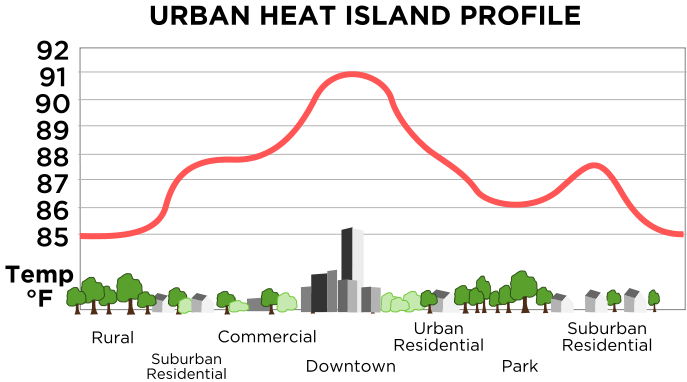
What I’m going to talk about is a very familiar experience to a lot of you – when you go into the center of a city, it’s a lot warmer … That effect, namely the temperature … tends to be anywhere from 5-7 deg F warmer in the city than outside the city …

Image Credit: Wikimedia Commons

The heat has not only an effect of causing discomfort, but has economic effects, too … Looking at some SMUD data … went up to about 107 degrees that day … As the day goes on, it gets hotter and hotter, and the demand for electricity gets higher and higher … finally it cools down and people turn off their air conditioners a little bit. … To get this power, you need about 5.5 power plants, but the power used in January is much less, so the power company has to have in reserve all these power plants. So there is capital involved in having these in reserve … And the ones in reserve are generally the oldest, most polluting plants … so it’s an unfortunate effect …

Another effect that goes on is that when things are very hot, there are actually deaths … Chicago in 1995, there were 739 deaths attributed to the heat wave – almost all occurred on the top floor of buildings with black roofs …

So what can we do about it? … How is the air heated in the first place? The sun does not heat the air directly … Sunlight travels very well through the atmosphere … There are opaque surfaces – the light comes in from the sun and strikes a surface … some stays in the surface and heats the surface, then the air comes along and touches the surface and heats up … The surface is acting as a converter, so if we can modify the surface, we can get a handle on it … If you have a building underneath a roof, that heat travels into the building, then you have to run on the air conditioning. …  Also pavements suffer if it gets too hot … the pavement needs to handle the deterioration that the heat causes … …

One way to look at this is to look at the solar reflectance … If you have no light coming out, it’s black … if it all comes out, it’s very bright. If the light is not all caught by the material, it has a higher solar reflectance, and it’s cooler … If you decrease the solar reflectance, the temperature can rise 80-90 degrees F over the ambient air – and you don’t want that … …

There’s another feature, which is that once the surface is warm, it radiates … there are gases in the air which absorb this thermal radiation, and it’s like a blanket. It’s blocked by the gases in the atmosphere… this is the atmospheric greenhouse effect. If we can affect the light from sticking in the surfaces, we reduces the greenhouse effect, too, and keep the planet a bit cooler …

Image credit: Wikimedia Commons

What can we make cooler? … Looking again at Sacramento … about 39% of what we could see from the sky was pavements … … … If we reflect sunlight, it mostly passes back out of the atmosphere without heating the air…

– – –

Part 2 is posted here. Part 3 is posted here. Part 4 is posted here.

– – –

33% of California Energy Renewable by 2020

2

photo credit: Wikimedia Commons

Last month the California Air Resources Board (CARB) announced new standards to increase renewable energy sources into the California energy mix. CARB has unanimously passed a new standard for the state- to increase renewable source energy in California to 33% of energy usage by 2020.

CARB’s press release states that, “The standard will promote green jobs to construct and run renewable facilities in California, reduce hundreds of tons of harmful air pollution, insulate California’s economy from the shock of volatile natural gas prices and help establish the state as a global leader in the research, development and manufacturing of clean, renewable energy sources.”

The new standard is also a significant push toward the fulfillment of the state’s landmark climate bill, AB 32,  coming at a time when AB 32 is under threat via proposition 23 in the November elections.

The new standard is a product of collaboration between CARB, the California Public Utilities Commission (CPUC), the California Energy Commission (CEC), and the California Independent System Operator (CA ISO).

– – –

Chris Field – Director of Dept. of Global Ecology

2

On Friday (10/1) and Saturday (10/2), I was in the audience at the Berkeley Repertory Theatre in Berkeley, California, as Chris Field, Director of the Carnegie Institution’s Department of Global Ecology at Stanford University, gave a presentation titled “The Velocity of Climate Change: 2010”.

The post below consists of selected snippets of my record of the presentation. All portions are included in chronological order.

An ellipsis (…) indicates that I was not able to capture the words or thoughts skipped. The presentation is transcribed as accurately as possible – punctuation choices are mine.

– – –

… What I want to do is talk about pace … in four different contexts … We already know enough to make smart decisions and the challenge is how we go from at atmosphere of doubt to one where we can really make decisions … … The idea of a threshold isn’t necessarily the best way to think of this issue – there are some places that have probably already passed their threshold … we need to instead think of risk management …

Risk = probability x consequence

In terms of the calculation of risk, there’s risk in high-probability events, but also risk in low-probability events that happen over a wide spectrum … Steve Schneider compared climate change to playing with loaded dice …

… … …

Today, I want to talk about the velocity of climate change in terms of the rate of climate change, the history of understanding climate change, the velocity required for ecosystem and societal responses (adaptation), and commitments to future changes.

The warming of the climate system is unequivocal … there is some indication that the pace is increasing … What we do in the future makes a huge difference … It’s really striking that there’s still a tremendous amount of uncertainty about where we’ll wind up … We can see a very wide range between the low end and the high end of temperature impacts … We need research into coping and adaptation strategies …

There is now more thinking about climate change impacts in the context of risk … fire in the western United States … risk of extreme events (2003 heat wave in Western Europe) …

There is also thinking about velocities of ecosystems on the ground … the plants and animals that are best at moving and taking advantage of climate change are the weeds and pests …

… … …

… We are not looking at consequences of a century or two of climate change, but essentially fixed changes … The inertia in the system is really dramatic … The Hoover Dam was completed in 1936, and we are still using it … When we’re thinking of setting up energy infrastructure for the future, we need to remember that the infrastructure lasts for a long time. We’re building the energy infrastructure for the next century now … There are significant emissions commitments from existing infrastructure … In China, much of the infrastructure is new and won’t be retired very fast. In the United States, we have mostly old infrastructure, so the committed emissions could drop rapidly. This type of analysis gives us a sobering picture of the amount of climate change we can’t avoid …

In looking at where the missions are coming from, it’s useful to look per country and per capita … the United States still has fives times the emission per capita as China …

… … …

In terms of the pace of human responses to climate change, there are many reasons we might want to delay: to avoid unnecessary expenditures, to allow natural progress with technology development, and to start from a position of greater wealth … But there are questionable economics in the study of rapid emissions reduction. In a paper in Nature (Wigley et al, 1996), it was concluded that if you want to optimize economically, you would stay with “business as usual” but then deploy technologies aggressively. But the paper didn’t really discuss the implications of delay. Delay doesn’t mean do nothing – it has to mean get prepared with investment and readiness to aggressively deploy technology …

Is the technology available? Humanity already possesses the fundamental scientific, technical, and industrial knowledge now to solve the carbon and climate problem for the next half century …

– – –

This exchange was followed by a question and answer session with the audience.

– – –

Update on Spending on Prop 23

From the New York Times today:

At the start of the campaign for California’s Proposition 23, the ballot measure that would suspend the state’s global warming law, opponents darkly warned that the Texas oil companies backing the initiative would spend as much as $50 million to win the election.

But with three weeks until Election Day, it is the No on 23 coalition of environmentalists, investors and Silicon Valley technology companies that is raking in the cash, taking in nearly twice as much money as the Yes on 23 campaign.

As of Monday, the No on 23 forces had raised $16.3 million to the Yes campaign’s $8.9 million, according to California Secretary of State records. Over the past two weeks, nearly $7 million has flowed into No campaign coffers while contributions to the Yes effort had fallen off dramatically.

Read the entire story here.

– – –

Don’t Call It A Retrofit… Or An Audit

2

A Lawrence Berkeley National Lab report examined case studies of retrofit projects across the United States as examples of local approaches that saved considerable energy. A recent article in Greentech Media highlights some of the results:

“The bottom line is that providing information and financing isn’t sufficient,” [Merrian] Fuller said during a DOE Technical Assistance Program webinar. For starters, put the message in terms people know and understand. Sell something people actually want. “Often people already assume they’re doing everything they can, so figure out what messages get beyond that,” said Fuller. LBNL found that comfort, health reasons (such as reducing allergens or mold), appealing to people’s social norms or even becoming a self-reliant American were all preferable to just talking about energy savings, or even bill savings. “Don’t assume saving 20 percent on your energy bill will motivate people,” she warned.

She went on to note that communications styles matter. People need hard examples. Instead of telling people their house is leaking energy, instead they need to hear that their hard-earned money is literally flying up the chimney, or that their house is the equivalent of a car getting only 15 miles per gallon. Carl Nelson, the Program and Policy Manager at Center for Energy and Environment in Minnesota, said his group leaders go through training with an improv comedian to more effectively lead community information sessions. They also shy away from the word ‘audit,’ because after all, people rarely associate the word with anything positive. “We try not to make it boring,” said Nelson. “We set up the expectation that they’re going to have this home visit and commit to making a major investment in their home.”

You can read all of the case studies and the full report here.

– – –

Assorted Links

The United States military is becoming a proponent of renewable energy – a director of “operational energy plans and programs” was appointed over the summer to oversee the military’s transition to a more energy-efficient and renewable future.

The White House goes solar (again) with photovoltaic solar collectors and a solar hot water heater.

Greentech Media offers the “real” history of solar at the White House via an account from Steven Strong.

Yesterday, the U.S. Secretary of the Interior, Ken Salazar, approved the first large-scale solar energy plants to be built on federal land.

– – –

Gigaton Throwdown

2

photo: Wikimedia Commons

While attending the two-day “Pathways to a Clean Energy Future” symposium put on by the Philomathia Foundation and U.C. Berkeley last week, I made a note to look up a recent initiative called the “Gigaton Throwdown” that was mentioned by Professor and Senior Energy and Climate Partnership of the Americas Fellow Dan Kammen, during his talk.

The Gigaton Throwdown Initiative is essentially a collaboration of a diverse group of academics and business/investment professionals, that spent 18 months looking at what it would take to bring nine clean energy technologies up to a gigaton threshold of power generation (one billion metric tons) by the year 2020. The nine technologies include biofuels, building efficiency, concentrated solar power, construction materials, geothermal, nuclear, plug-in hybrid cars, solar pv and wind. The technologies were selected for the capacity-building study because they already have a market presence and are able to attract investors.

The aim of this exercise, according to the Gigaton Throwdown website, is “to educate and inspire investors, entrepreneurs, business leaders, and policy makers to “think big” and understand what it would take to scale up clean energy massively over the next 10 years.” And really, in the face of the daunting challenges for the future of energy industries and policy, who can’t use the inspiration?

The GTI issued a report documenting the findings of their process. Key points center around the critical need for a cross-collaborative policy and investment framework to assist in the transition to a cleaner energy future.

Read the full report here.

– – –

A few weeks ago, Dan Kammen, who leads the Renewable and Appropriate Energy Laboratory at UC Berkeley, was appointed by the World Bank to be its first Clean-Energy Czar. At the time, we pointed readers to a couple interviews, which you can read here.

– – –