An op-ed has some interesting math lessons for locavores.
Sanford, Maine implemented a trash-metering system and residents reduced trash thrown away by 50%.
This Friday’s links highlight a few examples of city rankings…
– – –
The Natural Resources Defense Council (NRDC) has released a list of 22 American cities named “2010 Smarter Cities” for their investment in green power, energy efficiency measures and conservation – Oakland, San Francisco, Berkeley, and Santa Cruz are the Northern California cities that made the list and have profiles on the NRDC website.
– – –
Walk Score has ranked 2,508 neighborhoods in the largest 40 U.S. cities to help you find walkable neighborhoods – San Francisco is ranked #1!
– – –
The 2006 American Community Survey measured the percentage of commuters who take public transit, as opposed to walking, driving, riding a bicycle, or other ways of getting to work. In the top 50 are the Bay Area cities of San Francisco, Berkeley, Oakland, Richmond, and Concord.
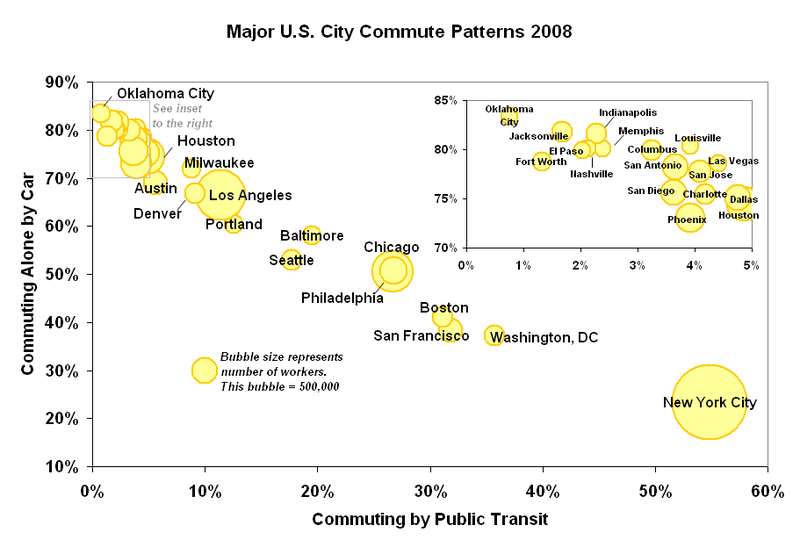
Image Credit: Wikimedia Commons
– – –
The Navy and Marine Corps plan to have bases be zero net energy in a decade.
The Sierra Club lists the greenest campuses.
St. Paul, Minnesota, experiments with bicycle-based compost collection.
Auburn University students design housing with non-recyclable cardboard.
The zero waste effort is starting to reach the fashion industry.
– – –
This Friday’s links highlight a few examples of global progress toward integrating cleaner energy into conventional energy grids.

Image credit: Wikimedia Commons
The New York Times reports on the impressive bump from 17% to nearly 45% renewable-source energy in Portugal’s grid over the past five years. However, the gain in cleaner energy has come at a hefty premium for consumers- take a look at how the Portuguese are balancing it all.
Visit Australia’s Clean Energy Council website and have a look at the interactive map of all clean energy plants over 100kW in operation.
Denmark’s official website cites 12 large scale solar operations in the country that add up to 20% of annual energy demand and offer flexibility within the national grid.
Lastly, read a discussion of progress toward integration of wind energy into European energy grids on the European Wind Energy Association’s website.
– – –
A number of interesting house-related tidbits came my way this week, and I wanted to share a few favorites…
– – –
NPR featured a story (with photos!) about incredibly tiny Japanese houses designed to fit on slivers of land. Every function and element has to be carefully considered.
– – –
Mother Earth News featured a story about how some folks are reusing round, metal grain bins (also called grain silos) as houses. One architect, Mark Clipsham, specializes in putting one bin inside another (with a crane) and then filling the space with foam insulation to improve thermal performance – there are photos of his work here.
– – –
And Treehugger featured a story about Michelle Kaufmann’s new “Zero” series of prefabricated homes. Her company is based in the Bay Area. Her website goes into more detail about the homes, and lists the “lessons learned” from her previous ventures into prefab, which are incorporated into this venture:
– – –
This edition of Friday links is dedicated to headlines about the stalling of Senate passage of a comprehensive U.S. climate bill.
The Economist provides a thorough overview of the situation and its implications for legislation, industry and legal tussles for years to come, here.
An article in Reuters puts the issue into its global context, here.
From the U.K. Guardian, Eric Pooley asks Where next for the wrecked U.S. climate bill?
And finally, the Huffington Post has a page dedicated to the climate bill, related photos and breaking coverage.
– – –
U.S. Representative and House Appropriator Mike Honda secured funding to the tune of $2 million towards extension of the BART system to Silicon Valley as part of the FY 2011 Transportation, Housing and Urban Development spending bill. What is the “BART to Silicon Valley” project? It’s an extension of the existing BART system to Milpitas, San Jose, and Santa Clara starting from the future Warm Springs station in Fremont (along the eastern side of the South Bay).
– – –
Google Energy has signed its first contract, a 20-year wind power contract in Iowa. Google will sell the electricity on the spot market and retire the associated renewable energy credits (RECs) – via TechCrunch.
– – –
More people are freaking out about smart meters, but this time not in the Central Valley…
The Fairfax Town Council gave the nod to the creation of an ordinance that, if passed, would try to prevent PG&E from installing smart meters in Fairfax – via the Marin Independent Journal.
The Marin Association of Realtors has issued a statement calling for a moratorium on its SmartMeter program due to concerns in three areas: concerns about overcharging, concerns about health effects from the radio waves, and concerns about PG&E imposing meters on folks that don’t want them – via the Marin Independent Journal.
The Marin Independent Journal also reports that the Marin supervisors have sent a letter to Michael Peevey, president of the California Public Utilities Commission (CPUC), asking the CPUC to suspend PG&E’s SmartMeter rollout until a commission has reviewed the funtion of the meters and until the health implications of the electronic emissions from the wireless devices has been addressed…
– – –
The Department of Energy announced yesterday that $122 million has been awarded to a team of scientists from California (including Lawrence Berkley National Lab) to establish an Energy Innovation Hub that will be focused on converting sunlight into liquid fuel.
– – –

photo source: www.energy.ca.gov/sitingcases/abengoa/index.html
No one seems to dispute that solar technology will play an increasingly important role in transitioning away from fossil fuel dependence. But what is less clear is how solar tech will be deployed, and how fast. Is the market for single-point residential solar really ready to take off, or will it be large-scale solar fields? What can we learn from other countries that have had a longer history of serious solar initiatives (and will the U.S. commit to catching up)?
And although California is leading the charge in residential solar with innovative funding mechanisms like PACE – the Property Assessed Clean Energy model developed in Berkeley and influential in the planning of similar clean energy and efficiency programs around the country- the regulatory landscape under which these programs would operate remains uncertain at best.
This week’s links unearth information on the issues affecting California’s solar future from around the web:
Start with the July 15 broadcast of Forum from KQED Radio. This broadcast is a “Solar Panel” discussion featuring Danny Kennedy of Berkeley-based residential solar installation company Sungevity, Eicke Weber, director of the Fraunhofer Institute for Solar Energy Systems in Germany, U.C. Berkeley Professor and co-director of The Energy Institute, Severin Borenstein, and news reporter Todd Woody.
Next up, visit the California Energy Commission and California Public Utilities Commission’s “Go Solar California” website, urging CA residents to jump on the solar bandwagon.
Think the hot plains of the Mojave Desert are a great place for a giant solar farm? Many people do, but the “empty” desert is still home to ecosystems that need consideration- check out NPR’s coverage on how the plans are shaping up here.
Finally, we here at Zero Resource will be keeping up with the PACE debate, and you can too, by checking out the latest headlines- including the breaking news of Attorney General Jerry Brown’s lawsuit against Freddie Mac and Fannie May over delays to the program:
AG Brown sues feds over slowed solar PACE – San Jose Business Journal
California Sues Federal Mortgage Giants to Save Clean Energy Program – On Earth Magazine
California Sues Fannie, Freddie, Regulator over PACE program – NASDAQ
– – –
The Sacramento Municipal Utility District (SMUD) will receive $20 million from the federal stimulus funds designated for California. The money will launch a Home Performance Program, which will offer HERS audits and energy upgrades to about 15,000 homes in SMUD territory. Because the program is expected to increase demand for trained contractors and auditors, SMUD will be working with the Sacramento Employment and Training agency and Los Rios Community College to develop training programs – via SMUD.
The California Energy Commission also approved $8 million for the County of Los Angeles, $3 million for the County of San Diego, and $1.9 million for the City of Fresno from Recovery Act Energy Efficiency Conservation Block Grants for residential energy retrofit programs – via Imperial Valley News.
– – –
There’s a cool map of hotspots where water and energy are coming into conflict around the world – IEEE Spectrum.
– – –
There’s a new study from Arizona State University that analyzes the life cycle impact of swimming pools in nine cities in terms of their consumption of chemicals, water, and energy – via Environmental Science & Technology.
 Zero Resource

