Bus Rapid Transit (BRT)

1

This post is part of our definitions series on “eco-lingo” and technical terms.

– – –

If you have read articles about urban transit in recent years, chances are you have run across the phrase “BRT” or “bus rapid transit”. BRT refers to a mode of bus travel that is characterized by streamlined operations on heavily traveled routes to reduce travel and wait times and/or increase average daily trips. Elements of BRT may be any combination of dedicated bus lanes, limited stop “express” buses, increased coordination for “signal priority” at stop lights, quick-boarding platform placement and configuration , curb cuts and turn-abouts for faster maneuvering of buses and pre-board fare collection.

The argument for BRT is generally that there is an increasing need for fast and efficient public transit in cities spurred by factors such as population growth and greenhouse gas reduction goals. However, rail systems are extremely costly to build and maintain, and many of America’s cities lack even basic public rail infrastructure. BRT can bridge this gap and provide the efficiency and effectiveness of a rail system while utilizing the already existing roadways.
Visit AC Transit’s BRT page here, and visit the National Bus Rapid Transit Institute here.

– – –

What exactly does “sustainability” mean? How about “green”, “eco” or “environmentally friendly”? The truth is that these terms are just vague enough to mean many different things to many different people. With the staggering array of “green” products, ‘lifestyles’ and concepts being promoted by marketers and environmentalists alike (as well as the necessary coining of new terms to match new ideas) our definition series aims to make sense of the rising tide of “eco-lingo” and technical terms.

– – –
Vampire and Phantom Loads

1

This post is part of our definitions series on “eco-lingo” and technical terms.

– – –

We all know that we should switch off appliances and gadgets when they are not in use. But many appliances and gadgets continue to use a significant amount of power even when turned off – these gadgets are called vampire loads or phantom loads, using what’s called standby power.

According to the International Energy Agency, standby power accounts for 5-10% of residential electricity demand (in part because of the proliferation of gadgets such as iPods, netbooks, Wii systems, and Tivo, among many others).

Why do we have all these vampires?

One very common reason is power adaptors. Power adaptors (those little boxes that make up most of the charger or power cord for your gadgets) convert high-voltage alternating (AC) current from the socket into low-voltage direct current for your gadget. The Economist estimates that as of the end of 2009, there were about 5 billion power adaptors around the world. They don’t come with off switches and will continue to consume power while plugged in even if no device is being charged. Many folks in the energy-efficiency field call power adaptors wall warts because of their “ugliness” in terms of energy efficiency.

Vampire loads also occur because many gadgets have features that don’t turn off even if the device is not in use (like the clock on a microwave), and many devices have “instant on” functions that wait for remote control signals.

– – –

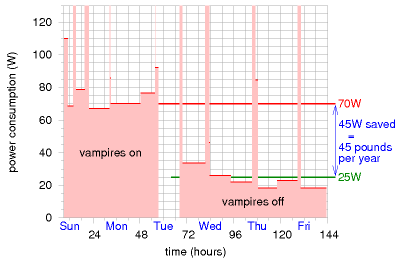
In his book “Sustainable Energy – Without the Hot Air”, David MacKay shows the results of an experiment he conducted to measure the electricity savings from turning off vampire loads.

Image credit: David MacKay

From the book (which is free and available online here), his description of the experiment (with British units):

I measured the electricity savings from switching off vampires during a week when I was away at work most of each day, so both days and nights were almost devoid of useful activity, except for the fridge. THe brief little blips of consumption are caused by the microwave, toaster, washing machine, or vacuum cleaner. On the Tuesday I switched off most of my vampires: two stereos, a DVD player, a cable modem, a wireless router, and an answering machine. The red line shows the trend of “nobody-at-home” consumption before, and the green line shows the “nobody-at-home” consumption after this change. Consumption fell by 45W, or 1.1 kWh per day.

– – –

What exactly does “sustainability” mean? How about “green”, “eco” or “environmentally friendly”? The truth is that these terms are just vague enough to mean many different things to many different people. With the staggering array of “green” products, ‘lifestyles’ and concepts being promoted by marketers and environmentalists alike (as well as the necessary coining of new terms to match new ideas) our definition series aims to make sense of the rising tide of “eco-lingo” and technical terms.

– – –

Resilience vs. Sustainability

2

This post is part of our definitions series on “eco-lingo” and technical terms.

– – –
photo by Derek Jensen

Is the glass half-sustainable or half-resilient?

Have you noticed the word ‘resilience’ cropping up in places where you might expect to see the word ‘sustainable’? Are the speakers making a real distinction here, or are they just moving on from yesterday’s buzz word? Let’s find out.

First, Merriam Webster defines the two words as follows:

resilience:

1. the capability of a strained body to recover its size and shape after deformation caused especially by compressive stress

2. an ability to recover from or adjust easily to misfortune or change

sustainability:

1. capable of being sustained

2a. of, relating to, or being a method of harvesting or using a resource so that the resource is not depleted or permanently damaged <sustainable techniques> <sustainable agriculture> 2b. of or relating to a lifestyle involving the use of sustainable methods<sustainable society>

Wow. Does the increased use of ‘resilience’ mean planners and policy makers are becoming more pessimistic? Are they already assuming the worst and now aiming for damage control instead of wise action? Well, maybe. But in all honesty, there is a difference, and it is important to make the distinction. This is not an either/or occasion, but more of a both/and.

Perhaps it seems obvious, but it is crucial to use the right words in order to come as close to the precise meaning as possible. ‘Sustainable’ is a very pro-active word, but it says nothing about the context in which it operates. The word ‘resilience’ by contrast implies a built in complexity; it is a word of reaction, and of endurance. The terms converge, but they are on separate tracks. My point is this – not only do the right words communicate to others better, but the right words can also re-frame the ‘same old thing’  in a beneficial and insightful way. In other words, if sustainability starts at home, maybe spin should too.

– – –

What exactly does “sustainability” mean? How about “green”, “eco” or “environmentally friendly”? The truth is that these terms are just vague enough to mean many different things to many different people. With the staggering array of “green” products, ‘lifestyles’ and concepts being promoted by marketers and environmentalists alike (as well as the necessary coining of new terms to match new ideas) our definition series aims to make sense of the rising tide of “eco-lingo” and technical terms.

– – –
Greenwashing

2

This post is part of our definitions series on “eco-lingo” and technical terms.

– – –

The term greenwashing is generally heard when one person or organizations accuses another of greenwashing a product or practice.

Greenwashing is when a company disingenuously promotes a product as “green” or as an more environmentally-friendly option.

The Wikipedia entry on greenwashing gives the following origin story for the term:

“Greenwashing was coined by New York environmentalist Jay Westerveld in a 1986 essay reagrdign the hotel industry’s practice of placing green placards in each room, promoting the reuse of guest towels, ostensibly to ‘save the environment’. Westerveld noted that, in most cases, little or no effort toward waste recycling was being implemented by these institutions…Westerveld opined that the actual objective of this ‘green campaign’ on the part of many hoteliers was, in fact, increased profit.”

Generally, a product, practice, or promotion is labeled as “greenwashing” when it seems that there has been significant effort or resources devoted to labeling something green, and much less effort devoted to looking at the underlying metrics in terms of environmental impact and actually improving environmental performance.

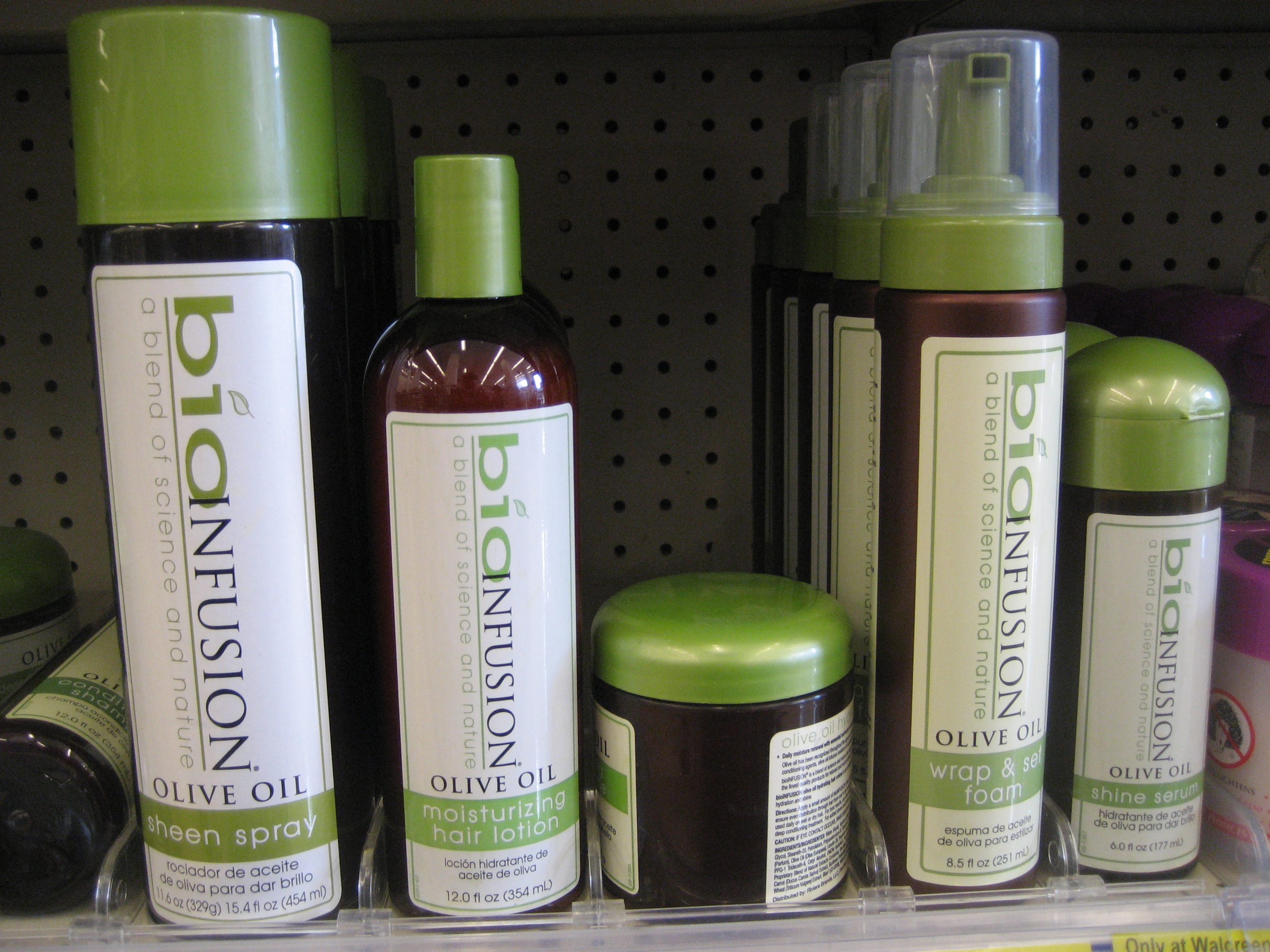
As an example, yesterday I passed a sign outside the local Walgreens advocating that I “save a tree by signing up for online promotions”. Another example is that many aerosol product labels still say “CFC-free” even though CFCs have been banned since before I was born.

Several years ago, TerraChoice Environmental Marketing put out a list of “Six Sins of Greenwashing”, which has now been expanded to seven.

The seven sins of greenwashing are:

1 – Sin of the hidden trade-off

2 – Sin of no proof

3 – Sin of vagueness

4 – Sin of worshipping false labels

5 – Sin of irrelevance

6 – Sin of lesser of two evils

7 – Sin of fibbing

TerraChoice has a comprehensive (and fun!) site covering the sins. The site also includes links to recent TerraChoice reports on greenwashing.

– – –

From my latest visit to the store (one of the MANY examples of greenwashing on the shelf):

– – –

What exactly does “sustainability” mean? How about “green”, “eco” or “environmentally friendly”? The truth is that these terms are just vague enough to mean many different things to many different people. With the staggering array of “green” products, ‘lifestyles’ and concepts being promoted by marketers and environmentalists alike (as well as the necessary coining of new terms to match new ideas) our definition series aims to make sense of the rising tide of “eco-lingo” and technical terms.

Bioplastics, part two

1

This post is part of our definitions series on “eco-lingo” and technical terms.

– – –

Part 1 of this post provides a definition for the term “bioplastic” and clarifies the distinctions between “degradable”, “biodegradable” and “compostable” plastics.

– – –

a compostable plastic cup from NatureWorks

While the idea of plant-based, biodegradable and compostable plastic made from renewable resources sounds like a potential panacea to the problem of plastic trash, the reality is -at this point- it is still too good to be true.

For starters, as I outlined in the first part of this post, not all bioplastics are created equal. To quickly re-cap, many are hybrids of conventional plastic polymers with added biomass; some are able to biodegrade and some are not; and the “compostable” type usually requires the high temperatures of a commercial composting facility in order to break down. What this means is that many new classes of plastics have been unleashed into the waste stream (with the catch-all rating of #7, or “other”) without the infrastructure in place to process them.  In large quantity, there is the real likelihood that they will complicate the recycling of traditional PET plastics.

Compostable plastics and serviceware such as coffee cups, to-go containers, etc., may be placed in municipal compost bins, but at this time no ‘bioplastics’ should  be placed in a regular mixed recycling bin (large scale efforts to recycle bioplastics in their own right could be termed “fledgling”, at best).

For example, the City of Portland Bureau of Planning and Sustainability authored a fact-sheet for area businesses considering using bioplastics that not only warns that the local recycling facility is not equipped to process many of the new plastics, but also calls into question the long-term wisdom of replacing one set of disposable products with another. In short, even if all things were equal with the logistical aspects of recycling bioplastics vs. conventional plastics, there is still the reality that bioplastics use fossil fuels in their creation, create greenhouse gases in their decomposition, cannot be processed by consumers at home, and can continue to perpetrate the problem of plastic trash in the ocean.

With all of that said, there may still be a place and a potential for bioplastics. The technology is rapidly evolving, and if the industries can coordinate with infrastructure, then proper use of the materials will be the result.

For more information visit:

The Sustainable Biomaterials Collaborative;

Bioplastics Magazine (a trade publication);

and Sustainable Plastics? a website and project of the Institute for Local Self Reliance.

– – –

What exactly does “sustainability” mean? How about “green”, “eco” or “environmentally friendly”? The truth is that these terms are just vague enough to mean many different things to many different people. With the staggering array of “green” products, ‘lifestyles’ and concepts being promoted by marketers and environmentalists alike (as well as the necessary coining of new terms to match new ideas) our definition series aims to make sense of the rising tide of “eco-lingo” and technical terms.

Advanced Framing

1

This post is part of our definitions series on “eco-lingo” and technical terms.

– – –

Also called Optimum Value Engineering (OVE), advanced framing is a way of  framing a house to reduce the amount of wood used. Careful design can both reduce the lumber needed and the waste generated by using standard material dimensions, increasing the spacing of framing members to 24″, adjusting the location of windows and doors, and adjusting the way corners are framed.

Aside from the benefit of reducing wood use and waste, there is the additional benefit that removing wood from walls creates additional space for insulation, improving the thermal performance of the envelope, especially in the corners.

A few specific examples of the difference between standard and advanced framing techniques are here and here.

– – –

What exactly does “sustainability” mean? How about “green”, “eco” or “environmentally friendly”? The truth is that these terms are just vague enough to mean many different things to many different people. With the staggering array of “green” products, ‘lifestyles’ and concepts being promoted by marketers and environmentalists alike (as well as the necessary coining of new terms to match new ideas) our definition series aims to make sense of the rising tide of “eco-lingo” and technical terms.

Bioplastic, part 1

1

This post is part of our definitions series on “eco-lingo” and technical terms.

– – –
photo credit: Tecknor Apex

Bioplastic :

The term “bioplastic”  generally refers to plastic made in whole or in part from plant-derived renewable resources and/or compounds that are subject to degradation from microbial action.

The “and/or” is key and this is where the confusion comes in. “Bioplastic” is a catch-all term that refers to several different classes of plastics. For example, some petroleum based plastics (non-renewable resource) can be made in such a way that they biodegrade over time, leaving behind a toxic residue. And some “bioplastics” made from renewable resources will not biodegrade.

While not a very new technology,  bioplastics have only recently begun to take off in the U.S.  There have been many new products hitting the shelves with claims that they are a cleaner and greener option. But not all of these products are interchangable with each other, or with the conventional plastics that they would replace.

To help you sort your plastics, here is the difference between “degradable”, biodegradable”, and “compostable”:

Degradable plastics are essentially meant to address the “lingering” characteristic of traditional plastics that can take decades or longer to break down, persisting as litter or consuming valuable landfill space. Degradable plastics are those that are engineered to break down into fragments, particles or residue more rapidly than conventional plastics, but “degradable” does not itself define what the constituent materials are.

Biodegradable plastics are typically a hybrid of sythetic polymers and biomass or starch-based plastics. Like degradable plastics, they break down to a point, but are not 100% biodegradable unless they are marked “compostable”…

Compostable plastics are able to fully biodegrade without leaving toxic elements behind (made completely without the use of synthetic polymers); however, compostable plastics are not instantly ‘back to nature’.  Although composed of biomass, most compostable plastics break down very slowly and often need the assistance of a commercial composting facility. The unfortunate misconception here is that one can toss a soy-plastic fork in a meadow after a picninc or in the backyard pile, and it will dissolve quickly. “Compostable” plastics can thus lead to litter and perhaps irresponsible consumer behaviors.

In part 2 of this post, I will discuss the recycling and end-of-use considerations of bioplastics.

– – –

What exactly does “sustainability” mean? How about “green”, “eco” or “environmentally friendly”? The truth is that these terms are just vague enough to mean many different things to many different people. With the staggering array of “green” products, ‘lifestyles’ and concepts being promoted by marketers and environmentalists alike (as well as the necessary coining of new terms to match new ideas) our definition series aims to make sense of the rising tide of “eco-lingo” and technical terms.

The Energy-Water Nexus

1

This post is part of our definitions series on “eco-lingo” and technical terms.

– – –

We have been hearing with increasing frequency about “the energy-water nexus” in California as we face potential changes to our climate and our water supply. But what is it?

Basically, water and energy supplies are fundamentally linked together. Producing energy requires a huge volume of water (even for renewables). Treating and distributing water requires a consistent supply of energy. Therefore, serious challenges to the supply of one threatens the reliability of the other.

According to Sandia National Laboratory, producing electricity from just fossil fuels and nuclear energy requires 190 billion gallons of water each day, which accounts for 39% of all U.S. freshwater use. Each kWh generated from coal necessitates 25 gallons of water (source here). Also, since the energy needed to treat and distribute water can account for up to 80% of the water’s final cost, a reduction in the amount of available, inexpensive energy will have a direct impact on the cost and supply of water.

– – –

What exactly does “sustainability” mean? How about “green”, “eco” or “environmentally friendly”? The truth is that these terms are just vague enough to mean many different things to many different people. With the staggering array of “green” products, ‘lifestyles’ and concepts being promoted by marketers and environmentalists alike (as well as the necessary coining of new terms to match new ideas) our definition series aims to make sense of the rising tide of “eco-lingo” and technical terms.

Extended Producer Responsibility (EPR)

6

This post is part of our definitions series on “eco-lingo” and technical terms.

photo by Ian Britton, FreeFoto.com

Extended Producer Responsibility refers to the concept that manufacturers have an obligation to take a more active role in the entire life-cycle of their products in order to reduce the burden of recycling and disposal currently borne by local governments and taxpayers. The approaches to EPR may vary, from optimized manufacturing processes that allow a product to be dismantled and recycled more easily thereby reducing the amount of waste and/or toxic materials sent to landfill, to “take back” programs that allow consumers to return an end-of-life product back to the manufacturer for recycling or disposal.

EPR is often achieved through mandates from local  and state governments. Besides “take back” programs, strategies may include:

–Additional fees or taxes for producers and consumers of certain products to recover disposal costs;

–“Environmentally preferable purchasing” guidelines for manufacturers that may, among other things, ensure less waste by setting recycled-content requirements for new products; and

–Design requirements that reduce the unnecessary packaging waste, extend the life of products, etc.

One common application of EPR programs and/or mandates is in regard to electronics waste, or “e-waste”.

Related term:

Product Stewardship is often used as another term  for extended producer responsibility, but can also incorporate actions that do not directly target manufacturing practices. Product stewardship may examine the entire structure of production and consumption including all stakeholders: manufacturers, vendors, consumers, and government, with the emphasis on shared responsibility for the end-of-life-cycle of products. Product stewardship, as EPR, may be achieved through any combination of legislation, mandates, incentives, collaborative processes, voluntary action from manufacturers and education and outreach to producers and/or consumers.

What exactly does “sustainability” mean? How about “green”, “eco” or “environmentally friendly”? The truth is that these terms are just vague enough to mean many different things to many different people. With the staggering array of “green” products, ‘lifestyles’ and concepts being promoted by marketers and environmentalists alike (as well as the necessary coining of new terms to match new ideas) our definition series aims to make sense of the rising tide of “eco-lingo” and technical terms.

Virtual Water

1

This post is part of our definitions series on “eco-lingo” and technical terms.

– – –

Virtual water (also referred to as embodied water) is the volume of fresh water used to produce a product at the location of production. This concept of virtual water applies to everything we use or buy, such as clothes, electronics, food, and building materials. For example, the average virtual water associated with 1 egg would be 53 gallons.

(For those familiar with energy issues, this is similar to embodied energy.)

The creator of the virtual water concept, Professor John Anthony Allan, was initially researching agricultural water issues in the Middle East and concluded that the region could survive with scarce water because it was importing large amounts of “virtual water” embedded in its food imports.

You can hear a podcast of Professor Allan’s seminar on virtual water here.

– –

What exactly does “sustainability” mean? How about “green”, “eco” or “environmentally friendly”? The truth is that these terms are just vague enough to mean many different things to many different people. With the staggering array of “green” products, ‘lifestyles’ and concepts being promoted by marketers and environmentalists alike (as well as the necessary coining of new terms to match new ideas) our definition series aims to make sense of the rising tide of “eco-lingo” and technical terms.