Noelle’s Links – 6/3/10

Interesting tidbits from my web travels…

The Green Products Innovation Institute is a non-profit that kicked off in May that provides guidance on the manufacture of safer products. The group offers the new “Cradle to Cradle” certification. Read Triplepundit‘s coverage of the launch.

Visit the Green Product Innovation Institute’s site here.

Read about Jerry Glover, Agroecologist, working towards the establishment of perennial crops that could be the next agricultural revolution, at National Geographic.

In case you haven’t seen one of the many tech blogs buzzing about this one yet, check out the Prepeat Printer as covered byGeek.com. The Prepeat is a rewritable printer from Japan’s Sanwa Newtec that uses special plastic sheets that can be written and erased up to a thousand times each. The machine is prohibitively expensive at $US 5,500 and a set of sheets will set you back thousands more. A laudable achievement, but plastic sheets? Discuss…

Current Events – AC Transit Cuts, part 2

2

Here is an update on the ongoing cuts to AC Transit service that I first reported on last week:

AC Transit is in trouble. Dire financial straits have forced the agency to consider enacting additional service cuts and the possible declaration of a fiscal emergency. Already adjusting to the 7 percent service cuts that went into effect at the end of March of this year, August is likely to bring an additional 8 percent less service, with more cuts in the pipeline if new funding sources are not found.

On May 26th, AC Transit held two public hearings, at 2 p.m. and 6 p.m. to solicit comments on three possible scenarios that could be rolled out in August.

Proposal one is to operate only trunk and major corridor services on the weekends;

Proposal two is to modify All Nighter and late-night services;

Proposal three is to distribute the reductions across all weekday, late-night and weekend services.

However, it is unlikely that any one scenario will be enacted in full, but rather some sort of amalgamation of the proposed cuts.
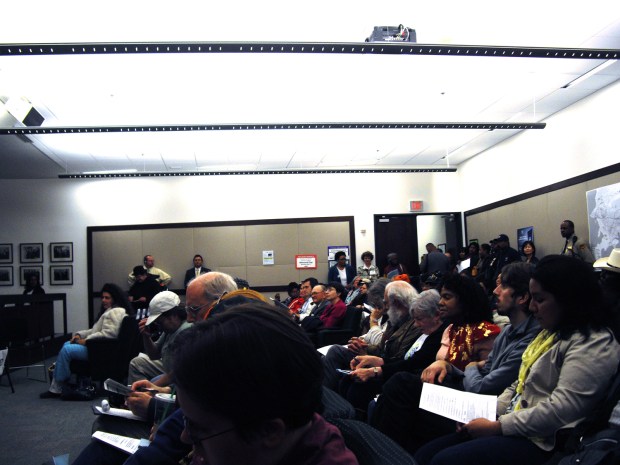
I attended the 6 p.m. public hearing and tensions were running high among those who came to speak out against the cuts. Time and again, concerned residents spoke of their fears about losing accessible transit. Many stated that they could not afford cars, or were seniors or disabled and could not walk or bike as an alternative. Some had moved to their residences specifically because they were accessible to bus routes- routes that are threatened under the new scenarios, either by reduction of service resulting in unreasonable wait times, or loss of service areas altogether.

While some expressed frustration with the board of directors, in truth these are deep and painful cuts that nobody wants to make and that will result in the continued erosion of the ridership base, further driving down revenues.

What can we, as informed and concerned citizens, do to try to recover the essential functions of the public service on which so many depend? we need to speak up if we want to keep our transit systems intact (or expanded). Transit is often at the bottom of the list because public outcry is greater on other issues; perhaps transit is seen as so fundamental that we take it as a given. What AC Transit is showing us, is that publicly funded transit is far from a given.

Contact your State Senator.

The Key System

2
Since  the decline of  bus service in the East Bay has been on my mind lately, this installment of Looking Back asks the question: What was AC Transit before AC Transit?
Image of a historic Key System map housed in UC Berkeley’s Earth Science and Map Library
The Key System, a privately held company, provided transit in the East Bay from 1903 until being sold to the public entity AC Transit in 1960.
The first cable car appeared in the East Bay in 1886  on the arterial road, San Pablo. Electric street cars followed in 1891, knitting togther Berkeley and Oakland with intercity rail lines. By 1893, the street cars were being consolidated into the Key System by Francis Marion “Borax” Smith. Although the conglomeration of tracks already served the East Bay from Richmond to San Leandro, Smith furthered the service by building a pier that pulled a track out into the bay, with the final 3 mile leg of the transbay service being completed by ferry. This jutting feature into the bay along with the maze of tracks on land resembled an old fashioned key in plan view, thus giving the Key System its name.
This image was originally posted to Flickr by jaycross at http://flickr.com/photos/66151780@N00/220773099.
By 1924 the Key System had reached a peak of 18 million riders and was typical of integral rail systems in cities across America. However, by the 1930s street cars were already losing major ground to automobiles. The transbay bridge was primed for car and truck crossing in 1936, but did not accomodate rail for another two years. Locals already calibrating to the speed of the auto era, were abandoning the leisurely street car-and-ferry crossing. In another blow to the Key System, tolls at bridge crossings dropped drastically, further driving up competition from auto commuters.
Although the lean war years did temporarily provide a second wind for the mass transit system, the system was beginning to age and infrastructural funds were not ready at hand. With the suburban boom that followed the end of WWII, transit began to decentralize. National City Lines backed by oil and tire companies began to buy up ailing rails across the country and replace them with bus service. In the East Bay, all electric street car lines, save the transbay route had been replaced by buses by 1948.
In 1956 voters approved the establishment of the publicly run Alameda Contra Costa Transit District. AC Transit bought out the nearly bankrupt Key System in 1960.
Credits: All information was gathered from the AC Transit website, and “The Rise and Fall of the Key System“, a slideshow presented at AC Transit Transbay Taskforce November 10, 2009 by Will Sparger.
For a good source of online historical photos of the Key System, click here. Take a trip across the historic Key System rails in a video here.

Editorial – How Much Space is Enough?

1

Houses have been getting bigger. Over the past fifty plus years (until 2008), the size of the average new house more than doubled, from 1,000 square feet or less in 1950 to 2,265 in 2000 (values from NAHB). The percentage of new homes smaller than 1,200 square feet has been dropping since 1987, while the percentage of new homes larger than 2,400 grew from 21% to 38% between 1987 and 2001 (values from this study). Interestingly, the size of the average new home dropped in 2008 (data here and an article here).

The general trend of larger and larger houses has a direct impact on the environment. Larger houses require more land to build on, more materials for construction, more energy to heat, cool, and light, and result in more waste, both during construction and demolition. While it is expected that there may be some “economy of scale” as houses get larger, there is a widely held suspicion that larger homes consume proportionally more materials because they often have higher ceilings and more complex geometry. Larger houses also require more materials to furnish and decorate.

It should be noted that larger homes are not only increasing in area (square footage); they are also increasing in volume, which may ultimately have a larger impact on the energy consumption of the house. Larger houses are usually constructed with extra features that are not surface area efficient (such as complicated roofs and dormer windows) and which consume more energy for heating and cooling than a compact house of the same volume.

New houses should be both smaller and more compact.

However, it has been difficult to build smaller homes. Aside from the social cache afforded those with larger homes, zoning rules and mortgage practices have also pushed “bigger is better.” For example, mortgage lenders often required the home to be “three times the value of the land,” which then determined a minimum house size for a certain area.

The recent, slight tilt towards smaller home is likely due to the recession and the constrained finances of those building, financing and buying homes. But it is encouraging. When considering what they could afford financially, people chose smaller houses. If we consider what we can “afford” using metrics of energy, water, and materials, we should prioritize building smaller houses.

Photo – A Geyser in Downtown Berkeley

1

A huge geyser was caused when a car hit a fire hydrant in the center of Shattuck Ave on April 16th.

(And apparently, it’s not the first time this has happened in Berkeley, CA.)

Foodshed

1

This post is part of our definitions series on “eco-lingo” and technical terms.

– – –

Essentially, a “foodshed” is a way to conceptualize the total system of food production from farm to table. This includes the various intermediate stages of processing, packaging, preparation and travel before a good reaches its final destination. Similar to a watershed (the system of rivers, streams and aquifers that define a regions’ water supply) one can discuss the impacts of factors such as pesticides, delivery systems and resource efficiency within a foodshed. However, unlike a watershed which is more or less constrained by local topography, a modern American foodshed is limited only by consumer choice and the behavior and/or regulation of industry and agriculture.

See the American Farmland Trust’s study on the San Francisco bay area’s foodshed

Related terms

Locavore: A person who strives to eat primarily locally sourced/produced/grown foods.

CSA (Community Supported Agriculture): A food supply model whereby individuals receive produce and goods directly from the farm that produces them. Consumers assume a portion of the farmer’s risk by buying subscriptions for a prescribed period of time. This allows farmers to effectively manage financial resources with less impact from weather fluctuations and other circumstantial losses. In return, subscribers benefit from receiving  a variety local, seasonal produce and sharing in high yields. Finally, because CSA’s tend to grow a wide range of foods for their subscribers, organic methods of soil management, including crop-rotation is often practiced.

See the Ecology Center’s list of bay area CSAs

– – –

What exactly does “sustainability” mean? How about “green”, “eco” or “environmentally friendly”? The truth is that these terms are just vague enough to mean many different things to many different people. With the staggering array of “green” products, ‘lifestyles’ and concepts being promoted by marketers and environmentalists alike (as well as the necessary coining of new terms to match new ideas) our definition series aims to make sense of the rising tide of “eco-lingo” and technical terms.

Finding Data – Watershed Mapping

1

Pictured above is the U.S. EPA 'Surf your Watershed' site’s display of the six watersheds of Alameda County.

‘Surf your Watershed’ is an excellent tool from the U.S. Environmental Protection Agency that helps you find basic data on all the watersheds in your county. The site includes U.S. Geologic Survey data, water quality information, and links to local citizen’s groups working on water stewarship, clean up and other  issues (39 in Alameda County!)

Check it out

Finding Data – The Water Intensity of Food

3

Many of us have heard that we should eat locally grown food to reduce the energy needed to transport and preserve the food between the source and our table. Many of us have also heard that we should reduce our meat consumption to reduce the amount of land and other resources needed to support our diets and lifestyles. Another metric to consider is how much water is needed to produce different foods.

Based on values from the Water Footprint Network, I compiled a chart of how much water is needed to produce certain foods. This is obviously not an inclusive list of all foods, but gives an idea of the range of values for different kinds of foods. These values will also differ in different countries and regions. As noted by the director of the Water Footprint Network, Arjen Y. Hoekstra, “Water problems are often closely tied to the structure of the global economy. Many countries have significantly externalised their water footprint, importing water-intensive goods from elsewhere. This puts pressure on the water resources in the exporting regions, where too often mechanisms for wise water governance and conservation are lacking.”

In the table on the left, values are generally for liters per kilogram unless otherwise noted. In the table on the right, values are generally for gallons per pound unless otherwise noted.

You can calculate your own water footprint with this calculator for an estimate of which parts of your diet and lifestyle are most water intensive.

Ixtoc I and ESI Maps

2

News sources and commentators have been comparing the size of the current oil spill in the Gulf to that of the Exxon Valdez spill in 1989. There are of course numerous differences between the spills – the Exxon Valdez spill was in an isolated area in Alaska, for example, and the maximum volume of the spill was known at the beginning of the crisis. The boat could only spill as much oil as it could hold. And the Exxon Valdez spill occurred at the surface – oil was not rising from the bottom of the ocean, becoming emulsified and harder to clean up.

A better comparison for the current Gulf spill might be the Ixtoc I spill of 1979, the worst offshore spill in North American history.

After the well blowout on June 3, 1979, it took more than nine months to cap the well. Nine months. During that time, the well was spewing roughly 10,000 to 30,000 barrels of oil a day into the Bay of Campeche in the Gulf of Mexico. 3 million barrels of oil wound up in the Gulf.

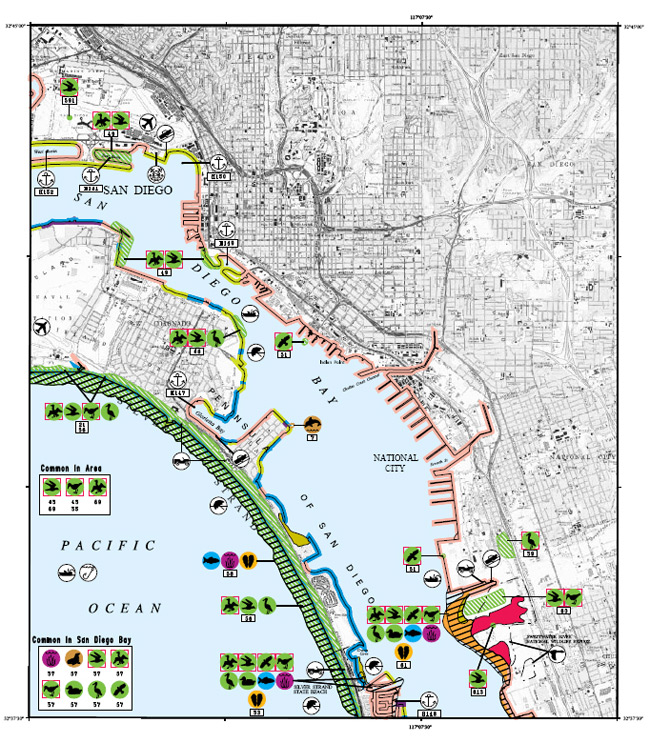
As a result of this major spill, new procedures were instituted, existing procedures were revised, and new information was gathered. The National Oceanographic and Atmospheric Administration (NOAA) Office of Response and Restoration (OR&R) developed Environmental Sensitivity Index (ESI) sensitivity maps, which plot information about the shoreline and biological and human-use resources. This helps responders identify risks and develop priorities quickly. An example  of an ESI map of San Diego Bay (from NOAA’s website) is below.

An overview of the “anatomy” of ESI maps can be found here. ESI maps can be downloaded here.

Anna’s Links – 5/26/10

A round-up of interesting (and depressing) analysis of the recent oil rig explosion and oil spill…

A “live” feed of the BP oil spill is now posted online (though traffic has been so high that it’s not always possible to view) – U.S. Energy and Commerce Committee.

Experts examining a previous video of the oil leak released by BP estimate that the size of the oil spill is much larger than official estimates – NPR.

Scientists fault the government for “failing to conduct an adequate scientific analysis of the damage and of allowing BP to obscure the spill’s true scope” – New York Times.

Some experts are starting to say that the oil leaks could last for years because “we don’t have any idea how to stop this” – National Geographic.

Aerial photos of the Gulf oil spill show its vast size – NASA Earth Observatory.

A scientist at Lawrence Berkeley National Lab notes that some of the detergents used to clean up spill sites can be more toxic that the oil itself – Lawrence Berkeley National Lab.

– – –

Other interesting tidbits from the web…

Two campuses of the University of California system, Berkeley and Davis, have been given  MacArthur grants to launch a new master’s degree program in sustainable development practice – UC Berkeley and MacArthur Foundation.

Developers in Las Vegas are cranking up their sales pitches for brand new homes again, even though the city has 9,500 empty houses and another 5,600 that were repossessed in the first quarter of 2010 – New York Times.

Las Vegas as a whole has been very dependent on growth and construction – the recent drop in new construction had a major impact on municipal funding – Aguanomics and Bloomberg.

Federal officials want public input on a proposal to revise policies for managing urban water shortages in the Central Valley – meetings will be held in Sacramento on May 26, June 23, July 20, and August 19 – The Sacramento Bee.