Berkeley Gets Shiny New Recycling Bins

2

I have to confess… I was pretty excited when I was walking home this afternoon and noticed a new bin outside every house on my street. Including my house.

– – –

The Ecology Center, which manages Berkeley’s recycling program, and Mayor Tom Bates have unveiled the new bins to be used by Berkeley residents. According to Berkeleyside:

The new carts have already started to appear on curbsides and a total of 36,000 of them will be delivered to Berkeley residents in single family homes over the next month.  Seven new trucks designed to handle the new carts are also now in use — the trucks are also divided into two sections, the larger of which holds paper and cardboard materials.

Apparently the bins are also designed to discourage poachers:

Accessing materials is more difficult than from an open box which might … put off potential poachers. The lid of the new cart is also printed with an advisory that the material contained in the cart is city property.

You can read the entire story here.

– – –

Assorted Links

Berkeley, San Francisco, and Oakland have a proportionally higher stock of older housing than many East Coast and Midwestern cities that were founded and developed much earlier — places such as Philadelphia, New York City, Baltimore, Chicago, Hartford, Conn., Savannah, Ga., and Washington, D.C.

Stormwater from areas around the nine-county Bay Area contribute more toxic pollution to San Francisco, San Pablo and Suisun bays than the rivers carrying agricultural runoff from the Valley.

– – –

LBNL Open House on Saturday 10/2

Image credit: LBNL website

Lawrence Berkeley National Laboratory, located up in the hills overlooking Berkeley, California, is hosting an open house on Saturday, October 2.

Ever wonder how biofuels are produced, cool roofs and smart windows reduce energy use, the Internet was created, or supernovas are discovered? Families, community members, and others who want to learn the answers to these and other scientific questions are invited to attend Berkeley Lab’s Open House.

Visitors can talk directly with scientists conducting cutting-edge research, check out a cosmic ray detector, sequence DNA, create and measure their own seismic waves, build a motor at the Family Adventure Zone, or take a tour of the Advanced Light Source, one of the world’s brightest sources of ultraviolet and soft x-ray beams, among numerous other activities. Performances, displays, demonstrations, lectures, tours and food vendors will also be featured.

It is important to note that registration is required for everyone interested in attending. There are two sessions, morning and afternoon. More details are available here.

– – –

Full List of AC Transit Cuts

The full list of night and weekend buses with service being cut has now been posted on the AC Transit website here.

Weekend lines that will continue to operate include: Lines 1, 1R, 18, 20, 22, 26, 40, 45, 51A, 51B, 57, 60, 72, 72M, 73, 76, 88, 97, 99, 210 and 217.

Lines that will be cut include: Lines 7, 11, 12, 14, 21, 25, 31, 32, 49, 52, 54, 62, 65, 67, 68, 70, 71, 74, 85, 86, 89, 93, 95, 98, 242, 251, 275, 332, 345, 350, 376, 386, F, NL and O.

The discontinued All-Nighter service includes Lines 802, 805, 840 and 851. Lines 800 and 801 will not be affected.

– – –

Update on AC Transit Cuts

2

Image Credit: Wikimedia Commons

Last night, AC Transit’s board of directors voted unanimously to slash night and weekend bus service in an effort to reduce the projected $40 million budget deficit.

Thirty-nine “minor” weekend routes are on the chopping block, but most major weekend routes will be left intact.

Four of the six all night buses will disappear. The only surviving lines will be the 800 and the 801.

According to Berkeleyside, 9 weekend services will be eliminated in Berkeley – the 1R, 7, 12, 25, 49, 52, 65, 67 and the Transbay F.

Another decision on paratransit services was postponed.

The full set of cuts should be posted on the AC Transit site soon.

– – –

Noelle has previously written about the challenges facing AC Transit – AC Transit Cuts (5/25/10), AC Transit Cuts, Part 2 (6/2/10), and AC Transit Cuts, Part 3 (7/8/2010).

– – –

Dan Kammen, Clean-Energy Czar

3

Dan Kammen, who leads the Renewable and Appropriate Energy Laboratory at UC Berkeley, was just appointed by the World Bank to be its first Clean-Energy Czar.

The New York Times Green Inc. blog posted an interview with him today:

Q – One of the chief criticisms of the World Bank is that, even as it has increased funding for renewable energy and energy efficiency projects in developing countries to $3.3 billion annually, it continues to provide significant funding for carbon-intensive projects like coal-fired power plants. Do you see a need for the bank to maintain financing for those projects?

A – This is really at the heart of the tension between traditional development — meaning more energy, more access, irrespective of environmental damage — and the emerging environmental mandate that we’ve got to cut our greenhouse gas emissions so dramatically. So you get cases like the very controversial $3.5 billion investment in coal in South Africa, and at the same time, how to build the emerging economies around solar, biofuels, wind, etc.

You can read the entire interview on the New York Times website.

– – –

UPDATE: There is also an interview with Dan Kammen posted on Grist:

Q – The climate bill process fell apart in Congress this year and it seems like the U.N. process isn’t headed for a big treaty either. How can things actually get done?

A – There’s no simple answer to that. When we look back at the Montreal Protocol and CFCs, people thought that process looked impossible until a few companies and countries realized that cleaning circuit boards without CFCs might actually save them money and be more effective. A couple successes turned a story that looked like it was going to be a failure into one that we all look back now and say, “Oh, that was easy by comparison.”

I’m not sure exactly how many successes we need to tip the balance so that a big treaty is possible, but no group is better positioned than the World Bank to facilitate them.

You can read the entire interview at Grist.org.

– – –

Peter Darbee, CEO of PG&E – Part 3

4

On Tuesday, August 31, I was in the audience at the Haas School of Business at UC Berkeley as Peter Darbee, CEO of Pacific Gas & Electric Co., responded to moderator questions about the energy industry and the company’s stance on climate change.

The post below consists of Part 3, the final part, of my record of the conversation – all portions are included in chronological order. Read the previous posts on the conversation – Part 1 and Part 2.

An ellipsis (…) indicates that I was not able to capture the words or thoughts skipped. Moderator questions are paraphrased. Responses are included as accurately as possible – punctuation choices are mine. The moderators were Bev Alexander (BA) and Joey, a student.

– – –

Joey

SmartMeters – I saw your talk at the CPUC  – there were protesters saying Dumb Meters. Talk about the backlash.

Peter Darbee

In California, there has been a tier system of rates… Tiers depend on how much power you use. Originally the tiers were not so steep…all of the rate changes have been amplified in tiers 3-5. In Bakersfield last year…had 17 days over 100 degrees. The previous year had 6… And I’m talking about in July. So folks get rocketed into the higher tiers. There were some folks who didn’t have SmartMeters… Some had SmartMeters for a year and hadn’t had issues until that July… Then they held hearings… And this whole outcome is an inadvertant result of government, freezing the first 2 tiers.

… … ….

… But PG&E could have done better at communications… We kind of assumed they were infrastructure… We assumed that people didn’t give a lot of thought about the meters on the side of the house… We were wrong.

Bev Alexander

In California, it’s a very activist state – you came out in support of AB 32, PG&E advocated decoupling, used to support shareholder incentives for energy efficiency, has a very aggressive RPS at 33% – combined with the federal level, there’s potential for overlapping and conflicting mandates – what works? Why these positions?

Peter Darbee

I’ve done a lot of thinking about climate change…and where is the public on climate change…and they have concerns it may happen…but they don’t want to pay a lot…have to be very attentive to the cost concerns of our customers. What this says is energy efficiency is a no brainer.

…AB 32 envisions a cap and trade system…time to transition to cleaner technologies…for utilities benefits pass through to customers.

… … …

Climate change is a planetary issue, and if a state rigs the system to help themselves, it gets expensive… If we do it in a very expensive way, the people of Ca will revolt, and it will set us back tremendously.

Joey

How did you teach your kids about energy efficiency? What advice do you have for future leaders on climate change?

Peter Darbee

The kids would leave the lights on, the stereo on…in every single room… I instituted a policy that if you leave the lights on, and you’re not in the room, it’s 25 cents…went up as they got older… We now have kids that are tremendously concerned about the environment…

The challenge of climate change will fall more greatly on you and your children…

Write your obituary… The way you create transformational change is you put a stake in the ground for the future…an attractive future…then plan from future back to present. You have a choice.

– – –

This exchange was followed by a question and answer session with the audience.

– – –

Peter Darbee, CEO of PG&E – Part 2

5

On Tuesday, August 31, I was in the audience at the Haas School of Business at UC Berkeley as Peter Darbee, CEO of Pacific Gas & Electric Co., responded to moderator questions about the energy industry and the company’s stance on climate change.

The post below consists of Part 2 of my record of the conversation – all portions are included in chronological order. Read Part 1 here.

An ellipsis (…) indicates that I was not able to capture the words or thoughts skipped. Moderator questions are paraphrased. Responses are included as accurately as possible – punctuation choices are mine. The moderators were Bev Alexander (BA) and Joey, a student.

– – –

Joey

I want to go back to a shareholder value article in the Wall Street Journal – a professor from Michigan says we should focus exclusively on profit. Why worry about corporate responsibility?

Peter Darbee

I used to have that view – I lived and breathed Milton Friedman… It’s tragic that more people haven’t continued the journey of being realistic… What [the professor] is saying is that if you maximize profit each quarter…line up the quarters…then that will maximize profit forever… But you cut back on expenditures that are needed… There’s such a time between when policies are set and it comes home to roost…

I want to make sure PG&E is here 100 years from now and I’m setting up good people and good culture…

I couldn’t disagree with that teacher more…it’s rubbish.

Bev Alexander

The direction the industry is headed will call for a lot of innovation. How are you shifting the culture? How will the utilities integrate new technology?

Peter Darbee

Utilities have been very conservatively run and prone to not changing…but the environment is of new technology and changing regulation… You could say the risk is that utilities won’t change quickly enough… … Utilities react to their commissions…can be punished for change… … Our commission has been open to change and promoted change…

How do we create innovation? An organization is the shadow of its leader…and of the leaders that have come before… The people who have the best ideas are the people closest to the work…want to create an environment for trial and looking into things.

We had an opportunity to invest in solar in space…structure the risk…so that we only pay for the power if it’s delivered…ensure that they are abiding  by the rules of government. The two principle objections went away.

Bev Alexander

Other technology you’re working with – robust energy efficiency, electric cars, renewables – what are the most important? What are choke points on the grid that need to be addressed?

Peter Darbee

… If we’re going to deal with the carbon problem, we’re going to need all the tools in the arsenal…nuclear, renewables, the first fuel should always be energy efficiency, demand management, carbon capture and sequestration… We’re going to need chips on all the squares… What’s scary is we need a lot from each…from energy efficiency to renewables.

… We’re going to need nuclear… I know a lot of people aren’t keen on nuclear… The storage issue is far less than the challenge of climate change.

– – –

Part 1 was posted yesterday. Part 3 will be posted on Monday.

– – –

Peter Darbee, CEO of PG&E – Part 1

4

On Tuesday, August 31, I was in the audience at the Haas School of Business at UC Berkeley as Peter Darbee, CEO of Pacific Gas & Electric Co., responded to moderator questions about the energy industry and the company’s stance on climate change.

The post below consists of Part 1 of my record of the conversation – all portions are included in chronological order.

An ellipsis (…) indicates that I was not able to capture the words or thoughts skipped. Moderator questions are paraphrased. Responses are included as accurately as possible – punctuation choices are mine. The moderators were Bev Alexander (BA) and Joey, a student.

– – –

Bev Alexander

Over the last decade, you’ve led the industry through major turmoil…

Peter Darbee

I go different places, around the world and country, and I hear that a utility gets a guaranteed return, so anyone can run that place. Then why were we in financial distress ten years ago?

What’s happening in the industry is very dynamic…deregulation, reregulation…customer choice provides opportunity for others to take over…When government dramatically changes rules, there’s a mad scramble. And there’s the introduction of new technology all the time…these are disruptive technologies. This demands the most of management…

Bev Alexander

You’ve distinguished yourself on the issue of climate change…but you’re a business leader. Why is this a top priority?

Peter Darbee

You have to talk to your conscience. On January 1, 2005, I thought about the awesome responsibility of running a huge company… The question of climate change came up…

How would you feel if you were running this huge company and it had a dramatically negative impact on the planet?… How could you live with yourself if…you did not do everything you could to mitigate your impact?

Also, I owe a fiduciary responsibility to shareholders…so need to reconcile the two. So if we emit as much carbon as we can, and someone sues…the questions could be a problem… I have to do everything I can within the context of my role to reduce carbon emissions… We learned as much as we could about the issue and tried to change the industry… So what we did is called together some of the greatest scientists…put together top people in the country…tried to get to the bottom of the issue…came up with the statement “The earth is warming, mankind is responsible, and the time for action is now.”

Joey

I read your paper on climate change, but other folks in the audience might be concerned – why aren’t other companies on board?

Peter Darbee

… … … Why other companies don’t feel the same way… They love to moan, and say it’ll be horrible if we have to make that change… Folks at PG&E complained 30 years ago about decoupling… Everyone overreacts and creates a boogeyman… But this issue has become so political that we can’t have a conversation about it…and this is true in my own family.

… … I’ve never known anything good to happen when people are screaming at each other…and have lost the ability to listen.

– – –

Part 2 will be posted tomorrow. Part 3 will be posted on Monday.

– – –

City Rankings – Energy, Walkability, and Transit

1

This Friday’s links highlight a few examples of city rankings…

– – –

The Natural Resources Defense Council (NRDC) has released a list of 22 American cities named “2010 Smarter Cities” for their investment in green power, energy efficiency measures and conservation – Oakland, San Francisco, Berkeley, and Santa Cruz are the Northern California cities that made the list and have profiles on the NRDC website.

– – –

Walk Score has ranked 2,508 neighborhoods in the largest 40 U.S. cities to help you find walkable neighborhoods – San Francisco is ranked #1!

– – –

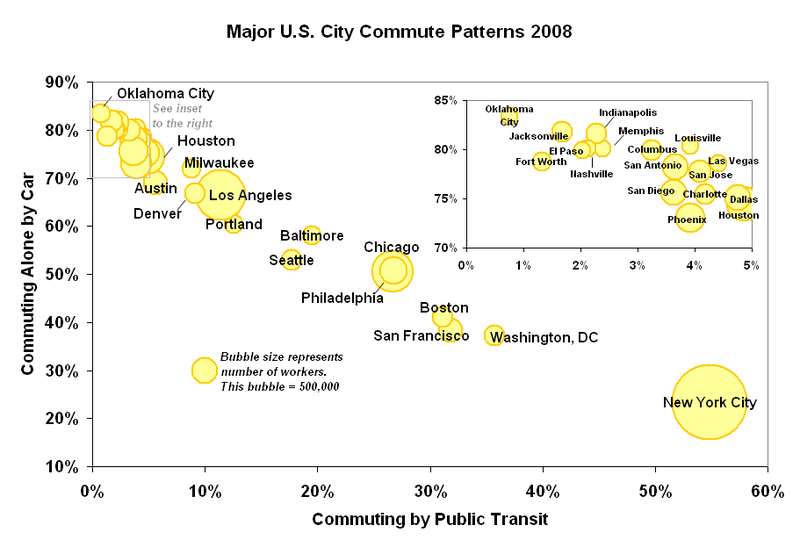
The 2006 American Community Survey measured the percentage of commuters who take public transit, as opposed to walking, driving, riding a bicycle, or other ways of getting to work. In the top 50 are the Bay Area cities of San Francisco, Berkeley, Oakland, Richmond, and Concord.

Image Credit: Wikimedia Commons

– – –