NRDC Report on Climate Change, Water and Risk

Image: NRDC

The Natural Resource Defense Council (NRDC) has released a study, conducted on their behalf by Tetra Tech, which examined the effects of climate change on probable future water supply and demand in the United States. One of the main findings of the study is that one-third of the U.S. counties (> 1,100 counties) will likely face water shortages by 2050.

The full report is available as a PDF here.

The Water Supply Sustainbility Index developed by Tetra Tech for the report can be viewed interactively in Google Earth – a link to the data can be found on the NRDC’s website here. You can also turn on and off markers for which counties are top producers of different crops to get a sense of the potential impact of the water shortages. It looks like this (the green dots indicate that the county is one of the top 100 counties for producing vegetables):
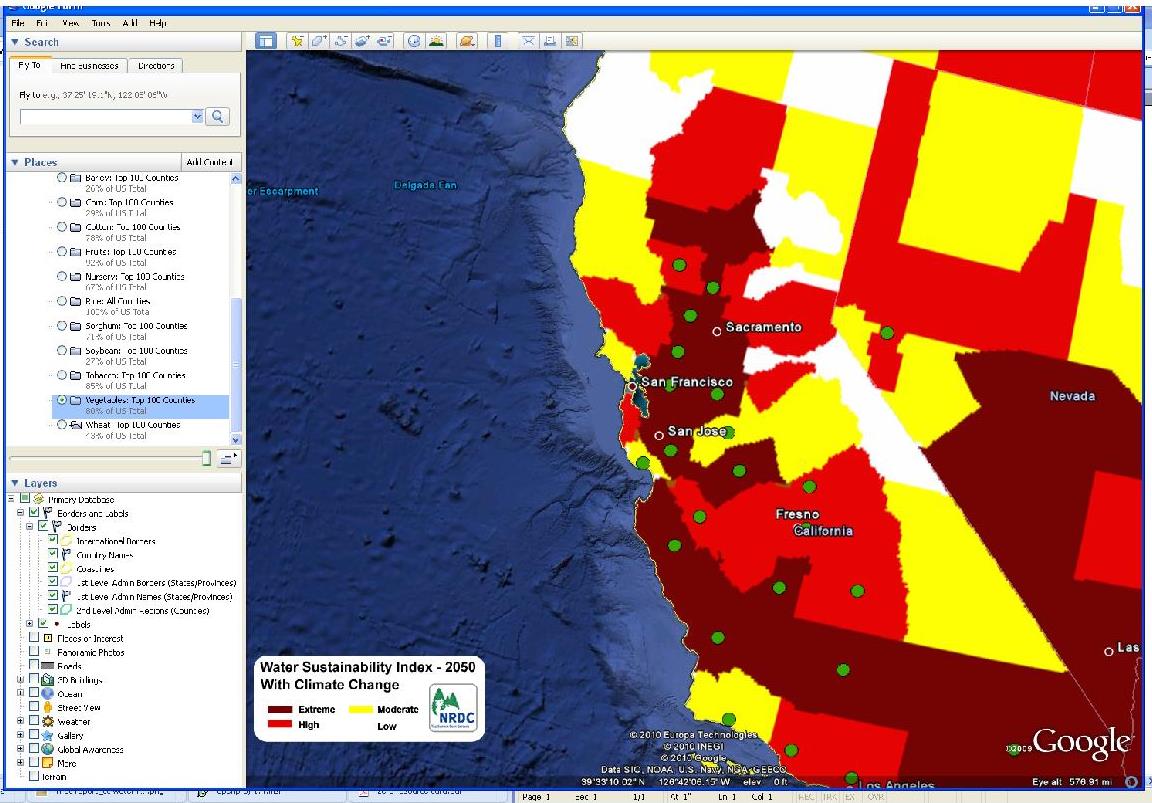
The NRDC also released a one-page overview of water shortage risk and crop value in at-risk counties by state (as a PDF here). According to the overview of California’s risk due to climate change:

Percent of CA counties at risk of water shortages: 83%

Total number of CA counties at risk: 48

Total number of CA counties at extreme risk: 19

Total number of CA counties at high risk: 17

Total number of CA counties at moderate risk: 12

The value of all the crops being producing in at-risk CA counties (in $1,000s): $21,585,354

– – –

Global Warming’s Six Americas

1

This post is part of an ongoing effort to discover, and provide a venue for, data collection , reports,  and metrics related to the topics of waste, water, energy and transportation.

A graph from the Global Warming’s Six Americas report

Global Warming’s Six Americas is a report released in May of 2009 by the George Mason University Center for Climate Change Communication, and Yale’s Project on Climate Change Communication,  illuminating American attitudes towards global climate change and climate change policy. The report has the stated premise that “Climate change public communication and engagement efforts must start with the fundamental recognition that people are different and have different psychological, cultural, and political reasons for acting – or not acting– to reduce greenhouse gas emissions”.

The group used data gathered during 2008 from an in-depth questionnaire to assess attitudes, concerns, perceptions, risk values, policy preferences and other identified survey dimensions, ultimately enumerating 6 common response types among Americans at large regarding issues related to global climate change.

The six “types” identified by the report are the Alarmed (18%), the Concerned (33%), the Cautious (19%) , the Disengaged (12%), the Doubtful (11%), and the Dismissive (7%). Each group corresponds to a distinct station on the spectrum of attitudes and responses cataloged by the researchers.

It never hurts to hear it again: with only 5% of the world’s population, America is yet responsible for 25% of greenhouse gas emissions (GGE)s. This, argues the report, is why understanding the diverse views of the American public on climate change is so crucial for and understanding our collective behaviors and for creating effective public education and policy messages.

Read the full “6 Americas” report here.