New Water Magazine from Johns Hopkins

Johns Hopkins University’s Global Water Program has published its first issue of Global Water Magazine, which is available online here.

The magazine will focus the editorial pieces around six main themes: Water & Energy, Water & Food, Water & Health, Water in the Environment, Water Infrastructure, and Water Policy.

In the first issue, there are several articles that I think would be of interest to readers of this blog, listed below.

– – –

Imperatives for Urban Water Professionals on the Pathway to 2050 by Paul Reiter

Abstract: Looking forward to 2050, the challenges of adding 2 billion more people to an already resource-constrained planet will require major changes in the resources efficiency, energy efficiency and cost of urban water systems of the future. A step change including the integration of city planning and urban water system design will be required to optimize the efficiency and resilience of urban water systems in addition to the development of physical and institutional linkages between agricultural, energy and urban water uses.

– – –

The First Stop on the Road to Corporate Water Reporting: Measurement by Eva Zabey

Abstract: External demands on companies to report on their water use and impacts are intensifying. But before reporting, business needs to measure, and many groups are developing approaches to do just that.

– – –

The Energy-Water Nexus: Finding Solutions in the Balance by Jan Dell and Kathy Freas

Abstract: With uncertainties associated to climate change projections, companies and public utilities face a convergence of energy, water and carbon issues that are impacting their operations and planned projects in sectors and geographical regions.

– – –

NRDC Report on Climate Change, Water and Risk

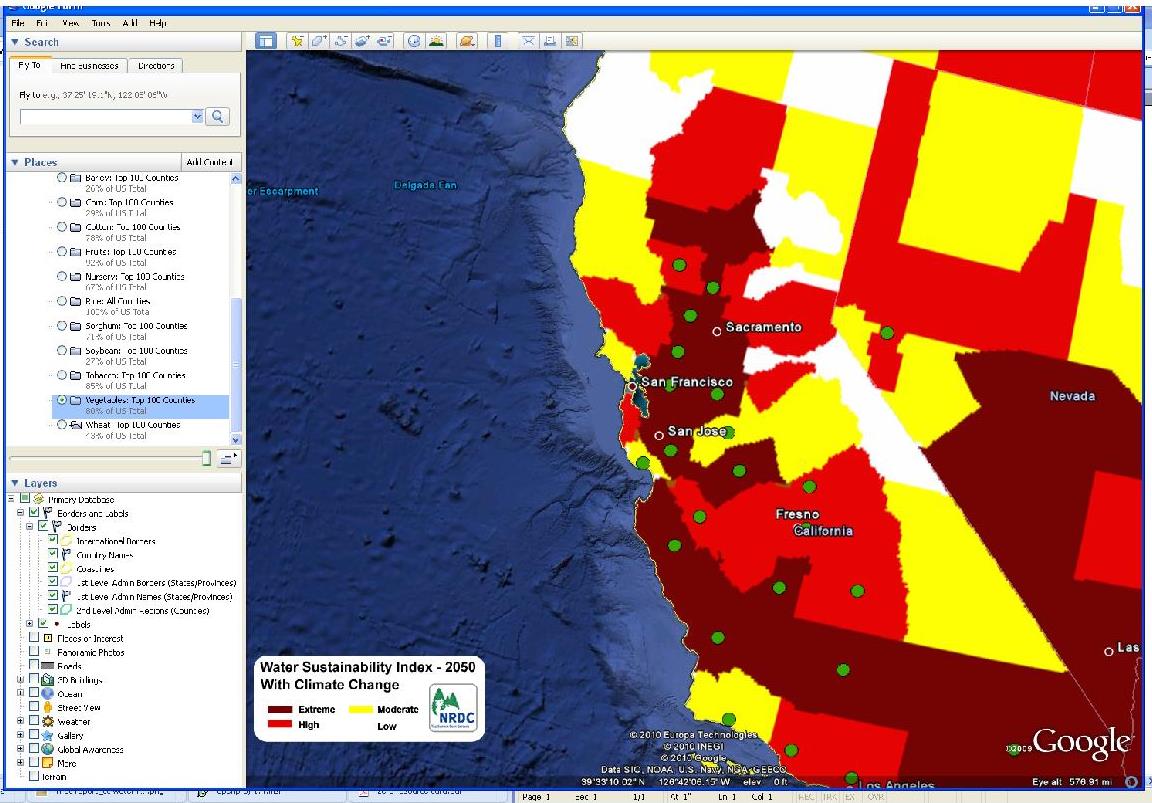
Image: NRDC

The Natural Resource Defense Council (NRDC) has released a study, conducted on their behalf by Tetra Tech, which examined the effects of climate change on probable future water supply and demand in the United States. One of the main findings of the study is that one-third of the U.S. counties (> 1,100 counties) will likely face water shortages by 2050.

The full report is available as a PDF here.

The Water Supply Sustainbility Index developed by Tetra Tech for the report can be viewed interactively in Google Earth – a link to the data can be found on the NRDC’s website here. You can also turn on and off markers for which counties are top producers of different crops to get a sense of the potential impact of the water shortages. It looks like this (the green dots indicate that the county is one of the top 100 counties for producing vegetables):

The NRDC also released a one-page overview of water shortage risk and crop value in at-risk counties by state (as a PDF here). According to the overview of California’s risk due to climate change:

Percent of CA counties at risk of water shortages: 83%

Total number of CA counties at risk: 48

Total number of CA counties at extreme risk: 19

Total number of CA counties at high risk: 17

Total number of CA counties at moderate risk: 12

The value of all the crops being producing in at-risk CA counties (in $1,000s): $21,585,354

– – –

They Don’t Have Water Meters?!

1

photo credit: freefoto.com

Many residents of California don’t have water meters. According to a recent column in the San Francisco Chronicle by Peter Gleick, the recent legislation mandating water meters is needed, as the many residents of California that don’t have meters are very reluctant to install them.

But everyone should have meters. According to Ellen Hanak, a water researcher with the Public Policy Institute on California, metered cities use about 15 percent less water than unmetered cities, and cities with a tiered rate system use an additional 10 percent less (via KQED).

A few statistics from Gleick’s column:

— Sacramento only has meters in 25 percent of residences, and has no plans to meter everyone else anytime soon.

— In the San Joaquin Valley, more than half of all residents don’t have water meters.

— The city of Fresno charges all single-family households a flat rate, no matter how much water is used.

Fresno’s water rates are some of the lowest in California, and it has some of the highest water use (3 times as high as Los Angeles residents, and 5 times as high as San Francisco residents, via The California Report). There is an interesting study comparing water rates – when the study was conducted (2006), the average monthly charge was $18.52 in Fresno County, $37.55 in Alameda County, and $57.25 in Santa Cruz County.

The meters are coming. There are several laws that will require the installation of meters for all Californians (via KQED).

— All homes built after 1992 must have meters.

— Cities that receive federal water have to install meters by 2013.

— All California cities have to install meters by 2025.

Seriously, though, 2025 is a long time for a state that has major water management issues.

– – –

Last year, there was a story from The California Report that covers the struggle to meter reluctant Fresno residents (listen to the story here).

San Jose Might Sell Its Water System

1

To close budget gaps (the current shortfall is $116.2 million for the fiscal year 2010-2011), San Jose is considering privatizing its municipal water system, which provides water to about 124,000 people (via Silicon Valley Mercury News). The sale could net the city $50 million.

The current potential buyer is reported to be San Jose Water Company, which provides water to about 1 million people in the Bay Area, including about 80 percent of San Jose residents. The potential sale would likely result in higher water rates for the formerly municipal customers. The company has also expressed interest in leasing and operating the water system.

While I think it is shortsighted to sell city assets to fix budget gaps (what will be sold next year?), San Jose Water Company boasts on its website that it delivered less water in 2007 than it did in 1987, despite serving an additional 80,000 people. And the company credits its water conservation programs (more info here).

Finding California Incentives and Rebates

1

There are hundreds of energy, water, and waste incentives, rebates, and services available for homes  in California, but it can be daunting to find them. Here are a few places to start:

Flex Your Power allows you to search for energy-related incentives and technical help available from utility companies, water agencies, and other organizations by entering your zip code.  A search in my zip code (in Berkeley) found 71 incentives and 18 services.

The Database of State Incentives for Renewables & Efficiency (DSIRE) lists state and local incentives by category and also lists related programs and initiatives. It can be much harder to figure out which specific programs are applicable, though. The database also lists federal incentives.

The California Urban Water Conservation Council lists programs participating in its Smart Rebates by water utility district.

For folks living in the East Bay:

East Bay Municipal Utility District lists its residential conservation rebates and services.

StopWaste.Org lists waste prevention and recycling services available to residents of Alameda County.

Stimulus Money for Energy Efficiency

1

The Sacramento Municipal Utility District (SMUD) will receive $20 million from the federal stimulus funds designated for California. The money will launch a Home Performance Program, which will offer HERS audits and energy upgrades to about 15,000 homes in SMUD territory. Because the program is expected to increase demand for trained contractors and auditors, SMUD will be working with the Sacramento Employment and Training agency and Los Rios Community College to develop training programs – via SMUD.

The California Energy Commission also approved $8 million for the County of Los Angeles, $3 million for the County of San Diego, and $1.9 million for the City of Fresno from Recovery Act Energy Efficiency Conservation Block Grants for residential energy retrofit programs – via Imperial Valley News.

– – –

There’s a cool map of hotspots where water and energy are coming into conflict around the world –  IEEE Spectrum.

– – –

There’s a new study from Arizona State University that analyzes the life cycle impact of swimming pools in nine cities in terms of their consumption of chemicals, water, and energy – via Environmental Science & Technology.

Anna’s Links – Water and Solar Energy

I recently wrote a post as an overview of the energy-water nexus. Here are a couple articles that highlight the link between solar projects and water.

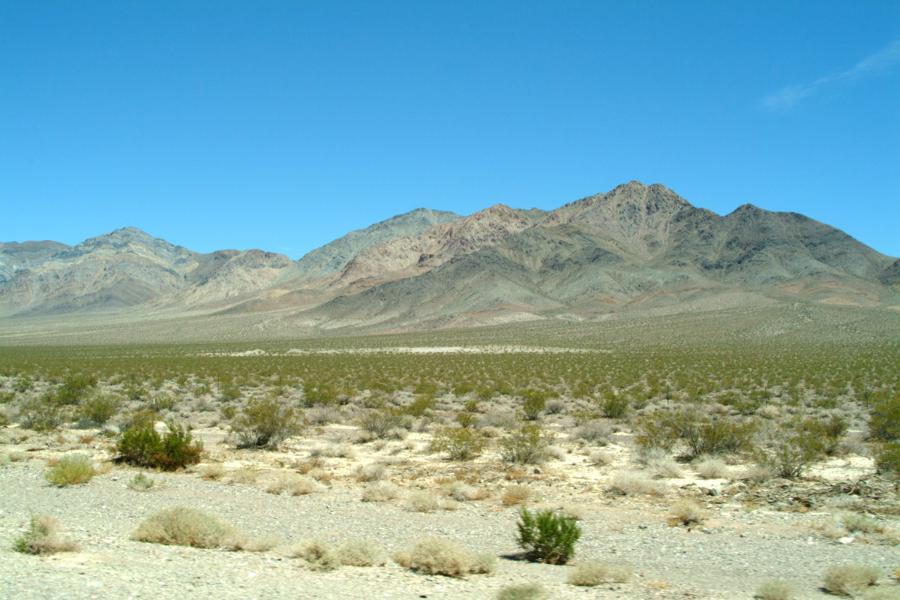
Armagosa Valley, Nevada (freefoto.com)

Last year, the New York Times ran an article about how a promising solar project in Armagosa Valley,  Nevada, by Solar Millenium ran hard up against western worries about water. The two proposed solar farms would require 1.3 billion gallons of water a year, or 20 percent of the local water available.

The Las Vegas Sun reports on the Skyline Solar facility in Nipton, California, that will use concentrating solar photovoltaic (CPV). CPV plants are expected to use much less water than solar thermal plants, which means they may be better candidates for places with lots of sun, but not as much water.

The energy-water nexus generally refers to needing water to produce energy and needing energy to move and filter water; however, it seemed fitting to include a story about using the sun and water to reduce energy use:

 NPR reports that the Camp Lejeune Marine Corps base in North Carolina is becoming one of the largest communities to widely install solar hot water panels. FLS Energy owns and installs the panels and then sells the hot water to the base, which means that there are basically only two main actors and decision-makers needed to install  systems on all 900 homes.  (The base is also planning a LEED Platinum fitness center – more info on the base website.)

San Francisco’s Smart Water Meters

1
                                                                                          water supply leak, Free Foto.com

San Francisco began to roll out its new ‘smart’ water meters to city residences this month. The new devices can accurately track water usage in real-time and the San Francisco Public Utilities Commission (SFPUC) plans to make personal water use data available to customers online. Other benefits include the streamlining of operations- meters communicate wirelessly, eliminating the need for house-to-house readings- and the early detection of system leaks and unusual usage surges.

The SFPUC will replace over 175,000 meters beginning with 5,000 this spring/summer,with an estimated install completion for the full number by 2012. The expectation is that the new meters will be able to assist individual and system-wide conservation efforts, increase response time for problems, and allow for a more accurate and refined fee structure.

California, as a drought-prone state, can stand to benefit greatly from increased water use data collection. As it stands today, water use is not uniformly tracked in all homes and businesses, nor is there any correlation between regional water scarcity and water service rates. While agriculture, industry and conveyance also play leading roles in the general water picture in the state, having accurate home and commercial usage data is a step forward, and can only be a benefit in creating sound management policies for this precious and scarce resource.

Anna’s Links – Smart Meters for Energy and Water

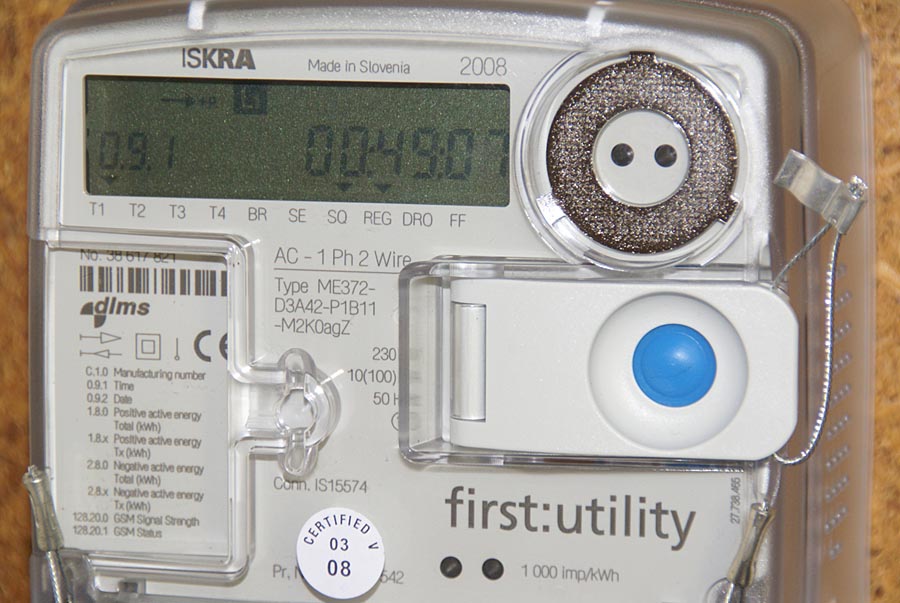
photo credit: freefoto.com

Many of you may have heard about the goings-on around the widespread installation of smart energy meters in California (after all, there have been lawsuits, legislative hearings, and mandated independent meter testing, just for the Pacific Gas and Electric meter installations).

So why go through all that to install smart energy meters? Because they hold huge promise for helping consumers reduce their energy use and for adding flexibility and reliability to how the grid is managed.

What you may not have heard as much about is that smart water meters are also being installed – more than half of California water utilities have some smart meters in their districts (via the New York Times). Ideally, smart water meters would provide real-time (or near real-time) feedback on water use to both the water utility and the consumer.

Also, Oracle has apparently developed an interest in smart water meters as a potential future market, as they already sell software systems to water (and power) utilities (via GreenTechmedia).

The Cycle of Insanity: The Real Story of Water

1

Today’s video is a short film from the Surfrider Foundation that outlines some of the radical changes to our water cycle that have happened due to increased population, urban development, and irrigation practices. The animated video is about 20 minutes long.

You can also see the video here.

As with many water issues, the end recommendation is integrated water management, with detailed examples.