Major Appliance Efficiency Agreement

1

Image credit: Wikimedia Commons

A few days ago, appliance manufacturers and energy efficiency advocates announced an agreement to call for new national minimum efficiency standards to improve energy and water efficiency standards for refrigerators, freezers, clothes washers, clothes dryers, dishwashers, and room air conditioners. The coalition of major appliance manufacturers, their trade union, and the energy efficiency advocates propose that the new national minimum efficiency standards and tax credits be instituted through action by the Department of Energy and by Congress.

According to the press release, the recommended standards and tax credits would save more than 9 quads of energy over 30 years. The recommended water efficiency standards and tax credits for clothes washers and dishwashers would save about 5 trillion gallons of water over 30 years.

Below, I’ve put together a rough timeline of how the proposed standards would take effect:

  • January 2013 – dishwashers would see 14% energy savings and 23% water savings
  • January 2014 – new refrigerator and freezer energy reduced up to 30%
  • June 2014 – room air conditioners would increase in efficiency 10-15%
  • 2015 – top loading clothes washers would have 26% energy savings and 16% water saving compared to current standards
  • 2015 – front loading clothes washers would have 43% energy savings and 52% water savings compared to current standards
  • 2015 – clothes dryers will increase in efficiency 5%
  • 2018 – top loading clothes washers would have 37% energy and water saving compared to current standards

An overview of the agreement is here.
The agreement was signed by major appliance manufacturing members of the Association of Home Appliance Manufacturers (AHAM) and by major energy and water efficiency organizations, consumer groups and environmental organizations including the American Council for an Energy-Efficient Economy, Alliance for Water Efficiency, Alliance to Save Energy, Appliance Standards Awareness Project, Consumer Federation of America, National Consumer Law Center, Natural Resources Defense Council, Northwest Power and Conservation Council, and Northeast Energy Efficiency Partnerships.

Calls For A Third Party Smart Meter Study

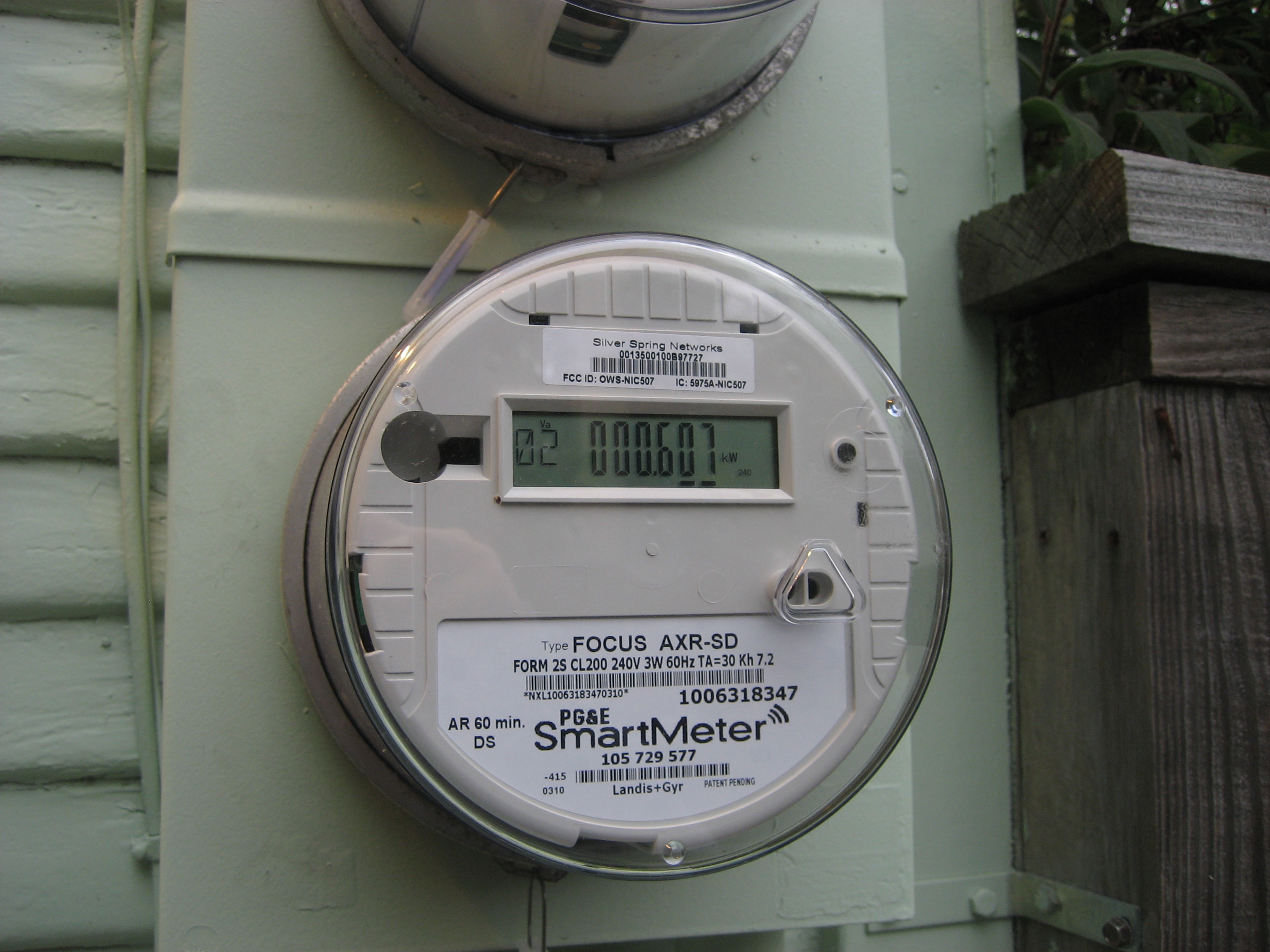
Pacific Gas and Electric Company has been facing a number of challenges in its attempts to roll out Smart Meter technology throughout California.  Advocates of the technology promote the meters as an essential component in realizing energy efficiency goals. Opponents have raised concerns about the accuracy and privacy of the meters and are increasingly raising concerns about public health and safety issues. The meters use wireless electromagnetic signals that provide real-time readings. Some customers complain that the new meters are causing them to be over-charged, yet it seems inevitable that there should be some discrepancy when moving from an older less precise system to a newer more responsive one.

However, the privacy and health and safety arguments represent much more complex and nuanced issues. The technology used by the meters is not much different than that used for cell phones or a myriad other everyday devices. However, under the current deployment of the meters, there is no ‘opt-out’ proviso, meaning that those who raise concerns over the meters are not left with a choice. Thus, it is not just a cut-and-dried matter of accuracy, but also a stickier problem of public perception, personal choice and the questioning of the adequacy of the Federal Communication Commissions’ safety standards by local communities. For example, it was widely reported this week the Town of Fairfax issued an emergency ordinance that will put a six month moratorium on the installation of the meters citing accuracy, privacy and safety concerns.

According to an article in the San Rafael Patch, San Rafael Assemblyman Jared Huffman who represents Marin and Southern Sonoma County (including the Town of Fairfax) has called for an independent review by the California Council on Science and Technology to determine the adequacy of FCC standards and provide more substantial science to the debate.  Huffman commented “If the FCC standards are deemed adequate, then the SmartMeter program can move forward with greater public confidence in the safety of the devices,” Huffman said.  “If the standards are inadequate, we need to know that so that we can get to work on better standards.”

Read more about Fairfax’s decision here, and listen to KQED’s coverage here.

Houses – Small, Reused, and Prefab

4

A number of interesting house-related tidbits came my way this week, and I wanted to share a few favorites…

– – –

NPR featured a story (with photos!) about incredibly tiny Japanese houses designed to fit on slivers of land. Every function and element has to be carefully considered.

– – –

Mother Earth News featured a story about how some folks are reusing round, metal grain bins (also called grain silos) as houses. One architect, Mark Clipsham, specializes in putting one bin inside another (with a crane) and then filling the space with foam insulation to improve thermal performance – there are photos of his work here.

– – –

And Treehugger featured a story about Michelle Kaufmann’s new “Zero” series of prefabricated homes. Her company is based in the Bay Area. Her website goes into more detail about the homes, and lists the “lessons learned” from her previous ventures into prefab, which are incorporated into this venture:

  1. Minimize button up work / maximize what is done off-site
  2. Have a system that can offer both efficiencies with repetition in module types, but designed to offer a great variety of overall configurations so each home can be uniquely composed for the specific site conditions and client goals.
  3. Use materials and systems that have been researched and tested for the optimal balance of beauty, longevity, sustainability and cost
  4. Maximize efficiencies in dimensions of materials by designing to construction and shipping “sweet spots” to reduce waste and costs

– – –

Berkeley’s New Bike Station

1

Bike Station is an outfit that seeks to help municipalities and transit agencies reach their goals for transit oriented development by providing spacious, secure bike parking and bicycle rentals and repair services at key points along public transit routes. After months of anticipation, Berkeley’s new Bike Station opened to the public this month. The Berkeley Bike Station is the second largest in the country and expands the capacity for Downtown Berkeley BART friendly bicycle parking four-fold.

Funded in partnership by the City of Berkeley and BART, the Bike Station is located at 2208 Shattuck Avenue, just a half block from the BART entrance, and provides free bike parking to commuters from 9 a.m. to 5 p.m. For the cost of a few pennies an hour, commuter memberships are also available for those who want off-hour cardkey access.

Vampire and Phantom Loads

1

This post is part of our definitions series on “eco-lingo” and technical terms.

– – –

We all know that we should switch off appliances and gadgets when they are not in use. But many appliances and gadgets continue to use a significant amount of power even when turned off – these gadgets are called vampire loads or phantom loads, using what’s called standby power.

According to the International Energy Agency, standby power accounts for 5-10% of residential electricity demand (in part because of the proliferation of gadgets such as iPods, netbooks, Wii systems, and Tivo, among many others).

Why do we have all these vampires?

One very common reason is power adaptors. Power adaptors (those little boxes that make up most of the charger or power cord for your gadgets) convert high-voltage alternating (AC) current from the socket into low-voltage direct current for your gadget. The Economist estimates that as of the end of 2009, there were about 5 billion power adaptors around the world. They don’t come with off switches and will continue to consume power while plugged in even if no device is being charged. Many folks in the energy-efficiency field call power adaptors wall warts because of their “ugliness” in terms of energy efficiency.

Vampire loads also occur because many gadgets have features that don’t turn off even if the device is not in use (like the clock on a microwave), and many devices have “instant on” functions that wait for remote control signals.

– – –

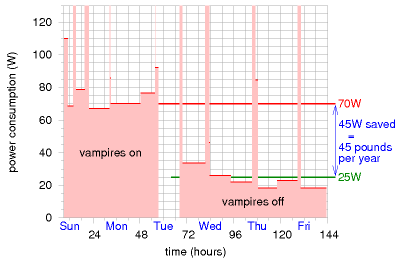
In his book “Sustainable Energy – Without the Hot Air”, David MacKay shows the results of an experiment he conducted to measure the electricity savings from turning off vampire loads.

Image credit: David MacKay

From the book (which is free and available online here), his description of the experiment (with British units):

I measured the electricity savings from switching off vampires during a week when I was away at work most of each day, so both days and nights were almost devoid of useful activity, except for the fridge. THe brief little blips of consumption are caused by the microwave, toaster, washing machine, or vacuum cleaner. On the Tuesday I switched off most of my vampires: two stereos, a DVD player, a cable modem, a wireless router, and an answering machine. The red line shows the trend of “nobody-at-home” consumption before, and the green line shows the “nobody-at-home” consumption after this change. Consumption fell by 45W, or 1.1 kWh per day.

– – –

What exactly does “sustainability” mean? How about “green”, “eco” or “environmentally friendly”? The truth is that these terms are just vague enough to mean many different things to many different people. With the staggering array of “green” products, ‘lifestyles’ and concepts being promoted by marketers and environmentalists alike (as well as the necessary coining of new terms to match new ideas) our definition series aims to make sense of the rising tide of “eco-lingo” and technical terms.

– – –

California – 20th in Beach Water Quality

1

photo credit: Alan Cleaver 2000

According to the National Resource Defense Council’s annual water quality report for the nation’s beaches, this year had the sixth highest levels of contamination in the 20 year history of the study. The NRDC reports that a range of causes are contributing to dirtier coastlines, including stormwater runoff and aging sanitation and combined sewer systems that may overflow into coastal waters during storm events.

Although contaminated waters can pass pathogens along to swimmers, the water tests currently employed take up to 24 hours to reveal problems, and so warranted beach closures are often delayed.

How does California fare in all of this? Of the 30 states with coastal waters, the cleanliness of California beaches rank at a sad #20. The top 3 polluted beaches include North Avalon beach in Los Angeles County where 82% of sampled water exceeded national pollution standards; Mendocino County’s Pudding Creek beach where 65% of samples exceeded national standards; and Poche County beach in Orange County that had an excessive pollution rate of 62%.  The county that received the dubious honor of  having the highest percentage of  beach water samples that  exceeded national pollution standards was San Francisco County at 17%. However, on a more positive note, the level of pollution in California beach water has trended downward in the last five years.

Read the report on California’s coastal waters, hereand the full Testing the Waters NRDC report, here.

California Proposition 23

Proposition 23 is the result of an initiative launched by Texas oil giants Valero Energy Inc. and Tesoro Corporation to postpone enforcement  of AB 32. The ballot initiative would delay enforcement until unemployment in California stays under 5.5% for an entire year. California unemployment is currently at about 12%.

Image source: Google Public Data

– – –

How do Californians feel about Prop 23?

The public: A poll by the Public Policy Institute of America this month indicates that 67% of California residents support AB 32 (via LA Times).

Governor Arnold Schwarzenegger:  “This initiative sponsored by greedy Texas oil companies would cripple California’s fastest-growing economic sector, reverse our renewable energy policy and decimate our environmental progress for the benefit of these oil companies’ profit margins” (via LA Times).

Republican Gubernatorial Candidate Meg Whitman: Whitman has not taken a formal stand on Prop 23. However, AB 32 authorizes a governor to delay some of the provisions for up to a year in the event of “threat of significant economic harm.” While campaigning for the Republican primary, Whitman stated that we would suspend AB 32 on her first day in office (via SF Chronicle).

Democratic Gubernatorial Candidate Jerry Brown: “Addressing  climate change is one of the great challenges of our time, something that California has been a leader on,” said Sterling Clifford, Brown’s campaign spokesman (via SF Chronicle).

– – –

The full text of Prop 23 is available here.

– – –

The Yes on Prop 23 campaign has filed suit against Attorney General Jerry Brown over the language that will go on the ballot to describe the proposition. The ballots of be printed in mid-August will say that the measure “Suspends Air Pollution Control Laws Requiring Major Polluters to Report and Reduce Greenhouse Gas Emissions That Cause Global Warming Until Unemployment Drops Below Specified Level for Full Year.” More information in the LA Times.

– – –