GM and PG&E reassure us that electric cars won’t bring down the grid (assuming we get smart grid communications).
CNN Money on what the election means for renewable energy.
National Geographic looks at why solar energy is so expensive.
– – –
GM and PG&E reassure us that electric cars won’t bring down the grid (assuming we get smart grid communications).
CNN Money on what the election means for renewable energy.
National Geographic looks at why solar energy is so expensive.
– – –
Energy Modeling for the Small and Midsize Architecture Firm
November 9, 2010 – 6:00 – 8:00 pm
AIA San Francisco, 130 Sutter Street, Suite 600
With the development of LEED and other energy efficiency standards, energy simulation has developed tremendously over the last decade. It is becoming imperative that architects better understand the available tools so that they can make informed decisions throughout the design process. Given the complexity of energy modeling, this session will focus on how architects in small and mid-size firm can best use energy simulation. What types of questions should be answered with energy models? What types of energy modeling information is most useful, and when during design should it be used? What simulation tools are favored among small and mid-size firms? How do they develop expertise within their design teams and address budgetary constraints? A panel of Bay Area architects and designers, all of whom are noted for advances in sustainable design, will address these questions. Following the panel discussion, the presenters will be available for an extended question-and-answer session.
MODERATOR:
Claire Maxfield
PANELISTS:
Philip Banta, Charlie Stott, David Scheer, & Stet Sanborn
For more information and moderator and panelist bios, see the AIA SF event site, here.
This is a FREE event.
– – –

Las Vegas, Nevada (Image credit: Wikimedia Commons)
– – –
24/7 Wall St. evaluated a couple recent studies (from Ceres and the NRDC) and also conducted some of its own analysis, focusing on the 30 largest American cities, to come up with the following list of 10 large American cities at the greatest risk of running out of water:
10. Orlando, FL
9. Atlanta, GA
8. Tucson, AZ
7. Las Vegas, NV
6. Fort Worth, TX
5. San Francisco Bay Area, CA
4. San Antonio, TX
3. Phoenix, AZ
2. Houston, TX
1. Los Angeles, CA
You can read more about their analysis and reasons for inclusion of each city here.
A note from Anna – I do not know much about 24/7 Wall St. or their track record on this sort of analysis. I think this sort of list is good for raising awareness that it is not just cities in the dry Southwest that are facing future water shortages. However, there are a few items in this article that gave me pause – first is the consistent misspelling of San Francisco as “San Fransisco”, second is the consistent listing of the NRDC (Natural Resources Defense Council) as the “National Resources Defense Council.”
– – –
I just want to remind folks that we have launched a “Webinars” page to feature interesting online presentations. You can navigate to the Webinars page using links at the right side of the blog.
– – –
November 10, 2010 (Wednesday)
Pacific Energy Center: “Chris Hammer – What’s Behavior Got To Do With Energy Efficiency?”
6:30 pm – 8:00 pm
We often look to technology to capture energy savings. What about the behavior of individuals in the home and workplace? Chris Hammer will describe occupant actions that save energy, discuss social science research on behavior and energy, and review case studies of organizations that implemented behavior change programs.
Free event. For more info and links to register here.
– – –
November 18, 2010 (Thursday)
Build It Green: “Passive House – A Sustainable Building Revolution in California”
11:00 am – 12:30 pm
Expectations for building occupant comfort, health and efficiency are increasing simultaneously. The Passive House standard meets all of these requirements at once. By producing buildings with energy demands that can be met at a renewable scale of production, Passive House can future-proof our communities and put California on track to meet our greeenhouse gas emission reduction targets. The future of building is here!An in-depth look at the Passive House standard by the leading local experts in the field, this webinar will:
- Detail current retrofit and new construction Passive House projects and approaches in the Bay Area
- Retrofit lessons learned and phased approaches
- Illustrate how Passive House meets or exceeds the California Energy Efficiency Strategic Plan, and makes net-zero and energy-positive buildings feasible TODAY in the most cost-effective way possible
- Explore how the Passive House standard can integrate with and enhance GPR and other green building rating systems.
Free for Build It Green members, $10 for non-members – more info and links to register here.
– – –
So… it’s finally Election Day 2010. There are a couple propositions on the California ballot – Prop 23 and Prop 26 – that have implications for energy and transportation policy. Statewide ballot measures just need a majority to pass.

Image credit: Wikimedia Commons
– – –
Proposition 23
–
Who is funding Prop 23?
According to MapLight.org:
Total Contributions in Support of Prop 23: $10,654,560
Total Contributions in Opposition to Prop 23: $31,245,543
–
Top Contributors in Support of Prop 23:
| Valero Services, Inc. | — | $5,075,315 |
| Tesoro Companies | — | $2,040,637 |
| Flint Hills Resources | — | $1,000,000 |
| Marathon Petroleum Company LLC | — | $500,000 |
| Adam Smith Foundation | — | $498,000 |
| Occidental Petroleum Corp. | — | $300,000 |
| Tower Energy Group | — | $200,000 |
| CVR Energy Inc. | — | $150,000 |
| Howard Jarvis Taxpayers Assoc. | — | $102,568 |
| National Petrochemical & Refiners Assoc. | — | $100,000 |
| World Oil Corp. | — | $100,000 |
–
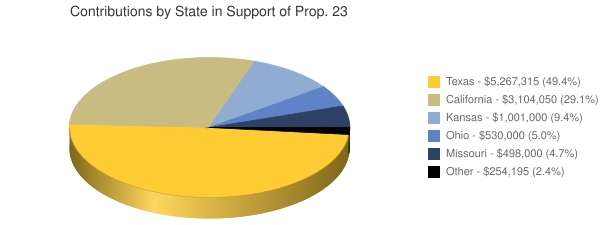
Image credit: MapLight.org
Top Contributors in Opposition to Prop 23:
| Thomas Steyer & Kathryn Taylor | — | $5,099,000 |
| National Wildlife Federation | — | $3,000,000 |
| L. John & Ann Doerr | — | $2,100,000 |
| The League of Conservation Voters | — | $1,250,000 |
| Vinod Khosla | — | $1,037,267 |
| Gordon Moore | — | $1,000,000 |
| James Cameron | — | $1,000,000 |
| Robert J. Fisher | — | $1,000,000 |
| ClimateWorks Foundation | — | $900,000 |
| Sierra Club | — | $855,890 |
| The Nature Conservancy | — | $800,000 |
| Bill Gates | — | $700,000 |
| Claire Perry | — | $500,000 |
| Green Tech Action Fund | — | $500,000 |
| John P. Morgridge | — | $500,000 |
| Julian H. Robertson Jr. | — | $500,000 |
| Pacific Gas & Electric | — | $500,000 |
| Wendy Schmidt | — | $500,000 |
–
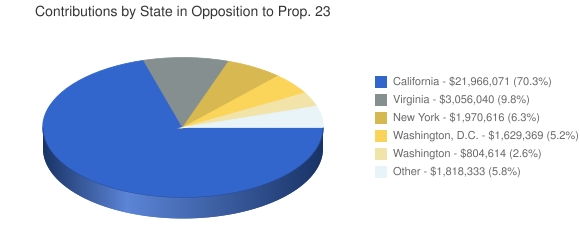
Image credit: MapLight.org
–
What is Prop 23?
From the Official Voter Information Guide:
SUSPENDS IMPLEMENTATION OF AIR POLLUTION CONTROL LAW (AB 32) REQUIRING MAJOR SOURCES OF EMISSIONS TO REPORT AND REDUCE GREENHOUSE GAS EMISSIONS THAT CAUSE GLOBAL WARMING, UNTIL UNEMPLOYMENT DROPS TO 5.5 PERCENT OR LESS FOR FULL YEAR. INITIATIVE STATUTE.
- Suspends State law that requires greenhouse gas emissions be reduced to 1990 levels by 2020, until California’s unemployment drops to 5.5 percent or less for four consecutive quarters.
- Suspends comprehensive greenhouse-gas-reduction program that includes increased renewable energy and cleaner fuel requirements, and mandatory emissions reporting and fee requirements for major emissions sources such as power plants and oil refineries.
Summary of Legislative Analyst’s Estimate of Net State and Local Government Fiscal Impact:
- The suspension of AB 32 could result in a modest net increase in overall economic activity in the state. In this event, there would be an unknown but potentially significant net increase in state and local government revenues.
- Potential loss of a new source of state revenues from the auctioning of emission allowances by state government to certain businesses that would pay for these allowances, by suspending the future implementation of cap-and-trade regulations.
- Lower energy costs for state and local governments than otherwise.
–
Why does Prop 23 matter?
According to the Natural Resources Defense Council:
Proposition 23 would stop progress on curbing global warming emissions and transitioning to clean energy by “suspending” California’s landmark law, AB 32, until unemployment is below 5.5 percent for four consecutive quarters. This unemployment threshold has only been reached 3 times in the past forty years. Prop 23 would pull the rug out from the one sector of our economy that is actually growing – clean technology and clean energy – and create loads of uncertainty for businesses that have already made investments and are looking to expand.
According to the supporters of Prop 23:
We all want to do our part for global warming, but implementing our current plan is not the way to go. Families and businesses simply cannot afford to pay fifty percent or more in higher electricity and utility costs, and even more at the gas pump. A Yes vote on Proposition 23 temporarily postpones a new, costly program until our economy stabilizes and people are back to work, making it easier for families to make ends meet.New rules, regulations, and fines are about to take effect under California’s Global Warming Solutions Act (AB 32), which will increase energy costs by billions of dollars and destroy more than a million jobs. Proposition 23 would suspend those new rules until the economy improves and unemployment drops.
– – –
Proposition 26
–
Who is funding Prop 26?
According to MapLight.org:
Total Contributions in Support of Prop 26: $18,306,433
Total Contributions in Opposition to Prop 26: $6,547,122
–
Top Contributors in Support of Prop 26:
| California Chamber of Commerce | — | $3,937,323 |
| Chevron Corporation | — | $3,750,000 |
| American Beverage Association | — | $2,450,000 |
| Philip Morris USA Inc. * | — | $2,250,000 |
| Anheuser-Busch Companies, Inc. * | — | $925,000 |
| ConocoPhillips | — | $525,000 |
| Cypress Management Company, Inc. * | — | $500,000 |
| Howard Jarvis Taxpayers Association | — | $432,948 |
| Wine Institute * | — | $381,093 |
| Aera Energy LLC | — | $350,000 |
| MillerCoors | — | $350,000 |
* Includes contributions from the Small Business Action Committee
–
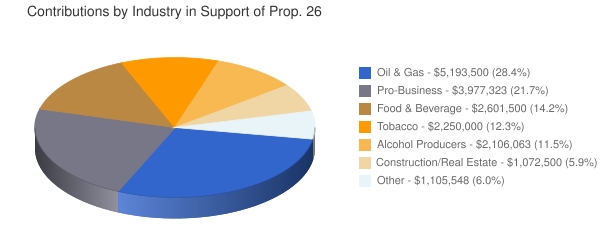
Image credit: MapLight.org
–
Top Contributors in Opposition to Prop 26:
| Democratic State Central Committee of California | — | $1,326,674 |
| Thomas F. Steyer | — | $1,000,000 |
| League of Conservation Voters (Prop. 23 Committee) | — | $900,000 |
| California Teachers Association | — | $505,050 |
| California State Council of Service Employees | — | $500,000 |
| John Doerr | — | $400,000 |
| Ella Baker Center | — | $350,000 |
| SCOPE S.I. | — | $250,000 |
| A.L.L.E.R.T. | — | $200,000 |
| California Public Securities Association | — | $150,000 |
| State Building and Construction Trades Council of California | — | $150,000 |
–

Image credit: MapLight.org
–
What is Prop 26?
From the Official Voter Information Guide:
REQUIRES THAT CERTAIN STATE AND LOCAL FEES BE APPROVED BY TWO-THIRDS VOTE.FEES INCLUDE THOSE THAT ADDRESS ADVERSE IMPACTS ON SOCIETY OR THE ENVIRONMENTCAUSED BY THE FEE-PAYER’S BUSINESS. INITIATIVE CONSTITUTIONAL AMENDMENT.
- Requires that certain state fees be approved by two-thirds vote of Legislature and certain local fees be approved by two-thirds of voters.
- Increases legislative vote requirement to two-thirds for certain tax measures, including those that do not result in a net increase in revenue, currently subject to majority vote.
Summary of Legislative Analyst’s Estimate of Net State and Local Government Fiscal Impact:
- Decreased state and local government revenues and spending due to the higher approval requirements for new revenues. The amount of the decrease would depend on future decisions by governing bodies and voters, but over time could total up to billions of dollars annually.
- Additional state fiscal effects from repealing recent fee and tax laws: (1) increased transportation program spending and increased General Fund costs of $1 billion annually, and (2) unknown potential decrease in state revenues.
–
Why does Prop 26 matter?
According to the Natural Resources Defense Council:
Proposition 26 is another disastrous measure for California’s environment, public health and local communities. It would eliminate the ability of a majority of the legislature to enact fees on industries that pollute our air and water and endanger our health. Currently, a simple majority vote can enact a fee (used to remedy a specific harm), but a tax (used for general purposes) requires a two-thirds vote. Prop 26 would make it much harder to ensure that polluters are held accountable for the harm caused by their activity. But Prop 26 goes farther – it also dictates what local governments should do by requiring cities and counties to run costly elections and reach a 2/3 majority to enact a fee. Prop 26 would make it nearly impossible for local communities to deal with issues like traffic and public safety for large events and would shift the burden to taxpayers for cleaning up hazardous waste and other pollution. A broad coalition of environmental and health groups, local governments, civic organizations and public safety professionals have come together to defeat this initiative.
According to the supporters of Prop 26:
State and local politicians routinely circumvent the state Constitution’s requirements by disguising taxes as fees because fees are easier to pass than tax increases. At the state level, the Legislature calls many taxes “fees” so they can pass or increase the tax with a bare majority vote – not the two-thirds vote required for taxes. At the local level, politicians call taxes “fees” so they can avoid voters and our Constitutional right to vote on most tax increases… Prop. 26 will give voters more control to stop the politicians from using gimmicks to impose hidden taxes on California families just by calling them fees. No longer will the politicians be able to hide new or higher taxes under the name of a “fee” to try to get more taxpayer money with a bare majority vote of the Legislature – or without any public vote at all at the local level.
– – –
Significant adjustments to nearly 70 transit lines took effect today. According to the AC Transit website:
Significant changes include:
- Reducing frequency on 28 lines
- Starting service later in the morning and/or ending earlier in the evening on 18 lines
- Eliminating or operating shorter routes on weekends on four lines
- Reconfiguring service in some areas, including West Oakland/Emeryville, Lakeshore Ave./Grand Ave. in Oakland, Bay Farm Island in Alameda, and San Leandro
- Discontinuing service to Orinda BART and along Broadway Terrace in Oakland
- Adding extensions to two lines to replace limited service in Piedmont, and service between Alameda and the Oakland Airport
All changes are listed in detail on the AC Transit website here.
– – –
The Fresno Bee reports that the EPA is awarding $127 million to California’s Department of Public Health and another $147 million to the State Water Resources Control Board.
The agency said at least 20 percent of the money must be used to fun so-called “green” infrastructure projects that improve water conservation, energy efficiency and environmental projects.
The two agencies will be responsible for awarding dozens of grants or low-interest loans to cities throughout the state for new sewers and drinking water facility upgrades.
Read the entire story here.
– – –
Via the New York Times:
Citing figures from the California secretary of state, Maplight.org reports that Bill Gates has donated $700,000 to the campaign against Proposition 23, the ballot measure that would repeal a California law related to reining in global warming. According to Maplight’s list, that would make him the 11th-biggest contributor to the opposition effort to date.
The story is here.
– – –
 Zero Resource

