PACE Programs Here, and Gone

1

This post is part of our ongoing focus on energy, water, waste and transportation issues relevant to California at large.

– – –

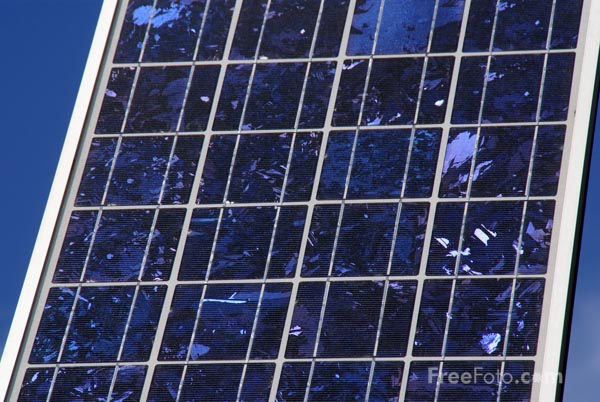
photo credit: free foto.com

Property Assessed Clean Energy (PACE) programs are being quickly halted due to a recent announcement by the Federal Housing Finance Agency (FHFA) that declared the investments potentially unsafe for lenders. The new and upcoming PACE programs being piloted and planned by cities and counties around the country would offer homeowners bond-backed loans for solar and other energy efficiency upgrades to homes.

Under most terms, the PACE loan (which is attached to the house itself, like an assessment) would have first priority for repayment ahead of the mortgage. This repayment structure provoked a warning pronouncement from Fannie Mae and Freddie Mac last month. Now the FHFA has dealt another blow by also warning lenders that the programs could prove risky- effectively halting operations for the time being.

Read more coverage on the FHFA’s PACE announcement in:

The Bond Buyer, The Huffington Post, and Greentech Media.

AC Transit Cuts, part three

2

This post is part of our coverage on water, waste, energy and transportation issues of interest to the local Bay Area community.

Here is a check-in on the ongoing budget crisis within AC Transit, the East Bay’s bus system:

Despite months of negotiations and meetings, AC Transit and the union representing most of its workers,  the Amalgamated Transit Union (ATU), Local 192 have so far been unable to reach a mutually acceptable strategy to close the $56 million deficit facing the agency by the close of 2011.

June 30th represented a milestone in the negotiations- that was the day that the ATU’s previous contract terms expired. The process has nonetheless stagnated. AC Transit Director Greg Harper is quoted in the AC Transit News as commenting, “I think we are definitely at an impasse because the union has so far offered less than 50 percent of what is needed to close the budget deficit.”

The Agency is looking to recoup 8 to 9 percent of employment costs in the new contract. The grim financial scenario has already resulted in fee hikes for riders, service cuts, layoffs, and 5% salary cuts for the board of directors. With a 75% share of the operating budget being allocated to employee costs, the Board of Directors is maintaining that shortfalls cannot be met without some concessions from the union.

The declared impasse and revised terms of employment, effective July 18, have been laid out by the Board of Directors. It remains uncertain if a strike will be avoided.

Global Warming’s Six Americas

1

This post is part of an ongoing effort to discover, and provide a venue for, data collection , reports,  and metrics related to the topics of waste, water, energy and transportation.

A graph from the Global Warming’s Six Americas report

Global Warming’s Six Americas is a report released in May of 2009 by the George Mason University Center for Climate Change Communication, and Yale’s Project on Climate Change Communication,  illuminating American attitudes towards global climate change and climate change policy. The report has the stated premise that “Climate change public communication and engagement efforts must start with the fundamental recognition that people are different and have different psychological, cultural, and political reasons for acting – or not acting– to reduce greenhouse gas emissions”.

The group used data gathered during 2008 from an in-depth questionnaire to assess attitudes, concerns, perceptions, risk values, policy preferences and other identified survey dimensions, ultimately enumerating 6 common response types among Americans at large regarding issues related to global climate change.

The six “types” identified by the report are the Alarmed (18%), the Concerned (33%), the Cautious (19%) , the Disengaged (12%), the Doubtful (11%), and the Dismissive (7%). Each group corresponds to a distinct station on the spectrum of attitudes and responses cataloged by the researchers.

It never hurts to hear it again: with only 5% of the world’s population, America is yet responsible for 25% of greenhouse gas emissions (GGE)s. This, argues the report, is why understanding the diverse views of the American public on climate change is so crucial for and understanding our collective behaviors and for creating effective public education and policy messages.

Read the full “6 Americas” report here.

Problems for PACE Programs?

1

An article in the New York Times today highlights problems that may arise for Property Assessed Clean Energy programs (initiated here in Berkeley in 2008).  Fannie Mae and Freddie Mac have warned lenders that “an energy efficiency lien may not be senior to any mortgage delivered” to the loan giants.

For at least one home in California, the lenders refused to approve a loan for the purchase of a home with heating and cooling systems financed through a program in Sonoma County.  The property tax assessment that was to cover the cost of the systems had to paid off before the lenders would issue a loan for the property.

The full New York Times article, with more information about PACE programs and implications for them and other property tax assessment programs, is here.

More information about PACE programs can be found here.

Fast-Track Geothermal Project in Nevada


photo credit: freefoto.com

The Las Vegas Sun reports that the federal Bureau of Land Management just approved a fast-track geothermal project in Pershing County, Nevada. The company that proposed the project, Ormat Technologies, plans to build a 30 megawatt plant that covers about 13 square miles.

From the BLM announcement – “The BLM Fast-Track projects are those where the companies involved have demonstrated to the BLM that they have made sufficient progress to formally start the environmental review and public participation process. These projects could potentially be cleared by December 2010, thus making them eligible for economic stimulus funding under the American Recovery and Reinvestment Act of 2009. There are 34 national fast-track projects – 14 solar, 7 wind, 6 geothermal, and 7 transmission lines.”

A list of fast-track renewable energy projects can be found here on the BLM website.

Nevada currently has 11 geothermal plants, 3 of which are on Bureau of Land Management-managed public land.

San Francisco’s Smart Water Meters

1
                                                                                          water supply leak, Free Foto.com

San Francisco began to roll out its new ‘smart’ water meters to city residences this month. The new devices can accurately track water usage in real-time and the San Francisco Public Utilities Commission (SFPUC) plans to make personal water use data available to customers online. Other benefits include the streamlining of operations- meters communicate wirelessly, eliminating the need for house-to-house readings- and the early detection of system leaks and unusual usage surges.

The SFPUC will replace over 175,000 meters beginning with 5,000 this spring/summer,with an estimated install completion for the full number by 2012. The expectation is that the new meters will be able to assist individual and system-wide conservation efforts, increase response time for problems, and allow for a more accurate and refined fee structure.

California, as a drought-prone state, can stand to benefit greatly from increased water use data collection. As it stands today, water use is not uniformly tracked in all homes and businesses, nor is there any correlation between regional water scarcity and water service rates. While agriculture, industry and conveyance also play leading roles in the general water picture in the state, having accurate home and commercial usage data is a step forward, and can only be a benefit in creating sound management policies for this precious and scarce resource.

Environmental Impacts of the World Cup

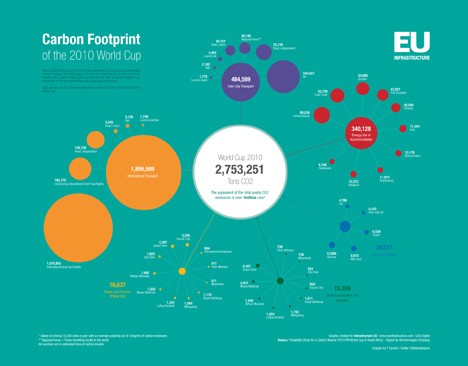
 Infographic by EU Infrastructure

As far as major international sporting events go, short of the Olympics, it doesn’t get much bigger than the World Cup. Massive international travel, infrastructure upgrades to accommodate the influx of visitors, building or renovation of stadiums, and the large amounts of waste generated by spectators are all part of the preparation and running of such a massive event.

This got us thinking, just how big is the carbon footprint of something like the World Cup? And what sorts of mitigation strategies are already in practice?

The answer to the carbon footprint question is: BIG. According to a pre-event study estimate by the South African Department of Environmental Affairs and Tourism in conjunction with the area Norwegian embassy, the carbon footprint for the event is 2.8 million tons. To quote Mike Berners-Lee, posting on the UK Guardian’s Green Living blog, “(that) is roughly equivalent to 6,000 space shuttle fights, three quiet years for Mount Etna, or 20 cheeseburgers for every man, woman and child in the UK.”

Levity aside, it is important to note that estimates of the impact vary widely, and what is important is to look at the overall pattern. Without question, the lion’s share of emissions are associated with athlete and spectator travel. This can make it hard for a more remote locale such as South Africa to remain competitively “green” compared to an event such as Germany’s 2006  World Cup event, which drew many of its participants via Europe’s centralized rail systems.

To the second question we posed, what are the best practices already in place for mega sporting events?

It is heartening to note that the problem of lessening impacts of major international sporting events is being taken seriously as a factor in weighing bids to host events. The bar was set by the the Local Organizing Committee (LOC) for the Lillehammer winter Olympic games in 1994, which incorporated sustainability dimensions in its planning. Incorporating sustainability concerns was then supported formally the International Olympic Committee (IOC) and has been a consideration of LOC’s at all subsequent Olympic games (Sebake & Gibberd, 2007). The bar was raised for the World Cup event by Germany’s 2006 LOC in partnership with the World Wildlife Fund and the Oko-Institut, who together developed a “Green Goal Initiative”.

Read More

World Cup 2010 Fun Fact:

SABMiller and Crown developed a full aperture beer can for the event that allows the patron to fully remove the lid and use the can as a drinking cup. This will cut down on the waste from plastic concession cups.
Noelle’s Links – Bay Area Edition

1

Interesting tidbits from my web travels…

The SF Chronicle’s Chip Johnson weighs in on a promising Oakland streetcar proposal from Stanford student Daniel Jacobsen. The proposed line would link Piedmont to the Jack London waterfront, creating a focused amenity for downtown Oakland. Jacobsen’s careful and well-researched proposal which he gave to the city as a gift, is based on a similar street car system in Portland. Jacobsen includes feasibility analyses, job creation projections and a funding strategy.

East Bay Local Alert: The Beehive Market, a brand new sustainable-focus community market kicked off on Saturday, June 12 in West Berkeley. The Beehive features local food and produce vendors, eco-fashion, home, and personal care, and even features local bands, and speaker/educational events. What better way to start the weekend?

Berkeley’s recent intimations that it will begin collecting a fee for curbside recycling has been receiving a fair amount of press lately. While it may seem like an ecological dis-incentive, it is important to celebrate the success that Berkeley’s recycling program has had and its influence on the creation of recycling programs around the country. It is actually good news that recycling in Berkeley can no longer be funded solely on fees for landfill garbage collection. As municipalities start to make progress toward their waste diversion targets, it is time to start making headway on new models for funding mechanisms; be prepared- it may take a few tries to get it right.

The Red Vic Movie House in SF will be screening the new documentary “Oceans” on Sunday June 20, and Monday June 21st. With all of the harrowing events still unfolding in the BP Gulf oil spill, now seems to be an especially important time to raise our awareness of the ocean and its inhabitants. The documentary provides extensive underwater imagery captured with state-of-the-art techniques, and also discusses the human impacts on the ocean’s vital ecosystems.

The Murkowski Resolution and the EPA

1

Republican Senator Lisa Murkowski of Alaska introduced a resolution seeking to disrupt the Environmental Protection Agency’s authority to regulate greenhouse gases.

The EPA Administrator, Lisa Jackson, wrote a response to the proposed resolution that was posted today at The Huffington Post.

The Senate vote was today – the resolution failed 53 – 47  according to the Associated Press.

The White House had threatened a veto if it reaches the President’s desk. The official Statement of Administration Policy is posted here.

Anna’s Links – E-Waste Recycling and Green Roofs

New York state passed the “Electronic Equipment Recycling and Reuse Act,” requiring that manufacturers accept and recycle many types of e-waste starting in April 2011 (soon!)- NY State Dept. of Environmental Conservation and NRDC.

Green roofs are now required for many new buildings in Copenhagen – Treehugger.

A lawyer has started a blog focusing on legal issues specifically related to green building, with many recent posts focusing on the LEED rating system and the USGBC – Green Building Law Update.