Upcoming Events

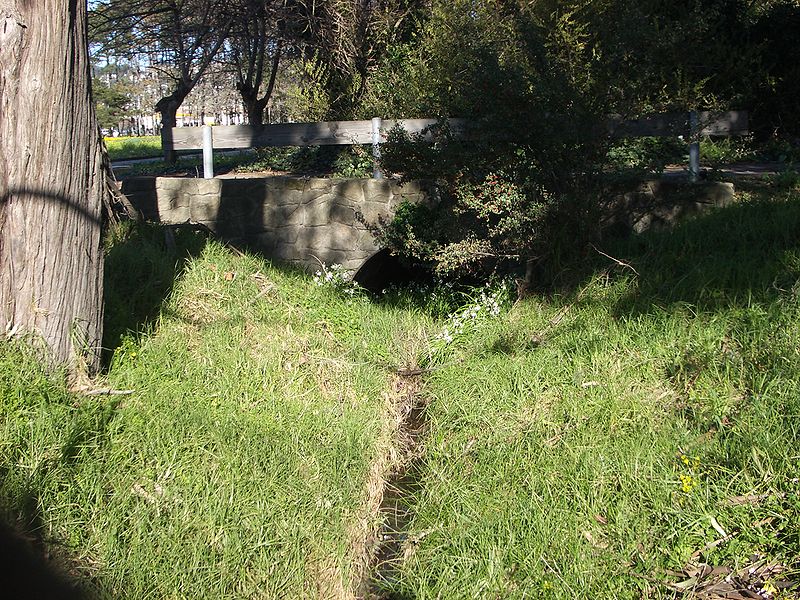
Daylighted  Marin Creek (Village Creek) as it flows through U.C. Village (Image credit: Wikimedia Commons)

– – –

Tonight:

Is Urban Stream Restoration Possible?

Ann L. Riley will present case studies from urban stream restoration projects. Riley serves as the advisor on watershed and river restoration for the San Francisco Bay Regional Water Quality Control Board and is the Executive Director of the Waterways Restoration Institute.

When: Wednesday, November 17, 7 p.m.

Where: Dimond Library, 3565 Fruitvale Ave. (cross street MacArthur), Oakland, CA

– – –

Net Impact San Francisco: Climate Change Policy Update – Looking forward to the next decade globally and locally

Net Impact SF’s professional chapter’s final meeting of 2010 will focus on the status and trajectories of national, international and local policy around climate change.

When: Tuesday, December 14, 7 – 9 p.m.

Where: TBD – More details here.

– – –

Compostmodern ’11 : Fertile Ground for Designing a Sustainable Future

Compostmodern is a two-day event at the interface of sustainable product design and industry to solve pressing sustainability and ecological  problems.   “Compostmodern engages designers, sustainability professionals, artists and entrepreneurs to collaborate in realizing a more environmentally, culturally and economically sustainable world.”

When: January 22 – 23, 2011

Where:  Day 1 – Herbst Theatre, 401 Van Ness Ave at McAllister St., San Francisco, CA

Day 2 – The Academy of Art, 79 New Montgomery between Market and Mission Streets, San Francisco, CA

Early bird rates until November 30. More info here.

– – –

New LEED Draft Open for Comment

1

Image Credit: USGBC

The first public comment draft of LEED is out for review. Comments are due by December 31, 2010.

This review period includes a revision of all of the LEED rating systems together, including New Design & Construction, Operations & Maintenance, Homes, and Neighborhood Development.

The drafts can be downloaded from the USGBC website here.

– – –

BuildingGreen.org has a summary of New Design & Construction changes and highlights major changes in each category:

USGBC released the draft to EBN just before the public comment period was to open. Our analysis of what’s (mostly) the same, what’s different, and what’s totally new follows. We focused our analysis on the LEED for New Construction (LEED-NC) rating system, but readers should see the rating system draft for all the rating systems, including details on LEED-NC that we didn’t have space to discuss.

You can see the changes for each category and read the entire article here.

– – –

For The Truly Nerdy – An ASHRAE Download

2

So, yes, I have to out myself as one of the truly nerdy…

– – –

Image credit: ASHRAE

From the ASHRAE website:

To promote energy efficiency, ASHRAE and the US Department of Energy are making Standard 90.1-2007 (I-P Edition) available for free download.

Standard 90.1 has been a benchmark for commercial building energy codes for over 35 years. It is an indispensable reference for engineers and other professionals involved in the design of buildings and building systems. The 2007 edition serves as the basis of many building codes.

You can download the free pdf document here.

– – –

For those that like to know what acronyms mean, ASHRAE stands for the American Society of Heating, Refrigerating, and Air-Conditioning Engineers. Their motto is now “Advancing HVAC&R to serve humanity and promote a sustainable world.” A cool bunch of very nerdy engineers – you can find out more about the organization here.

I would also like to add that ASHRAE is very generous with their support of students interested in buildings and energy.

– – –

Free Event 11/9 in SF – Energy Modeling

2
– – –
The SF AIA Committee on the Environment (COTE) presents:

Energy Modeling for the Small and Midsize Architecture Firm

November 9, 2010 –  6:00 – 8:00 pm

AIA San Francisco, 130 Sutter Street, Suite 600

With the development of LEED and other energy efficiency standards, energy simulation has developed tremendously over the last decade. It is becoming imperative that architects better understand the available tools so that they can make informed decisions throughout the design process. Given the complexity of energy modeling, this session will focus on how architects in small and mid-size firm can best use energy simulation. What types of questions should be answered with energy models? What types of energy modeling information is most useful, and when during design should it be used? What simulation tools are favored among small and mid-size firms? How do they develop expertise within their design teams and address budgetary constraints? A panel of Bay Area architects and designers, all of whom are noted for advances in sustainable design, will address these questions. Following the panel discussion, the presenters will be available for an extended question-and-answer session.

MODERATOR:

Claire Maxfield

PANELISTS:

Philip Banta, Charlie Stott, David Scheer, & Stet Sanborn

For more information and moderator and panelist bios, see the AIA SF event site, here.

This is a FREE event.

– – –

Regional Bike Sharing in the Bay Area

2

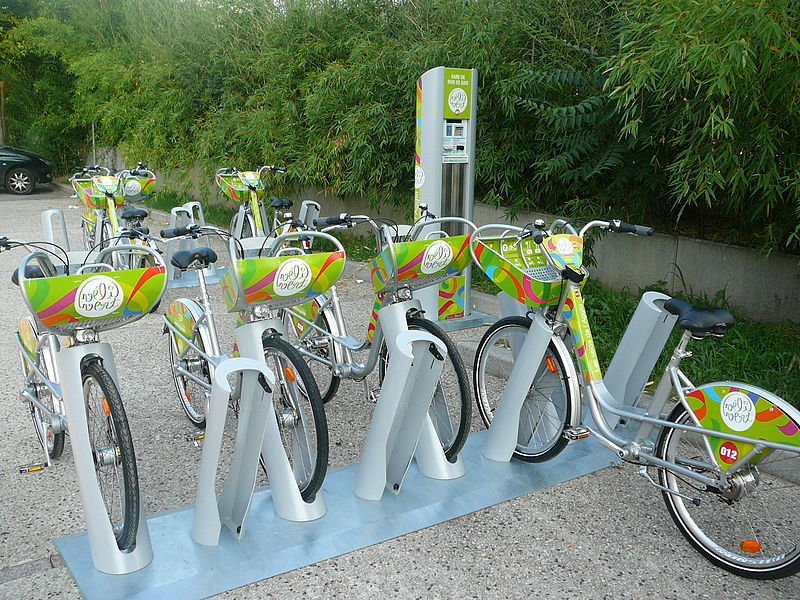
photo: a bike sharing system in the St. Etienne metro region wikimedia commons

Regional transit authorities have recently announced that they will go ahead with a new bike sharing program slated to start next year and  attributed as the first of-its-kind regional effort at a comprehensive bike sharing program in the nation.

The pilot program will put 1,000 new bikes on the road, and up to 100 kiosks around the Bay Area, with approximately half the amount being placed within the City of  San Francisco, and the other half being placed along the peninsula transportation corridor that includes Redwood City, Mountain View, Palo Alto and San Jose.

With transportation accounting for more than half of the air pollution in the Bay Area (SFMTA), the bike share project aims to reduce the number of vehicle miles traveled by encouraging people to increase bike travel for short trips in dense urban and downtown areas.

The Metropolitan Transit Commission (MTC) has approved an initial $4.29 million grant for the estimated $7 million project, that will be managed by the Bay Area Air Quality Management District (BAAQMD) and facilitated by a regional partnership between BAAQMD, SFMTA, SamTrans, Santa Clara Valley Transit Authority, San Mateo County and Redwood City. The participating jurisdictions and transit agencies will also contribute to the funding of the program.

When rolled out, the bike system will require users to buy a yearlong subscription and will utilize smart cards, GPS tracking and wireless technologies.

Read more:

San Francisco Bike Sharing Moves Ahead with Regional Plan and Funding: MTC grant to area partnership moves SFMTA plan forward, San Francisco Metropolitan Transit Authority(SFMTA) press release

Bike sharing project expected to begin next year, SF Chronicle

Bay Area maps out bike sharing effort, New York Times Green blog

Upcoming Webinars

I just want to remind folks that we have launched a “Webinars” page to feature interesting online presentations. You can navigate to the Webinars page using links at the right side of the blog.

– – –

November 10, 2010 (Wednesday)

Pacific Energy Center: “Chris Hammer – What’s Behavior Got To Do With Energy Efficiency?”

6:30 pm – 8:00 pm

We often look to technology to capture energy savings. What about the behavior of individuals in the home and workplace? Chris Hammer will describe occupant actions that save energy, discuss social science research on behavior and energy, and review case studies of organizations that implemented behavior change programs.

Free event. For more info and links to register here.

– – –

November 18, 2010 (Thursday)

Build It Green: “Passive House – A Sustainable Building Revolution in California”

11:00 am – 12:30 pm

Expectations for building occupant comfort, health and efficiency are increasing simultaneously. The Passive House standard meets all of these requirements at once. By producing buildings with energy demands that can be met at a renewable scale of production, Passive House can future-proof our communities and put California on track to meet our greeenhouse gas emission reduction targets. The future of building is here!An in-depth look at the Passive House standard by the leading local experts in the field, this webinar will:

  • Detail current retrofit and new construction Passive House projects and approaches in the Bay Area
  • Retrofit lessons learned and phased approaches
  • Illustrate how Passive House meets or exceeds the California Energy Efficiency Strategic Plan, and makes net-zero and energy-positive buildings feasible TODAY in the most cost-effective way possible
  • Explore how the Passive House standard can integrate with and enhance GPR and other green building rating systems.

Free for Build It Green members, $10 for non-members – more info and links to register here.

– – –

Election Day 2010 – Go Vote!

3

So… it’s finally Election Day 2010. There are a couple propositions on the California ballot – Prop 23 and Prop 26 – that have implications for energy and transportation policy. Statewide ballot measures just need a majority to pass.

Image credit: Wikimedia Commons

– – –

Proposition 23

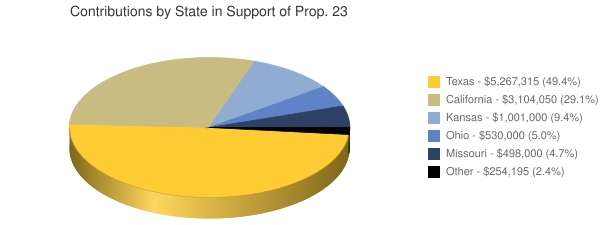
Who is funding Prop 23?

According to MapLight.org:

Total Contributions in Support of Prop 23: $10,654,560

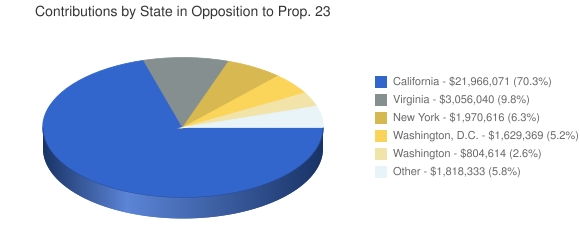
Total Contributions in Opposition to Prop 23: $31,245,543

Top Contributors in Support of Prop 23:

Valero Services, Inc. $5,075,315
Tesoro Companies $2,040,637
Flint Hills Resources $1,000,000
Marathon Petroleum Company LLC $500,000
Adam Smith Foundation $498,000
Occidental Petroleum Corp. $300,000
Tower Energy Group $200,000
CVR Energy Inc. $150,000
Howard Jarvis Taxpayers Assoc. $102,568
National Petrochemical & Refiners Assoc. $100,000
World Oil Corp. $100,000

Image credit: MapLight.org

Top Contributors in Opposition to Prop 23:

Thomas Steyer & Kathryn Taylor $5,099,000
National Wildlife Federation $3,000,000
L. John & Ann Doerr $2,100,000
The League of Conservation Voters $1,250,000
Vinod Khosla $1,037,267
Gordon Moore $1,000,000
James Cameron $1,000,000
Robert J. Fisher $1,000,000
ClimateWorks Foundation $900,000
Sierra Club $855,890
The Nature Conservancy $800,000
Bill Gates $700,000
Claire Perry $500,000
Green Tech Action Fund $500,000
John P. Morgridge $500,000
Julian H. Robertson Jr. $500,000
Pacific Gas & Electric $500,000
Wendy Schmidt $500,000

Image credit: MapLight.org

What is Prop 23?

From the Official Voter Information Guide:

SUSPENDS IMPLEMENTATION OF AIR POLLUTION CONTROL LAW (AB 32) REQUIRING MAJOR SOURCES OF EMISSIONS TO REPORT AND REDUCE GREENHOUSE GAS EMISSIONS THAT CAUSE GLOBAL WARMING, UNTIL UNEMPLOYMENT DROPS TO 5.5 PERCENT OR LESS FOR FULL YEAR. INITIATIVE STATUTE.

  • Suspends State law that requires greenhouse gas emissions be reduced to 1990 levels by 2020, until California’s unemployment drops to 5.5 percent or less for four consecutive quarters.
  • Suspends comprehensive greenhouse-gas-reduction program that includes increased renewable energy and cleaner fuel requirements, and mandatory emissions reporting and fee requirements for major emissions sources such as power plants and oil refineries.

Summary of Legislative Analyst’s Estimate of Net State and Local Government Fiscal Impact:

  • The suspension of AB 32 could result in a modest net increase in overall economic activity in the state. In this event, there would be an unknown but potentially significant net increase in state and local government revenues.
  • Potential loss of a new source of state revenues from the auctioning of emission allowances by state government to certain businesses that would pay for these allowances, by suspending the future implementation of cap-and-trade regulations.
  • Lower energy costs for state and local governments than otherwise.

Why does Prop 23 matter?

According to the Natural Resources Defense Council:

Proposition 23 would stop progress on curbing global warming emissions and transitioning to clean energy by “suspending” California’s landmark law, AB 32, until unemployment is below 5.5 percent for four consecutive quarters.  This unemployment threshold has only been reached 3 times in the past forty years.  Prop 23 would pull the rug out from the one sector of our economy that is actually growing – clean technology and clean energy – and create loads of uncertainty for businesses that have already made investments and are looking to expand.

According to the supporters of Prop 23:

We all want to do our part for global warming, but implementing our current plan is not the way to go. Families and businesses simply cannot afford to pay fifty percent or more in higher electricity and utility costs, and even more at the gas pump. A Yes vote on Proposition 23 temporarily postpones a new, costly program until our economy stabilizes and people are back to work, making it easier for families to make ends meet.New rules, regulations, and fines are about to take effect under California’s Global Warming Solutions Act (AB 32), which will increase energy costs by billions of dollars and destroy more than a million jobs. Proposition 23 would suspend those new rules until the economy improves and unemployment drops.

– – –

Proposition 26

Who is funding Prop 26?

According to MapLight.org:

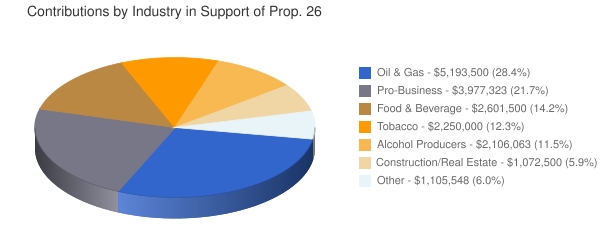
Total Contributions in Support of Prop 26: $18,306,433

Total Contributions in Opposition to Prop 26: $6,547,122

Top Contributors in Support of Prop 26:

California Chamber of Commerce $3,937,323
Chevron Corporation $3,750,000
American Beverage Association $2,450,000
Philip Morris USA Inc. * $2,250,000
Anheuser-Busch Companies, Inc. * $925,000
ConocoPhillips $525,000
Cypress Management Company, Inc. * $500,000
Howard Jarvis Taxpayers Association $432,948
Wine Institute * $381,093
Aera Energy LLC $350,000
MillerCoors $350,000

* Includes contributions from the Small Business Action Committee

Image credit: MapLight.org

Top Contributors in Opposition to Prop 26:

Democratic State Central Committee of California $1,326,674
Thomas F. Steyer $1,000,000
League of Conservation Voters (Prop. 23 Committee) $900,000
California Teachers Association $505,050
California State Council of Service Employees $500,000
John Doerr $400,000
Ella Baker Center $350,000
SCOPE S.I. $250,000
A.L.L.E.R.T. $200,000
California Public Securities Association $150,000
State Building and Construction Trades Council of California $150,000

Image credit: MapLight.org

What is Prop 26?

From the Official Voter Information Guide:

REQUIRES THAT CERTAIN STATE AND LOCAL FEES BE APPROVED BY TWO-THIRDS VOTE.FEES INCLUDE THOSE THAT ADDRESS ADVERSE IMPACTS ON SOCIETY OR THE ENVIRONMENTCAUSED BY THE FEE-PAYER’S BUSINESS. INITIATIVE CONSTITUTIONAL AMENDMENT.

  • Requires that certain state fees be approved by two-thirds vote of Legislature and certain local fees be approved by two-thirds of voters.
  • Increases legislative vote requirement to two-thirds for certain tax measures, including those that do not result in a net increase in revenue, currently subject to majority vote.

Summary of Legislative Analyst’s Estimate of Net State and Local Government Fiscal Impact:

  • Decreased state and local government revenues and spending due to the higher approval requirements for new revenues. The amount of the decrease would depend on future decisions by governing bodies and voters, but over time could total up to billions of dollars annually.
  • Additional state fiscal effects from repealing recent fee and tax laws: (1) increased transportation program spending and increased General Fund costs of $1 billion annually, and (2) unknown potential decrease in state revenues.

Why does Prop 26 matter?

According to the Natural Resources Defense Council:

Proposition 26 is another disastrous measure for California’s environment, public health and local communities.  It would eliminate the ability of a majority of the legislature to enact fees on industries that pollute our air and water and endanger our health.  Currently, a simple majority vote can enact a fee (used to remedy a specific harm), but a tax (used for general purposes) requires a two-thirds vote.  Prop 26 would make it much harder to ensure that polluters are held accountable for the harm caused by their activity.  But Prop 26 goes farther – it also dictates what local governments should do by requiring cities and counties to run costly elections and reach a 2/3 majority to enact a fee.  Prop 26 would make it nearly impossible for local communities to deal with issues like traffic and public safety for large events and would shift the burden to taxpayers for cleaning up hazardous waste and other pollution.  A broad coalition of environmental and health groups, local governments, civic organizations and public safety professionals have come together to defeat this initiative.

According to the supporters of Prop 26:

State and local politicians routinely circumvent the state Constitution’s requirements by disguising taxes as fees because fees are easier to pass than tax increases.  At the state level, the Legislature calls many taxes “fees” so they can pass or increase the tax with a bare majority vote – not the two-thirds vote required for taxes.  At the local level, politicians call taxes “fees” so they can avoid voters and our Constitutional right to vote on most tax increases… Prop. 26 will give voters more control to stop the politicians from using gimmicks to impose hidden taxes on California families just by calling them fees.  No longer will the politicians be able to hide new or higher taxes under the name of a “fee” to try to get more taxpayer money with a bare majority vote of the Legislature – or without any public vote at all at the local level.

– – –

Is the Grid Ready for Electric Cars?

2

photo: the Nissan Leaf

There has been a lot of excitement surrounding electric vehicles as the first “mainstream” fully electric vehicles (EV) are hitting the road with the promise of many new models coming down the pipeline in the coming years. But are electric cars a truly “green” solution, or will we be simply replacing one problem (fossil fuel dependence) for another one (increased electricity demand, not necessarily met by “clean” energy technologies)? And, importantly, can the American energy grid sustain a powerful new surge in demand?

Casting around for answers, I have assembled a few of the arguments from both the “worry” and “don’t worry” camps.

Worry

Grid stress could be felt on the local level if, for example, a single neighborhood has a high proportion of electric vehicles on one transformer and regular charging times are not sufficiently staggered or at off-peak hours.

– The only way to adequately manage supply-demand optimization is with smart grid technology that can communicate directly with vehicles and manage charging times. That widespread technology is still several to many years off.

– A 2007 Department of Energy Pacific Northwest National Lab (PNL) report found that even if smart grid technology were in place and charging regularly took place at off-peak hours, the nations energy infrastructure as it exists now could only accommodate a maximum 15% of vehicles being EVs.

Don’t Worry

The average age of cars on the road is nine years and going up.  Thus, it is unlikely that electric cars will hit the road en masse, but rather slowly integrate into the car stock, giving utilities time to prepare for increased demand.

-Incentives provided by utility companies can be enough encouragement to persuade most drivers to charge at off-peak hours in the years before smart grid technologies are widespread. Time-of-use plans can have substantially lower rates at off-peak hours.

– Experiments with “Vehicle to Grid” (V2G) technologies (in which Eletric Vehicles actually can store excess energy when demand is low and feed it back to the grid at peak hours) are already underway around the world, and could play a key role  in the grid of the future. See Journalist Dave Levithan’s article on the subject here.

– The U.S. Government has pledged $2 billion in grants for the manufacture of EV car batteries as well as a $400 million “downpayment” to jumpstart EV infrastructure.

Read more articles on electric cars and grid capacity here:

PHEVs: Will the Grid be Ready?, Matter Network

Can US Power Grid Handle Surge of Electric Cars?, Aol News

8 Myths About the Electric Car, Alt Transport

Is the Power Grid Ready for Electric Cars?, MSNBC Answer Desk

Ford Studying Ways to Charge Electric Vehicles, New York Times

Substandard Workmanship in Weatherization

2

The New York Times Green blog reports on a recent audit by the Department of Energy’s inspector general:

An audit by the inspector general focused on some work done by the Community and Economic Development Association of Cook County, one of 35 agencies in Illinois that are expected to share $91 million over three years. The audit looked at 15 homes and found that 12 failed final inspection “because of substandard workmanship.” In some cases, technicians who tuned up gas-fired heating systems did so improperly, so that they emitted carbon monoxide “at higher than acceptable levels.”

In eight cases, initial assessments of the houses and apartments called for “inappropriate weatherization measures.” In one case an inspector called for more attic insulation but ignored leaks in the roof, which would have ruined the insulation, the audit said. And for 10 homes, “contractors billed for labor charges that had not been incurred and for materials that had not been installed.’’

You can read the entire story here.

– – –

Cool Planet – Art Rosenfeld

4

In Berkeley, we are fortunate to have such events as Science at the Theater, where Lawrence Berkeley National Lab researchers give talks on their work at the Berkeley Repertory Theatre. The lectures are free and get a pretty sizeable audience.

On Monday, October 11, I was in the audience as researchers from Lawrence Berkeley National Laboratory (and the beloved Art Rosenfeld) gave a presentation titled “Cool Roofs, Cool Cities.” The post below consists of Part 4 of my record of the presentation – Art Rosenfeld gives an overview of how cool roofs and cool cities can leader to a cool planet. All portions are included in chronological order.

An ellipsis (…) indicates that I was not able to capture the words or thoughts skipped. The presentation is transcribed as accurately as possible – punctuation choices are mine. I also added any images.

– – –

I’m going to bring us into modern times and the question of global warming … Two thousand years ago, people tried to figure out how to keep houses cool, then a couple hundred years ago, we tried to figure out how to keep the cities cool, and now we’re trying to figure out how to keep the planet cool.

Taking a trip around the world … [looking at photos].

– – –
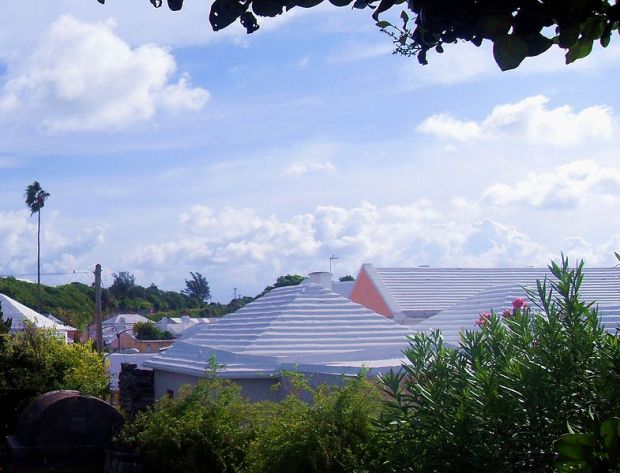
Image credit: Wikimedia Commons

In Bermuda, they use sloped white roofs to collect water.

– – –

Image credit: Wikimedia Commons

In Santorini, Greece, even the sides of the buildings are white.

– – –

Image credit: Wikimedia Commons

In Hyderabad, people like to sleep on the roof to be cool at night.

– – –

Here’s a Wal-Mart store in Northern California with white roof – they’ve done 4500 of their stores, and have 1500 to go.

– – –

Here’s an overview of UC Davis … Since 2005, the CEC Title 24 has required that if a roof is flat, cool roofs are required …

– – –
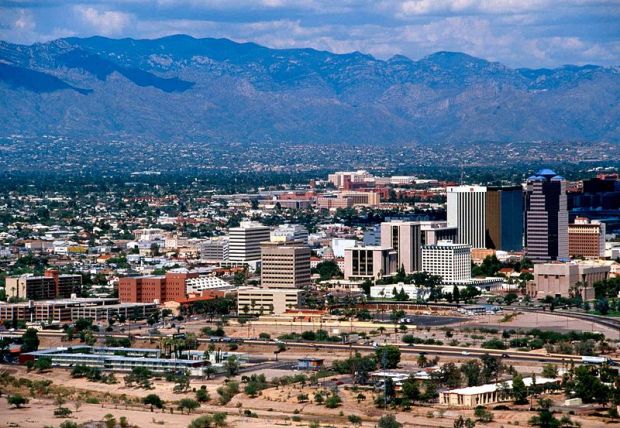
Image credit: Wikimedia Commons

Here’s the University of Tucson in the middle …  residential areas nearby also have white roofs … …

– – –

Here’s Washington, DC (federal) … The House and Senate office buildings do not have white roofs.

The most fun was this – this is the Pentagon. I went to a hilarious meeting – I got invited to give a talk at the Pentagon. There were innumerable generals and such around …

– – –

Now what about the Earth? … Part of what keeps the earth cool is ice and snow, which is decreasing in size … It would be nice to add some more white … …

Atmospheric climatologists have been aware of this issue for years, and back in the 1980s, Jim Hansen published a paper wondering whether cooling cities would make a difference – and he got an answer of about a 1/10th of a degree … But we weren’t so worried in those days … But we asked, maybe there’s a better way to sell this? … Look, carbon dioxide reflects heat, that’s called a positive radiation forcing onto the ground. And white roofs reflect heat … Carbon dioxide has a price … So we’ve got to do it per unit … 1000 square feet, winds up being about 10 tons of carbon. Suppose we multiply this by about 3 billion, since there are about 3 billion units of roof in cities, then avoid the heating effect of 25 billion tons of carbon dioxide…over the life of the roof. So let’s say 1 billion tons a year for 25 years … This winds up being 300 million cars off the road for 20 years … There are only about 600 million cars right now …

So what to do now? First, get other states to follow California… Arizona and Florida and Georgia have followed suit with cool roofs … The problem is a lot of the rest of the country, the hot part … the United States relies  on model building codes, and states are not required to adopt them. They can make them stronger and adopt them, but they are not required to adopt them. Texas doesn’t have any, the cities there have taken the lead …  DOE is going white, the Marine Corps is going white …

We’re going to launch a private club called 100 Cool Cities, with some DOE help, where were’ going to approach the 100 largest cities, which gets us  to a population of 200 million, where we’ll talk to them about cool roofs and try to get it into the building code … This will involve the Sierra Club, the Clinton Global Initiative, USGBC, ICLEI, the Energy Foundation, the Alliance for Climate Protection, ACEEE, and others …

Steve Chu will offer assistance to the first few countries to sign up to address this issue … …

So things are moving along nicely, and thank you very much.

– – –

Part 1 is posted here. Part 2 is posted here. Part 3 is posted here.

– – –