End Use

1

This post is part of our definitions series on “eco-lingo” and technical terms.

– – –

Studies frequently segment energy or water use by “end use”,  or the reason the energy was consumed, in order to better understand how the resource is used. For both energy and water, consumption is often first broken down by sector (commercial, residential, industrial) and then by end use (lighting, heating, etc.)

The first graph below is of California electricity use by sector. The second graph below is of California electricity use by sector AND by end use.

The end use categorizations in the graphs above are still pretty broad categories – some analyses break them down even further. The original data in the graphs comes from a CEC staff report. I used the same aggregate categories as Flex Your Power:

  • The Commercial Misc. category includes refrigeration, hot water, cooking, and office equipment.
  • The Residential Other category includes water heating, cooking, pool/spa, clothes washers, dishwashers, and freezers.
  • Industrial Process includes process fans, heating, pumping, and refrigeration.
  • Industrial Other includes material handling and processing.
  • The “Other” category includes street lighting and other government end uses.

– – –

What exactly does “sustainability” mean? How about “green”, “eco” or “environmentally friendly”? The truth is that these terms are just vague enough to mean many different things to many different people. With the staggering array of “green” products, ‘lifestyles’ and concepts being promoted by marketers and environmentalists alike (as well as the necessary coining of new terms to match new ideas) our definition series aims to make sense of the rising tide of “eco-lingo” and technical terms.

– – –

Patch-working the Grid

1

This Friday’s links highlight a few examples of global progress toward integrating cleaner energy into conventional energy grids.

Image credit: Wikimedia Commons

The New York Times reports on the impressive bump from 17% to nearly 45% renewable-source energy in Portugal’s grid over the past five years. However, the gain in cleaner energy has come at a hefty premium for consumers- take a look at how the Portuguese are balancing it all.

Visit Australia’s Clean Energy Council website and have a look at the interactive map of all clean energy plants over 100kW in operation.

Denmark’s official website cites 12 large scale solar operations in the country that add up to 20% of annual energy demand and offer flexibility within the national grid.

Lastly, read a discussion of progress toward integration of wind energy into European energy grids on the European Wind Energy Association’s website.

– – –

Major Appliance Efficiency Agreement

1

Image credit: Wikimedia Commons

A few days ago, appliance manufacturers and energy efficiency advocates announced an agreement to call for new national minimum efficiency standards to improve energy and water efficiency standards for refrigerators, freezers, clothes washers, clothes dryers, dishwashers, and room air conditioners. The coalition of major appliance manufacturers, their trade union, and the energy efficiency advocates propose that the new national minimum efficiency standards and tax credits be instituted through action by the Department of Energy and by Congress.

According to the press release, the recommended standards and tax credits would save more than 9 quads of energy over 30 years. The recommended water efficiency standards and tax credits for clothes washers and dishwashers would save about 5 trillion gallons of water over 30 years.

Below, I’ve put together a rough timeline of how the proposed standards would take effect:

  • January 2013 – dishwashers would see 14% energy savings and 23% water savings
  • January 2014 – new refrigerator and freezer energy reduced up to 30%
  • June 2014 – room air conditioners would increase in efficiency 10-15%
  • 2015 – top loading clothes washers would have 26% energy savings and 16% water saving compared to current standards
  • 2015 – front loading clothes washers would have 43% energy savings and 52% water savings compared to current standards
  • 2015 – clothes dryers will increase in efficiency 5%
  • 2018 – top loading clothes washers would have 37% energy and water saving compared to current standards

An overview of the agreement is here.

The agreement was signed by major appliance manufacturing members of the Association of Home Appliance Manufacturers (AHAM) and by major energy and water efficiency organizations, consumer groups and environmental organizations including the American Council for an Energy-Efficient Economy, Alliance for Water Efficiency, Alliance to Save Energy, Appliance Standards Awareness Project, Consumer Federation of America, National Consumer Law Center, Natural Resources Defense Council, Northwest Power and Conservation Council, and Northeast Energy Efficiency Partnerships.

Calls For A Third Party Smart Meter Study

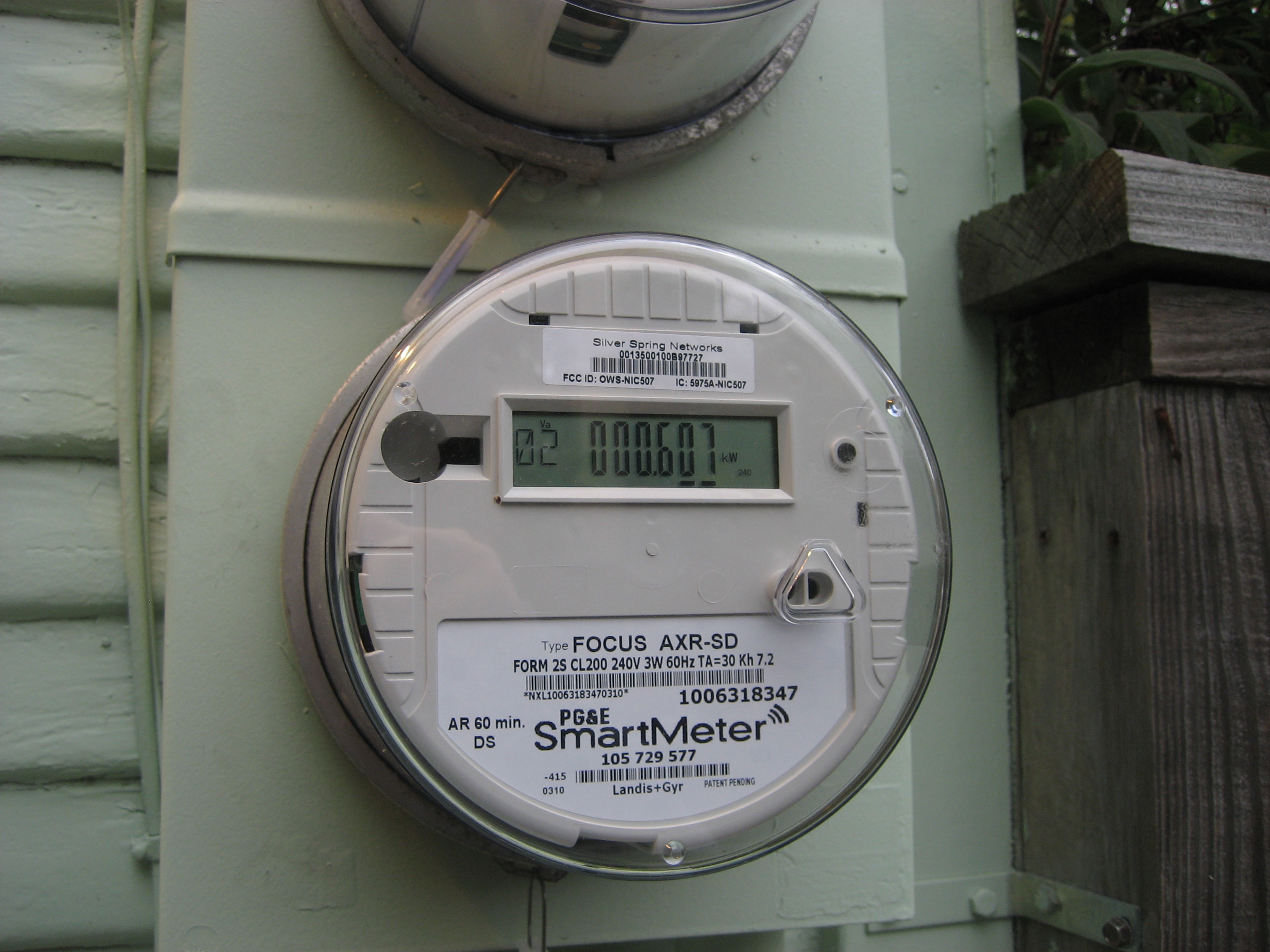
Pacific Gas and Electric Company has been facing a number of challenges in its attempts to roll out Smart Meter technology throughout California.  Advocates of the technology promote the meters as an essential component in realizing energy efficiency goals. Opponents have raised concerns about the accuracy and privacy of the meters and are increasingly raising concerns about public health and safety issues. The meters use wireless electromagnetic signals that provide real-time readings. Some customers complain that the new meters are causing them to be over-charged, yet it seems inevitable that there should be some discrepancy when moving from an older less precise system to a newer more responsive one.

However, the privacy and health and safety arguments represent much more complex and nuanced issues. The technology used by the meters is not much different than that used for cell phones or a myriad other everyday devices. However, under the current deployment of the meters, there is no ‘opt-out’ proviso, meaning that those who raise concerns over the meters are not left with a choice. Thus, it is not just a cut-and-dried matter of accuracy, but also a stickier problem of public perception, personal choice and the questioning of the adequacy of the Federal Communication Commissions’ safety standards by local communities. For example, it was widely reported this week the Town of Fairfax issued an emergency ordinance that will put a six month moratorium on the installation of the meters citing accuracy, privacy and safety concerns.

According to an article in the San Rafael Patch, San Rafael Assemblyman Jared Huffman who represents Marin and Southern Sonoma County (including the Town of Fairfax) has called for an independent review by the California Council on Science and Technology to determine the adequacy of FCC standards and provide more substantial science to the debate.  Huffman commented “If the FCC standards are deemed adequate, then the SmartMeter program can move forward with greater public confidence in the safety of the devices,” Huffman said.  “If the standards are inadequate, we need to know that so that we can get to work on better standards.”

Read more about Fairfax’s decision here, and listen to KQED’s coverage here.

California Proposition 23

Proposition 23 is the result of an initiative launched by Texas oil giants Valero Energy Inc. and Tesoro Corporation to postpone enforcement  of AB 32. The ballot initiative would delay enforcement until unemployment in California stays under 5.5% for an entire year. California unemployment is currently at about 12%.

Image source: Google Public Data

– – –

How do Californians feel about Prop 23?

The public: A poll by the Public Policy Institute of America this month indicates that 67% of California residents support AB 32 (via LA Times).

Governor Arnold Schwarzenegger:  “This initiative sponsored by greedy Texas oil companies would cripple California’s fastest-growing economic sector, reverse our renewable energy policy and decimate our environmental progress for the benefit of these oil companies’ profit margins” (via LA Times).

Republican Gubernatorial Candidate Meg Whitman: Whitman has not taken a formal stand on Prop 23. However, AB 32 authorizes a governor to delay some of the provisions for up to a year in the event of “threat of significant economic harm.” While campaigning for the Republican primary, Whitman stated that we would suspend AB 32 on her first day in office (via SF Chronicle).

Democratic Gubernatorial Candidate Jerry Brown: “Addressing  climate change is one of the great challenges of our time, something that California has been a leader on,” said Sterling Clifford, Brown’s campaign spokesman (via SF Chronicle).

– – –

The full text of Prop 23 is available here.

– – –

The Yes on Prop 23 campaign has filed suit against Attorney General Jerry Brown over the language that will go on the ballot to describe the proposition. The ballots of be printed in mid-August will say that the measure “Suspends Air Pollution Control Laws Requiring Major Polluters to Report and Reduce Greenhouse Gas Emissions That Cause Global Warming Until Unemployment Drops Below Specified Level for Full Year.” More information in the LA Times.

– – –

Reactions to the Stalled U.S. Climate Bill

1

This edition of Friday links is dedicated to headlines about the stalling of Senate passage of a comprehensive U.S. climate bill.

The Economist provides a thorough overview of the situation and its implications for legislation, industry and legal tussles for years to come, here.

An article in Reuters puts the issue into its global context, here.

From the U.K. Guardian, Eric Pooley asks Where next for the wrecked U.S. climate bill?

And finally, the Huffington Post has a page dedicated to the climate bill, related photos and breaking coverage.

– – –

As Climate Bill Falters, California is Crucial

1

AB32? Prop. 23? National climate bill? Keep it straight.

It seems that California is going to lead by example when it comes to climate change legislation in more ways than one. In 2006, California passed the historic Assembly Bill 32 (AB32), becoming the first state in the nation to address climate change broadly through a suite of emissions reductions and land use  regulation. Leading the charge, California’s legislation helped pave the way for the national climate bill. While the climate bill squeaked through the House of Representatives in the summer of 2009, the full bill was abandoned in the Senate this week, indefinitely. Because of an obvious lack of  Republican support to get the full bill through, Democrats offered a pared-down proposal on Tuesday. The new proposal has taken several distancing steps from a comprehensive “global warming bill”, and has the significant raising of a $75 million liability cap on oil spill damages as its focal point. With the aim of ushering the slimmed-down bill through before the August recess, its passage appears tenuous.

Meanwhile, California’s climate legislation, AB32 is meeting with similar opposition that will come to a head in the form of Proposition 23 on the November ballot that would effectively halt the implementation of AB32. How California reacts to the challenge will likely prove to the testing ground for climate change policy nationwide, for years to come.

We will be following this issue very closely, as well as the progress of local Bay Area implementation of AB32.

Visualizing the U.S. Power Grid

2

Source: NPR’s Power Hungry: Reinventing the U.S. Electric Grid series

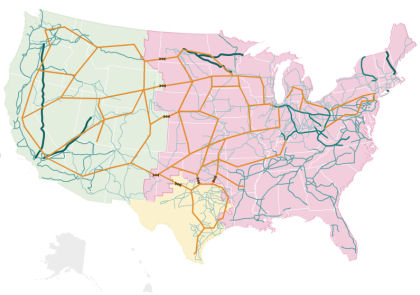
National Public Radio produced an intriguing series in April and May of 2009 called “Power Hungry: Reinventing the U.S. Electric Grid“.  The series looked at the structural make-up of power conveyance in the U.S.-and the need for it to get ‘smarter’ about controlling and tracking consumption patterns- and, at the growing pains of the newer energy industries such as wind and solar, and how to get them online to more Americans.

But the real star of the show for us map fans is the great interactive map, pictured above. The map illustrates the three discrete “grids” that make up the U.S. power network: Western, Eastern and Texas. The map also includes existing and proposed lines,power source ratios for each state (coal, hydro, etc.) and the distribution of wind and solar plants. See the full interactive map here.

– – –

Bay Area Public Meeting to Set SB375 Targets

Photographer: Manfred Werner Tsui at de.wikipedia.org

Passed in 2008, SB 375 is the nation’s first law to link greenhouse gas emissions with urban sprawl.  The thrust of AB 375 is to require not only emissions reduction targets, but also to require land use planning strategies and interagency collaboration in the process. In practice, this requires each region in the state to adopt a Sustainable Communities Strategy, or SCS, that is in line with regional emissions targets set by regional Air Resource Boards.

As SB 375 moves foward in its implementation, the time has come this August for the ARBs to annouce their emissions targets.

The California Air Resources Board has been holding workshops throughout California this month to accept public comment on the draft regional targets for reducing greenhouse gas emissions (GHG) from cars and light trucks.  The public comments will be taken into consideration before the Metro Planning Organizations (MPOs) announce their proposed targets in August. On Wednesday, July 21, the Bay Area gets to put in its two cents. The meeting information is as follows:

July 21, 2010     10:30 a.m. to 1:30 p.m

Caltrans Oakland Building, Auditorium, 111 Grand Ave, Oakland, CA 94612

For those unable to attend, the meeting will be webcast.

For more information on Senate Bill 375, see Urban Land Institute’s Summary and Key Findings report here, and the Governor’s Office factsheet here.

A list of all of the California ARB meetings in July can be found here.

– – –

What’s Next for California Solar?

photo source:  www.energy.ca.gov/sitingcases/abengoa/index.html

No one seems to dispute that solar technology will play an increasingly important role in transitioning away from fossil fuel dependence. But what is less clear is how solar tech will be deployed, and how fast. Is the market for single-point residential solar really ready to take off, or will it be large-scale solar fields? What can we learn from other countries that have had a longer history of serious solar initiatives (and will the U.S. commit to catching up)?

And although California is leading the charge in residential solar with innovative funding mechanisms like PACE – the Property Assessed Clean Energy model developed in Berkeley and influential in the planning of similar clean energy and efficiency programs around the country- the regulatory landscape under which these programs would operate remains uncertain at best.

This week’s links unearth information on the issues affecting California’s solar future from around the web:

Start with the July 15 broadcast of Forum from KQED Radio. This broadcast is a “Solar Panel”  discussion featuring Danny Kennedy of  Berkeley-based residential solar installation company Sungevity, Eicke Weber, director of the Fraunhofer Institute for Solar Energy Systems in Germany, U.C. Berkeley Professor and co-director of The Energy Institute, Severin Borenstein, and news reporter Todd Woody.

Next up, visit the California Energy Commission and California Public Utilities Commission’s “Go Solar California” website, urging CA residents to jump on the solar bandwagon.

Think the hot plains of the Mojave Desert are a great place for a giant solar farm? Many people do, but the “empty” desert is still home to ecosystems that need consideration- check out NPR’s coverage on how the plans are shaping up here.

Finally, we here at Zero Resource will be keeping up with the PACE debate, and you can too, by checking out the latest headlines- including the breaking news of Attorney General Jerry Brown’s lawsuit against Freddie Mac and Fannie May over delays to the program:

AG Brown sues feds over slowed solar PACE – San Jose Business Journal

California Sues Federal Mortgage Giants to Save Clean Energy Program – On Earth Magazine

California Sues Fannie, Freddie, Regulator over PACE program – NASDAQ

– – –