Finding Local Stimulus Projects

1

Recently while driving around Northern California, I’ve seen a number of signs saying “This project is supported by ARRA funds.” And I started wondering where all the local projects were. It turns out that if you go to Recovery.Gov, there is a map (here) where you can search by state or zip code to find nearby ARRA projects, as that information has been reported by the recipient of the funds.

photo credit: recovery.gov

You can click on each dot to get information about the organization and amount awarded.

You can see summaries by state (see California here) for different categories – by zip code, by top recipients, by top infrastructure projects, top congressional districts, by the funding federal agency, and by the jobs reported created.

AC Transit Cuts, part three

2

This post is part of our coverage on water, waste, energy and transportation issues of interest to the local Bay Area community.

Here is a check-in on the ongoing budget crisis within AC Transit, the East Bay’s bus system:

Despite months of negotiations and meetings, AC Transit and the union representing most of its workers,  the Amalgamated Transit Union (ATU), Local 192 have so far been unable to reach a mutually acceptable strategy to close the $56 million deficit facing the agency by the close of 2011.

June 30th represented a milestone in the negotiations- that was the day that the ATU’s previous contract terms expired. The process has nonetheless stagnated. AC Transit Director Greg Harper is quoted in the AC Transit News as commenting, “I think we are definitely at an impasse because the union has so far offered less than 50 percent of what is needed to close the budget deficit.”

The Agency is looking to recoup 8 to 9 percent of employment costs in the new contract. The grim financial scenario has already resulted in fee hikes for riders, service cuts, layoffs, and 5% salary cuts for the board of directors. With a 75% share of the operating budget being allocated to employee costs, the Board of Directors is maintaining that shortfalls cannot be met without some concessions from the union.

The declared impasse and revised terms of employment, effective July 18, have been laid out by the Board of Directors. It remains uncertain if a strike will be avoided.

Global Warming’s Six Americas

1

This post is part of an ongoing effort to discover, and provide a venue for, data collection , reports,  and metrics related to the topics of waste, water, energy and transportation.

A graph from the Global Warming’s Six Americas report

Global Warming’s Six Americas is a report released in May of 2009 by the George Mason University Center for Climate Change Communication, and Yale’s Project on Climate Change Communication,  illuminating American attitudes towards global climate change and climate change policy. The report has the stated premise that “Climate change public communication and engagement efforts must start with the fundamental recognition that people are different and have different psychological, cultural, and political reasons for acting – or not acting– to reduce greenhouse gas emissions”.

The group used data gathered during 2008 from an in-depth questionnaire to assess attitudes, concerns, perceptions, risk values, policy preferences and other identified survey dimensions, ultimately enumerating 6 common response types among Americans at large regarding issues related to global climate change.

The six “types” identified by the report are the Alarmed (18%), the Concerned (33%), the Cautious (19%) , the Disengaged (12%), the Doubtful (11%), and the Dismissive (7%). Each group corresponds to a distinct station on the spectrum of attitudes and responses cataloged by the researchers.

It never hurts to hear it again: with only 5% of the world’s population, America is yet responsible for 25% of greenhouse gas emissions (GGE)s. This, argues the report, is why understanding the diverse views of the American public on climate change is so crucial for and understanding our collective behaviors and for creating effective public education and policy messages.

Read the full “6 Americas” report here.

Environmental Impacts of the World Cup

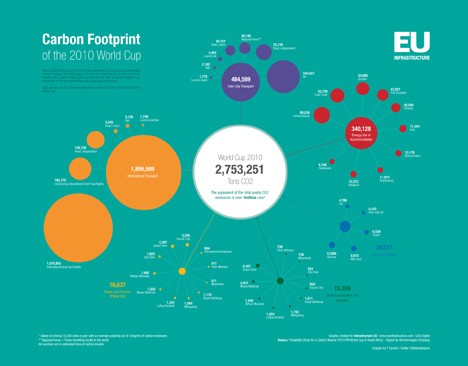
 Infographic by EU Infrastructure

As far as major international sporting events go, short of the Olympics, it doesn’t get much bigger than the World Cup. Massive international travel, infrastructure upgrades to accommodate the influx of visitors, building or renovation of stadiums, and the large amounts of waste generated by spectators are all part of the preparation and running of such a massive event.

This got us thinking, just how big is the carbon footprint of something like the World Cup? And what sorts of mitigation strategies are already in practice?

The answer to the carbon footprint question is: BIG. According to a pre-event study estimate by the South African Department of Environmental Affairs and Tourism in conjunction with the area Norwegian embassy, the carbon footprint for the event is 2.8 million tons. To quote Mike Berners-Lee, posting on the UK Guardian’s Green Living blog, “(that) is roughly equivalent to 6,000 space shuttle fights, three quiet years for Mount Etna, or 20 cheeseburgers for every man, woman and child in the UK.”

Levity aside, it is important to note that estimates of the impact vary widely, and what is important is to look at the overall pattern. Without question, the lion’s share of emissions are associated with athlete and spectator travel. This can make it hard for a more remote locale such as South Africa to remain competitively “green” compared to an event such as Germany’s 2006  World Cup event, which drew many of its participants via Europe’s centralized rail systems.

To the second question we posed, what are the best practices already in place for mega sporting events?

It is heartening to note that the problem of lessening impacts of major international sporting events is being taken seriously as a factor in weighing bids to host events. The bar was set by the the Local Organizing Committee (LOC) for the Lillehammer winter Olympic games in 1994, which incorporated sustainability dimensions in its planning. Incorporating sustainability concerns was then supported formally the International Olympic Committee (IOC) and has been a consideration of LOC’s at all subsequent Olympic games (Sebake & Gibberd, 2007). The bar was raised for the World Cup event by Germany’s 2006 LOC in partnership with the World Wildlife Fund and the Oko-Institut, who together developed a “Green Goal Initiative”.

Read More

World Cup 2010 Fun Fact:

SABMiller and Crown developed a full aperture beer can for the event that allows the patron to fully remove the lid and use the can as a drinking cup. This will cut down on the waste from plastic concession cups.

Finding Data – The Greendex

1

photo link

For the third year running National Geographic has teamed up with Globe Scan to provide the Greendex, an annual survey designed “to develop an international research approach to measure and monitor consumer progress towards environmentally sustainable consumption.”  Specifically, the Greendex is a tool to help consumers worldwide to both understand their consumption patterns and to be able to view them within context to others.

The Greendex survey questions were designed to capture the participant’s knowledge, behavior and views on environmental issues and consumer habits ranging from transportation to food choices. The study is based on a sample of 17,000 individuals in 17 countries (14 in 2008). So, while perhaps not a truly  “definitive” study on a global scale, the Greendex survey countries represent the heaviest hitters in terms of resource consumption, and the Greendex 2010 Report provides some interesting insights.

Some notables from the study:

– Respondents from 10 of the 17 countries polled showed an increase in “environmentally friendly consumer behavior” between this year and last.

– Consumers with the highest rankings for “green” choices are in developing nations. Top scores go to India, Brazil and China (in that order).

– Uh-oh USA … we’re showing slight improvement relative to ourselves last year, but we’re still at the bottom of the heap.

– The strongest changes in personal behavior that made positive impacts were in the Housing category (home energy efficiency).

Read the highlights report here.

Calculate your own personal “Greendex” here.

And finally, how reliable are self-reported behavior surveys anyway? Separate the fact from fiction with the Market Basket report.

Current Events – AC Transit Cuts, part 2

2

Here is an update on the ongoing cuts to AC Transit service that I first reported on last week:

AC Transit is in trouble. Dire financial straits have forced the agency to consider enacting additional service cuts and the possible declaration of a fiscal emergency. Already adjusting to the 7 percent service cuts that went into effect at the end of March of this year, August is likely to bring an additional 8 percent less service, with more cuts in the pipeline if new funding sources are not found.

On May 26th, AC Transit held two public hearings, at 2 p.m. and 6 p.m. to solicit comments on three possible scenarios that could be rolled out in August.

Proposal one is to operate only trunk and major corridor services on the weekends;

Proposal two is to modify All Nighter and late-night services;

Proposal three is to distribute the reductions across all weekday, late-night and weekend services.

However, it is unlikely that any one scenario will be enacted in full, but rather some sort of amalgamation of the proposed cuts.
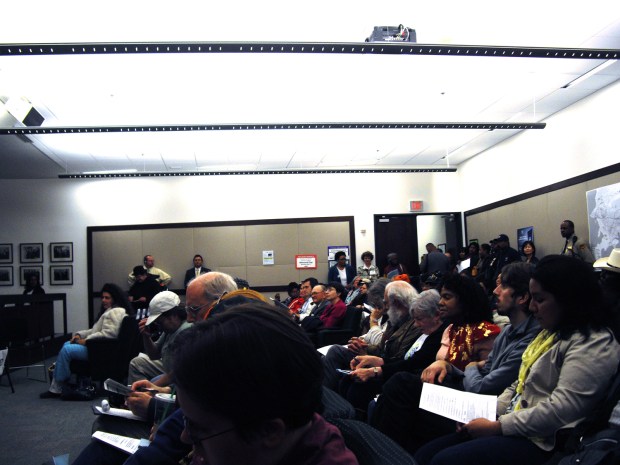
I attended the 6 p.m. public hearing and tensions were running high among those who came to speak out against the cuts. Time and again, concerned residents spoke of their fears about losing accessible transit. Many stated that they could not afford cars, or were seniors or disabled and could not walk or bike as an alternative. Some had moved to their residences specifically because they were accessible to bus routes- routes that are threatened under the new scenarios, either by reduction of service resulting in unreasonable wait times, or loss of service areas altogether.

While some expressed frustration with the board of directors, in truth these are deep and painful cuts that nobody wants to make and that will result in the continued erosion of the ridership base, further driving down revenues.

What can we, as informed and concerned citizens, do to try to recover the essential functions of the public service on which so many depend? we need to speak up if we want to keep our transit systems intact (or expanded). Transit is often at the bottom of the list because public outcry is greater on other issues; perhaps transit is seen as so fundamental that we take it as a given. What AC Transit is showing us, is that publicly funded transit is far from a given.

Contact your State Senator.

Editorial – AC Transit Service Cuts

1

*AC Transit is considering options for another 8% of service cuts (effective in August) to meet its budget. Public hearings and comment sessions on the new cuts will be held this Wednesday, May 26, 2p.m. and 6p.m. at 1600 Franklin Street in Oakland. We will be reporting on the new cuts next week.


Regular riders aware by now that several AC Transit lines underwent tweaks to schedules and routes at the end of March, most notably the split of the 51 line to “51A” and “51B” lines that terminate at the RockRidge BART station. Regular riders are also aware that public transit in the Bay Area has seen fare increases across the board in the past year. However, what many riders may not know is that most transit agencies only receive a fraction of their operating costs from cash fares. AC Transit for example, recoups less than 20 percent of its budget from cash fares. So, while it is true that fare rates have seen increases while services have declined, they do not even begin to touch the transit giant’s bottom line.

AC Transit’s pared down route system that went into effect at the end of March this year is just one manifestation of structural changes and deep cuts within the system. The statewide budget crisis has resulted in the loss of significant funding, mainly from State Transit Assistance (STA) grants. AC Transit’s baseline budget for FY 08/09 clocked in at $327 million and was on course to increase; Due to restructuring the FY 09/10 budget will be stripped back to $313.9 million and FY 10/11 is budgeted for $308.9 million.

In any very large organization there must be fat to be cut, and efficiency gains to be had. But why the withdrawal of millions of dollars of funding for public transit at a time when many are forced to scale back economically and possibly even give up their cars? AC Transit- and public transportation in the Bay Area in general- are not alone; major spending cuts for transit can be seen all across the country.

While giving up a car may be great for the planet, it can be a major liability for folks trying to stay mobile in areas of poor transit connectivity. Further, with extended wait times, curtailed hours and pared down routes, public transit may not win many converts-even among those who would like an alternative to driving. It was reported in the San Jose Mercury News that Bay Area public transit lost an estimated seven percent of its ridership within the past year, and the nation is not far behind with a six percent overall drop in public transit usage. This is the classic chicken and egg scenario: if ridership is down as the economy stagnates, funding will be down; If funding is down, service will be down; If service is down, ridership will be down, and so on. How we will restructure this ailing system remains to be seen.