Bay Watch

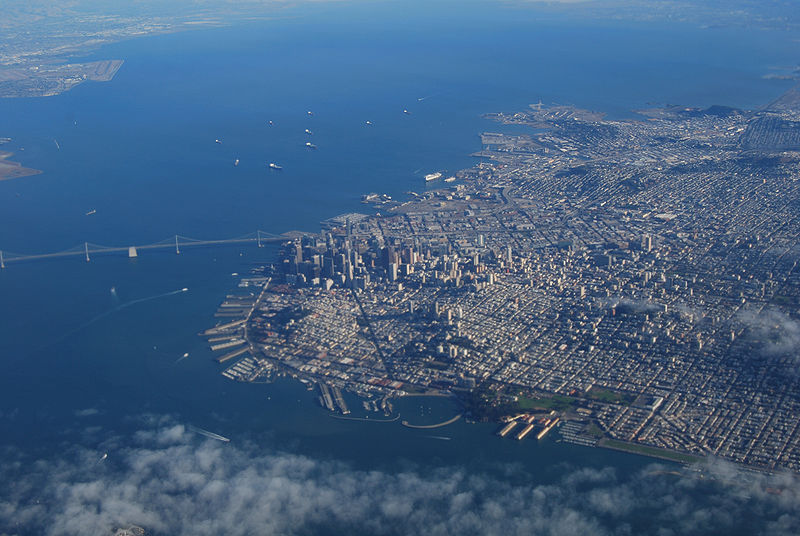
photo credit: Wing

The following are a few stories of interest tracking the latest developments in water quality for the San Francisco Bay region.

The S.F. Chronicle reports that a loophole in the laws protecting California’s coastal waters is finally being closed: sewage discharge from ships is now prohibited less than 3 miles from shore. The Chron reports that while many sea-going vessels have been voluntarily following this protocol for years, some even waiting until further off-shore, the new legislation will formalize the practice and help to address water quality issues along state beaches. Read the full story here.

Oakland’s splendid Lake Merritt is in for an overhaul. The 140 acre “lake” is actually a brackish tidal slough that is connected to the San Francisco Bay via a narrow channel. However for many years its waters have stagnated with inadequate connectivity to the Bay due to the deterioration of the channel. All that is about to change as the $115 million that was allocated to improve Lake Merritt  in 2002 as part of  Bond Measure DD to improve the lake finally hits the ground. The improvements to the lake will be chiefly through improving the connections between the bay and the lake, and the removal of a portion of 12th Street at the southern end of the lake. Read a thorough account of the project at Quest, here.

BCDC (the Bay Conservation and Development Commission) released it’s draft Subtidal Habitat Goals Project report this summer. The project represents a ” comprehensive and long-term management vision for research, restoration and management of the subtidal habitats of the San Francisco Bay”. Read the draft report here.

The Hidden Costs of California’s Water Supply

1

The Natural Resources Defense Council (NRDC) released a report in 2004 titled “Energy Down the Drain: The Hidden Costs of California’s Water Supply.” Especially in the western part of the United States, there is a tight connection between water and energy resources, as energy is needed to reliably treat and distribute water.

Because energy and water decision-making is often siloed, water planners are not generally taking into consideration the energy-related consequences of their planning.

The full report is available here as a pdf.

The authors carefully quantified the link between water and energy for three specific case studies – San Diego County’s future supply, the Westlands Water District, and the Columbia River basin (in the the Pacific Northwest). According to the report, the Westlands Water District is one of the largest agricultural users of water in the western United States.

The overarching message of the report is that decision makers should integrate energy issues in to water planning and decision-making. It also suggests a methodology for incorporating energy impacts into water planning.

The report contains numerous interesting tidbits:

  • “The more than 60,000 water systems and 15,000 wastewater systems in the United States are among the country’s largest energy consumers, using 75 billion kWh/year nationally – 3 percent of annual U.S. electricity consumption.”
  • “According to the Association of California Water Agencies, water agencies account for 7 percent of California’s energy consumption and 5 percent of the summer peak demand.”
  • “Ninety percent of all electricity used on farms is devoted to pumping groundwater for irrigation.”
  • “End use of water – especially energy intensive uses like washing clothes and taking showers – consumes more energy than any other part of the urban water conveyance and treatment cycle.”
  • “When water is diverted for irrigation before it reaches a dam, an enormous amount of energy – the foregone energy production – is lost.”

Why is DOE Regulating Showerheads?

2

Image credit: Wikimedia Commons

Why does the Department of Energy care what kind of showerhead you have? Well, unless you shower exclusively in cold water, the more water you use, the more energy is needed to heat that water.

The Energy Policy and Conservation Act of 1975 (EPCA) states that a showerhead manufactured after January 1, 1994, can deliver no more than 2.5 gallons per minute at a flowing water pressure of 80 pounds per square inch. However, the term “showerhead” was interpreted by manufacturers to be a device sending water over a bather. Each device was considered to count separately and  separately needed to meet the standard.

The draft interpretive rule published by the DOE clarifies that “a showerhead is any plumbing fitting that is designed to direct water onto a bather regardless of the shape, size, placement, or number of sprays or openings that it may have.”  All nozzles would need to jointly meet the 2.5 gallon per minute standard. This primarily will affect high-end showerheads that deliver much more than 2.5 gallons per minute.

The entire draft interpretive rule can be found on the DOE website here.

At this point, the DOE is planning enforcement actions only against the manufacturers of the offending showerheads. Some of the products that manufacturers have stopped selling as a result of letters from DOE include the “Shower Rose” from Grupo Helvex, which delivered 12 gallons a minute. The Plumbing-Heating-Cooling Contractors – National Association (PHCC-NA) is up in arms over the new interpretation of the definition and is trying to spin the new definition as having a negative impact on water conservation (though no reason is given in this article).

An article at BuildingGreen.com goes into more detail about reactions from plumbing manufacturers, the water conservation community, and the National Association of Home Builders (NAHB).

– – –

For readers in the East Bay, East Bay Municipal Utility District offers self-survey kits to help check flow rates and find leaks and free low-flow showerheads (2.0 gallons per minute).

Readers in San Francisco can schedule a free water use evaluation and free low-flow showerheads through the San Francisco Public Utilities Commission.

– – –

California – 20th in Beach Water Quality

1

photo credit: Alan Cleaver 2000

According to the National Resource Defense Council’s annual water quality report for the nation’s beaches, this year had the sixth highest levels of contamination in the 20 year history of the study. The NRDC reports that a range of causes are contributing to dirtier coastlines, including stormwater runoff and aging sanitation and combined sewer systems that may overflow into coastal waters during storm events.

Although contaminated waters can pass pathogens along to swimmers, the water tests currently employed take up to 24 hours to reveal problems, and so warranted beach closures are often delayed.

How does California fare in all of this? Of the 30 states with coastal waters, the cleanliness of California beaches rank at a sad #20. The top 3 polluted beaches include North Avalon beach in Los Angeles County where 82% of sampled water exceeded national pollution standards; Mendocino County’s Pudding Creek beach where 65% of samples exceeded national standards; and Poche County beach in Orange County that had an excessive pollution rate of 62%.  The county that received the dubious honor of  having the highest percentage of  beach water samples that  exceeded national pollution standards was San Francisco County at 17%. However, on a more positive note, the level of pollution in California beach water has trended downward in the last five years.

Read the report on California’s coastal waters, hereand the full Testing the Waters NRDC report, here.

New Water Magazine from Johns Hopkins

Johns Hopkins University’s Global Water Program has published its first issue of Global Water Magazine, which is available online here.

The magazine will focus the editorial pieces around six main themes: Water & Energy, Water & Food, Water & Health, Water in the Environment, Water Infrastructure, and Water Policy.

In the first issue, there are several articles that I think would be of interest to readers of this blog, listed below.

– – –

Imperatives for Urban Water Professionals on the Pathway to 2050 by Paul Reiter

Abstract: Looking forward to 2050, the challenges of adding 2 billion more people to an already resource-constrained planet will require major changes in the resources efficiency, energy efficiency and cost of urban water systems of the future. A step change including the integration of city planning and urban water system design will be required to optimize the efficiency and resilience of urban water systems in addition to the development of physical and institutional linkages between agricultural, energy and urban water uses.

– – –

The First Stop on the Road to Corporate Water Reporting: Measurement by Eva Zabey

Abstract: External demands on companies to report on their water use and impacts are intensifying. But before reporting, business needs to measure, and many groups are developing approaches to do just that.

– – –

The Energy-Water Nexus: Finding Solutions in the Balance by Jan Dell and Kathy Freas

Abstract: With uncertainties associated to climate change projections, companies and public utilities face a convergence of energy, water and carbon issues that are impacting their operations and planned projects in sectors and geographical regions.

– – –

NRDC Report on Climate Change, Water and Risk

Image: NRDC

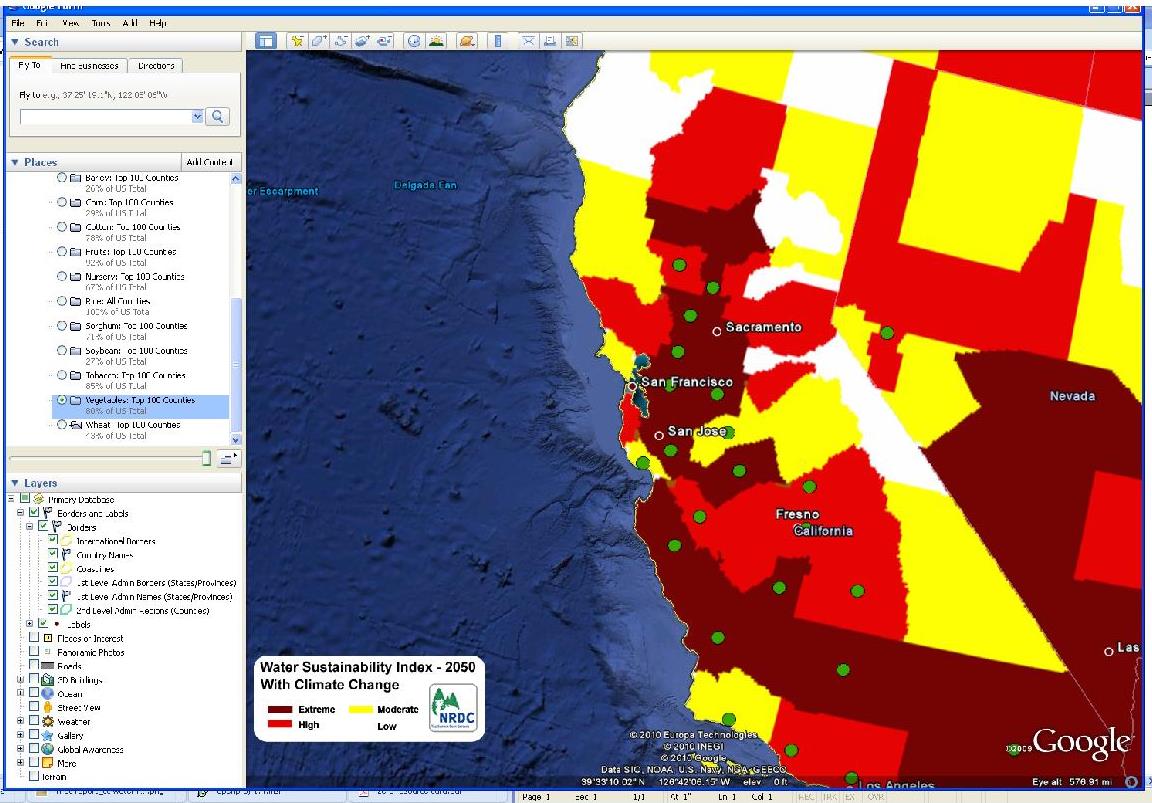
The Natural Resource Defense Council (NRDC) has released a study, conducted on their behalf by Tetra Tech, which examined the effects of climate change on probable future water supply and demand in the United States. One of the main findings of the study is that one-third of the U.S. counties (> 1,100 counties) will likely face water shortages by 2050.

The full report is available as a PDF here.

The Water Supply Sustainbility Index developed by Tetra Tech for the report can be viewed interactively in Google Earth – a link to the data can be found on the NRDC’s website here. You can also turn on and off markers for which counties are top producers of different crops to get a sense of the potential impact of the water shortages. It looks like this (the green dots indicate that the county is one of the top 100 counties for producing vegetables):

The NRDC also released a one-page overview of water shortage risk and crop value in at-risk counties by state (as a PDF here). According to the overview of California’s risk due to climate change:

Percent of CA counties at risk of water shortages: 83%

Total number of CA counties at risk: 48

Total number of CA counties at extreme risk: 19

Total number of CA counties at high risk: 17

Total number of CA counties at moderate risk: 12

The value of all the crops being producing in at-risk CA counties (in $1,000s): $21,585,354

– – –

They Don’t Have Water Meters?!

1

photo credit: freefoto.com

Many residents of California don’t have water meters. According to a recent column in the San Francisco Chronicle by Peter Gleick, the recent legislation mandating water meters is needed, as the many residents of California that don’t have meters are very reluctant to install them.

But everyone should have meters. According to Ellen Hanak, a water researcher with the Public Policy Institute on California, metered cities use about 15 percent less water than unmetered cities, and cities with a tiered rate system use an additional 10 percent less (via KQED).

A few statistics from Gleick’s column:

— Sacramento only has meters in 25 percent of residences, and has no plans to meter everyone else anytime soon.

— In the San Joaquin Valley, more than half of all residents don’t have water meters.

— The city of Fresno charges all single-family households a flat rate, no matter how much water is used.

Fresno’s water rates are some of the lowest in California, and it has some of the highest water use (3 times as high as Los Angeles residents, and 5 times as high as San Francisco residents, via The California Report). There is an interesting study comparing water rates – when the study was conducted (2006), the average monthly charge was $18.52 in Fresno County, $37.55 in Alameda County, and $57.25 in Santa Cruz County.

The meters are coming. There are several laws that will require the installation of meters for all Californians (via KQED).

— All homes built after 1992 must have meters.

— Cities that receive federal water have to install meters by 2013.

— All California cities have to install meters by 2025.

Seriously, though, 2025 is a long time for a state that has major water management issues.

– – –

Last year, there was a story from The California Report that covers the struggle to meter reluctant Fresno residents (listen to the story here).

San Jose Might Sell Its Water System

1

To close budget gaps (the current shortfall is $116.2 million for the fiscal year 2010-2011), San Jose is considering privatizing its municipal water system, which provides water to about 124,000 people (via Silicon Valley Mercury News). The sale could net the city $50 million.

The current potential buyer is reported to be San Jose Water Company, which provides water to about 1 million people in the Bay Area, including about 80 percent of San Jose residents. The potential sale would likely result in higher water rates for the formerly municipal customers. The company has also expressed interest in leasing and operating the water system.

While I think it is shortsighted to sell city assets to fix budget gaps (what will be sold next year?), San Jose Water Company boasts on its website that it delivered less water in 2007 than it did in 1987, despite serving an additional 80,000 people. And the company credits its water conservation programs (more info here).

Finding California Incentives and Rebates

1

There are hundreds of energy, water, and waste incentives, rebates, and services available for homes  in California, but it can be daunting to find them. Here are a few places to start:

Flex Your Power allows you to search for energy-related incentives and technical help available from utility companies, water agencies, and other organizations by entering your zip code.  A search in my zip code (in Berkeley) found 71 incentives and 18 services.

The Database of State Incentives for Renewables & Efficiency (DSIRE) lists state and local incentives by category and also lists related programs and initiatives. It can be much harder to figure out which specific programs are applicable, though. The database also lists federal incentives.

The California Urban Water Conservation Council lists programs participating in its Smart Rebates by water utility district.

For folks living in the East Bay:

East Bay Municipal Utility District lists its residential conservation rebates and services.

StopWaste.Org lists waste prevention and recycling services available to residents of Alameda County.

Noelle’s Links – Fireworks

The July 4 holiday is almost upon us, and with that comes the celebratory fireworks. While fireworks displays can be fun and dazzling, they do have an effect the environment. Not everyone shares an equal enthusiasm for this tradition, and some fireworks options are more ‘friendly’ than others. Read on.

Freefoto.com

*********

Traditional fireworks are propelled by gunpowder and colored with heavy metal colorants. Toxic chemicals from the fleeting displays can eventually make their way into soil and groundwater.  A 2006 study by Richard T. Wilkin et al, conducted at a municipal lake site in Oklahoma, found that elevated perchlorate levels in surface water spiked significantly after a display, not returning to background levels for 20 to 80 days following the event.

*********

The environmental group Coastal Environmental Rights Foundation of La Jolla, California filed suit last week against the City of San Diego and the annual Fourth of July celebration event planners to stop the fireworks display planned for the La Jolla Cove. The group contends that California Environmental Quality Act (CEQA) protocols and reqirements were not met in approving the event over a piece of sensitive coastline.

*********

Who’s the best known early adopter of eco-friendlier fireworks? It was actually Disney in 2004. Driven to action by neighbor complaints, Disney launched a program to use cleaner burning fireworks that use compressed air rather than gunpowder as an accelerants for lift-off  in it’s hundreds of yearly fireworks displays. However, widespread use of greener fireworks for environmental reasons are still taking a back-seat; these newer displays are not yet cost competitive.

*********