Cool Roofs – Melvin Pomerantz

5

In Berkeley, we are fortunate to have such events as Science at the Theater, where Lawrence Berkeley National Lab researchers give talks on their work at the Berkeley Repertory Theatre. The lectures are free and get a pretty sizeable audience.

On Monday, October 11, I was in the audience as researchers from Lawrence Berkeley National Laboratory (and the beloved Art Rosenfeld) gave a presentation titled “Cool Roofs, Cool Cities.” The post below consists of Part 1 of my record of the presentation – Melvin Pomerantz gives an introduction to the heat island effect and cool roofs. All portions are included in chronological order.

An ellipsis (…) indicates that I was not able to capture the words or thoughts skipped. The presentation is transcribed as accurately as possible – punctuation choices are mine. I also added any images.

– – –

What I’m going to talk about is a very familiar experience to a lot of you – when you go into the center of a city, it’s a lot warmer … That effect, namely the temperature … tends to be anywhere from 5-7 deg F warmer in the city than outside the city …
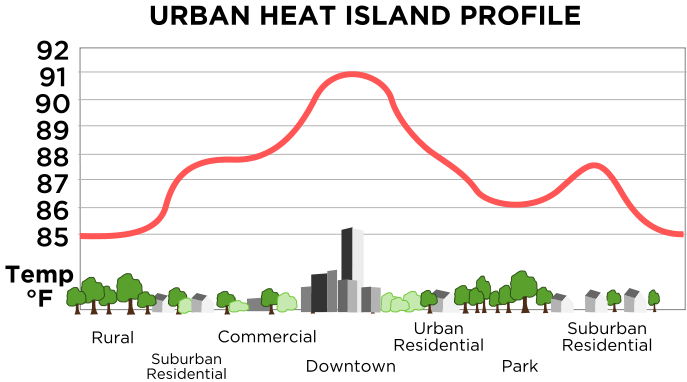
Image Credit: Wikimedia Commons

The heat has not only an effect of causing discomfort, but has economic effects, too … Looking at some SMUD data … went up to about 107 degrees that day … As the day goes on, it gets hotter and hotter, and the demand for electricity gets higher and higher … finally it cools down and people turn off their air conditioners a little bit. … To get this power, you need about 5.5 power plants, but the power used in January is much less, so the power company has to have in reserve all these power plants. So there is capital involved in having these in reserve … And the ones in reserve are generally the oldest, most polluting plants … so it’s an unfortunate effect …

Another effect that goes on is that when things are very hot, there are actually deaths … Chicago in 1995, there were 739 deaths attributed to the heat wave – almost all occurred on the top floor of buildings with black roofs …

So what can we do about it? … How is the air heated in the first place? The sun does not heat the air directly … Sunlight travels very well through the atmosphere … There are opaque surfaces – the light comes in from the sun and strikes a surface … some stays in the surface and heats the surface, then the air comes along and touches the surface and heats up … The surface is acting as a converter, so if we can modify the surface, we can get a handle on it … If you have a building underneath a roof, that heat travels into the building, then you have to run on the air conditioning. …  Also pavements suffer if it gets too hot … the pavement needs to handle the deterioration that the heat causes … …

One way to look at this is to look at the solar reflectance … If you have no light coming out, it’s black … if it all comes out, it’s very bright. If the light is not all caught by the material, it has a higher solar reflectance, and it’s cooler … If you decrease the solar reflectance, the temperature can rise 80-90 degrees F over the ambient air – and you don’t want that … …

There’s another feature, which is that once the surface is warm, it radiates … there are gases in the air which absorb this thermal radiation, and it’s like a blanket. It’s blocked by the gases in the atmosphere… this is the atmospheric greenhouse effect. If we can affect the light from sticking in the surfaces, we reduces the greenhouse effect, too, and keep the planet a bit cooler …

Image credit: Wikimedia Commons

What can we make cooler? … Looking again at Sacramento … about 39% of what we could see from the sky was pavements … … … If we reflect sunlight, it mostly passes back out of the atmosphere without heating the air…

– – –

Part 2 is posted here. Part 3 is posted here. Part 4 is posted here.

– – –

Berkeley Gets Shiny New Recycling Bins

2

I have to confess… I was pretty excited when I was walking home this afternoon and noticed a new bin outside every house on my street. Including my house.

– – –

The Ecology Center, which manages Berkeley’s recycling program, and Mayor Tom Bates have unveiled the new bins to be used by Berkeley residents. According to Berkeleyside:

The new carts have already started to appear on curbsides and a total of 36,000 of them will be delivered to Berkeley residents in single family homes over the next month.  Seven new trucks designed to handle the new carts are also now in use — the trucks are also divided into two sections, the larger of which holds paper and cardboard materials.

Apparently the bins are also designed to discourage poachers:

Accessing materials is more difficult than from an open box which might … put off potential poachers. The lid of the new cart is also printed with an advisory that the material contained in the cart is city property.

You can read the entire story here.

– – –

Update on Spending on Prop 23

From the New York Times today:

At the start of the campaign for California’s Proposition 23, the ballot measure that would suspend the state’s global warming law, opponents darkly warned that the Texas oil companies backing the initiative would spend as much as $50 million to win the election.

But with three weeks until Election Day, it is the No on 23 coalition of environmentalists, investors and Silicon Valley technology companies that is raking in the cash, taking in nearly twice as much money as the Yes on 23 campaign.

As of Monday, the No on 23 forces had raised $16.3 million to the Yes campaign’s $8.9 million, according to California Secretary of State records. Over the past two weeks, nearly $7 million has flowed into No campaign coffers while contributions to the Yes effort had fallen off dramatically.

Read the entire story here.

– – –

LBNL Open House on Saturday 10/2

Image credit: LBNL website

Lawrence Berkeley National Laboratory, located up in the hills overlooking Berkeley, California, is hosting an open house on Saturday, October 2.

Ever wonder how biofuels are produced, cool roofs and smart windows reduce energy use, the Internet was created, or supernovas are discovered? Families, community members, and others who want to learn the answers to these and other scientific questions are invited to attend Berkeley Lab’s Open House.

Visitors can talk directly with scientists conducting cutting-edge research, check out a cosmic ray detector, sequence DNA, create and measure their own seismic waves, build a motor at the Family Adventure Zone, or take a tour of the Advanced Light Source, one of the world’s brightest sources of ultraviolet and soft x-ray beams, among numerous other activities. Performances, displays, demonstrations, lectures, tours and food vendors will also be featured.

It is important to note that registration is required for everyone interested in attending. There are two sessions, morning and afternoon. More details are available here.

– – –

Assorted Links

Parts of California experience a record heat wave – Los Angeles had its highest recorded temperature of 113 deg F yesterday.

Schwarzenegger lashes out at the companies trying to get rid of California’s carbon regulation law,  AB 32.

Meg Whitman has now stated that she is against Prop 23 but would still suspend AB 32 for a year if elected.

– – –

Local Target Stores & Hazardous Waste

3

Image credit: Wikimedia Commons

According to the San Francisco Chronicle, all nine of the Target stores in Alameda County have been involved in illegal disposal of products containing hazardous waste by collecting and crushing batteries, phones and computers in the stores’ trash compactors to avoid disposal fees. An Alameda County judge has ordered the stores, among 240 in California accused of the practice, to stop.

According to the Washington Post, the lawsuit brought by the state of California and several cities and counties contends that Target stores routinely throw hazardous items such as bleach, pesticides, paint, aerosols and electronics directly into the trash. California has laws requiring special handling of hazardous waste.

Read the entire story here and here.

– – –

Noelle has previously addressed the need to properly disposed of e-waste as part of a post on Extended Producer Responsibility.

– – –

Tracking Water Resources in Real Time

2

Image credit: SEBAL North America

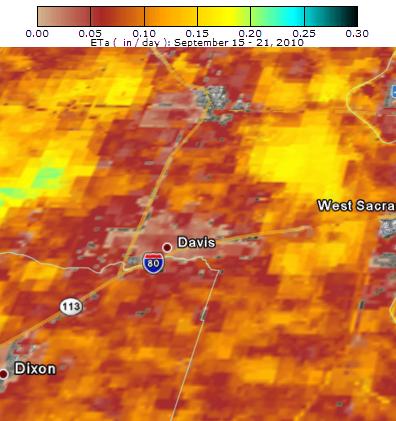
According to a recent press release, scientists at SEBAL North America, located in Davis, California, are tracking real-time consumption of water by crops, cities, and natural ecosystems using satellites.

This new technology, applicable to water management needs globally, reduces substantial uncertainties in traditional approaches, greatly increasing confidence in water management decisions. Grant Davids, the company’s president, notes the broad range of applications of SEBAL for water managers. “Water consumption is usually the most important yet often most poorly quantified water management parameter. More accurate and spatially discrete estimates of consumptive use lead to improved water management over a wide range of conditions, from local to basin scales and from historical analysis for planning to real-time operations decision support.”

The company will be providing weekly maps showing water use for the Central Valley. The company also makes image overlays that can be opened in Google Earth to allow users to look more closely at water use in specific areas. Maps and data can be found on the SEBAL website.

– – –

Assorted Links

Greentech Media discusses the ongoing infighting between the solar and energy efficiency sectors.

The coal industry costs more money than it creates in West Virginia.

Earth2Tech says we should all be watching the Texas smart meter market, not California.

Is Wal-Mart going green or greenwashing?

– – –

You can read our post on Greenwashing here.

– – –

The Koch Brothers and AB 32

2

I have previously posted about AB 32 and Prop 23.

– – –

Today, the New York Times published an editorial about the coalition of oil and gas companies and climate change skeptics that are trying to kill it through Prop 23.

…a well-financed coalition of right-wing ideologues, out-of-state oil and gas companies and climate-change skeptics is seeking to effectively kill that law with an initiative on the November state ballot. The money men include Charles and David Koch, the Kansas oil and gas billionaires who have played a prominent role in financing the Tea Party movement.

… …

The prospect that these rules could reduce gasoline consumption strikes terror into some energy companies. A large chunk of the $8.2 million raised in support of the ballot proposition has come from just two Texas-based oil and gas companies, Valero and Tesoro, which have extensive operations in California. The Koch brothers have contributed about $1 million, partly because they worry about damage to the bottom line at Koch Industries, and also because they believe that climate change is a left-wing hoax.

You can read the entire editorial on the New York Times website.

– – –

Assorted Links

Washington, Colorado, Massachusetts, New York, and California are the greenest states, according to a NMI survey of more than 3,000 U.S. consumers in the 25 largest states.

Oakland is recognized as a bike-friendly community by the League of American Bicyclists.

Texas and three other states threaten to sue California over AB 32.

– – –