As Climate Bill Falters, California is Crucial

1

AB32? Prop. 23? National climate bill? Keep it straight.

It seems that California is going to lead by example when it comes to climate change legislation in more ways than one. In 2006, California passed the historic Assembly Bill 32 (AB32), becoming the first state in the nation to address climate change broadly through a suite of emissions reductions and land use  regulation. Leading the charge, California’s legislation helped pave the way for the national climate bill. While the climate bill squeaked through the House of Representatives in the summer of 2009, the full bill was abandoned in the Senate this week, indefinitely. Because of an obvious lack of  Republican support to get the full bill through, Democrats offered a pared-down proposal on Tuesday. The new proposal has taken several distancing steps from a comprehensive “global warming bill”, and has the significant raising of a $75 million liability cap on oil spill damages as its focal point. With the aim of ushering the slimmed-down bill through before the August recess, its passage appears tenuous.

Meanwhile, California’s climate legislation, AB32 is meeting with similar opposition that will come to a head in the form of Proposition 23 on the November ballot that would effectively halt the implementation of AB32. How California reacts to the challenge will likely prove to the testing ground for climate change policy nationwide, for years to come.

We will be following this issue very closely, as well as the progress of local Bay Area implementation of AB32.

Resilience vs. Sustainability

2

This post is part of our definitions series on “eco-lingo” and technical terms.

– – –
photo by Derek Jensen

Is the glass half-sustainable or half-resilient?

Have you noticed the word ‘resilience’ cropping up in places where you might expect to see the word ‘sustainable’? Are the speakers making a real distinction here, or are they just moving on from yesterday’s buzz word? Let’s find out.

First, Merriam Webster defines the two words as follows:

resilience:

1. the capability of a strained body to recover its size and shape after deformation caused especially by compressive stress

2. an ability to recover from or adjust easily to misfortune or change

sustainability:

1. capable of being sustained

2a. of, relating to, or being a method of harvesting or using a resource so that the resource is not depleted or permanently damaged <sustainable techniques> <sustainable agriculture> 2b. of or relating to a lifestyle involving the use of sustainable methods<sustainable society>

Wow. Does the increased use of ‘resilience’ mean planners and policy makers are becoming more pessimistic? Are they already assuming the worst and now aiming for damage control instead of wise action? Well, maybe. But in all honesty, there is a difference, and it is important to make the distinction. This is not an either/or occasion, but more of a both/and.

Perhaps it seems obvious, but it is crucial to use the right words in order to come as close to the precise meaning as possible. ‘Sustainable’ is a very pro-active word, but it says nothing about the context in which it operates. The word ‘resilience’ by contrast implies a built in complexity; it is a word of reaction, and of endurance. The terms converge, but they are on separate tracks. My point is this – not only do the right words communicate to others better, but the right words can also re-frame the ‘same old thing’  in a beneficial and insightful way. In other words, if sustainability starts at home, maybe spin should too.

– – –

What exactly does “sustainability” mean? How about “green”, “eco” or “environmentally friendly”? The truth is that these terms are just vague enough to mean many different things to many different people. With the staggering array of “green” products, ‘lifestyles’ and concepts being promoted by marketers and environmentalists alike (as well as the necessary coining of new terms to match new ideas) our definition series aims to make sense of the rising tide of “eco-lingo” and technical terms.

– – –

Visualizing the U.S. Power Grid

2

Source: NPR’s Power Hungry: Reinventing the U.S. Electric Grid series

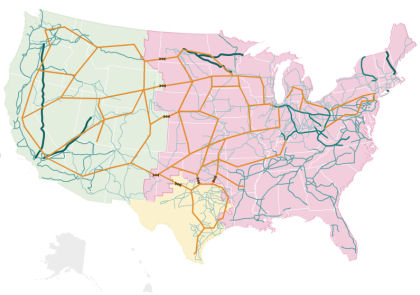
National Public Radio produced an intriguing series in April and May of 2009 called “Power Hungry: Reinventing the U.S. Electric Grid“.  The series looked at the structural make-up of power conveyance in the U.S.-and the need for it to get ‘smarter’ about controlling and tracking consumption patterns- and, at the growing pains of the newer energy industries such as wind and solar, and how to get them online to more Americans.

But the real star of the show for us map fans is the great interactive map, pictured above. The map illustrates the three discrete “grids” that make up the U.S. power network: Western, Eastern and Texas. The map also includes existing and proposed lines,power source ratios for each state (coal, hydro, etc.) and the distribution of wind and solar plants. See the full interactive map here.

– – –

Bay Area Public Meeting to Set SB375 Targets

Photographer: Manfred Werner Tsui at de.wikipedia.org

Passed in 2008, SB 375 is the nation’s first law to link greenhouse gas emissions with urban sprawl.  The thrust of AB 375 is to require not only emissions reduction targets, but also to require land use planning strategies and interagency collaboration in the process. In practice, this requires each region in the state to adopt a Sustainable Communities Strategy, or SCS, that is in line with regional emissions targets set by regional Air Resource Boards.

As SB 375 moves foward in its implementation, the time has come this August for the ARBs to annouce their emissions targets.

The California Air Resources Board has been holding workshops throughout California this month to accept public comment on the draft regional targets for reducing greenhouse gas emissions (GHG) from cars and light trucks.  The public comments will be taken into consideration before the Metro Planning Organizations (MPOs) announce their proposed targets in August. On Wednesday, July 21, the Bay Area gets to put in its two cents. The meeting information is as follows:

July 21, 2010     10:30 a.m. to 1:30 p.m

Caltrans Oakland Building, Auditorium, 111 Grand Ave, Oakland, CA 94612

For those unable to attend, the meeting will be webcast.

For more information on Senate Bill 375, see Urban Land Institute’s Summary and Key Findings report here, and the Governor’s Office factsheet here.

A list of all of the California ARB meetings in July can be found here.

– – –

What’s Next for California Solar?

photo source:  www.energy.ca.gov/sitingcases/abengoa/index.html

No one seems to dispute that solar technology will play an increasingly important role in transitioning away from fossil fuel dependence. But what is less clear is how solar tech will be deployed, and how fast. Is the market for single-point residential solar really ready to take off, or will it be large-scale solar fields? What can we learn from other countries that have had a longer history of serious solar initiatives (and will the U.S. commit to catching up)?

And although California is leading the charge in residential solar with innovative funding mechanisms like PACE – the Property Assessed Clean Energy model developed in Berkeley and influential in the planning of similar clean energy and efficiency programs around the country- the regulatory landscape under which these programs would operate remains uncertain at best.

This week’s links unearth information on the issues affecting California’s solar future from around the web:

Start with the July 15 broadcast of Forum from KQED Radio. This broadcast is a “Solar Panel”  discussion featuring Danny Kennedy of  Berkeley-based residential solar installation company Sungevity, Eicke Weber, director of the Fraunhofer Institute for Solar Energy Systems in Germany, U.C. Berkeley Professor and co-director of The Energy Institute, Severin Borenstein, and news reporter Todd Woody.

Next up, visit the California Energy Commission and California Public Utilities Commission’s “Go Solar California” website, urging CA residents to jump on the solar bandwagon.

Think the hot plains of the Mojave Desert are a great place for a giant solar farm? Many people do, but the “empty” desert is still home to ecosystems that need consideration- check out NPR’s coverage on how the plans are shaping up here.

Finally, we here at Zero Resource will be keeping up with the PACE debate, and you can too, by checking out the latest headlines- including the breaking news of Attorney General Jerry Brown’s lawsuit against Freddie Mac and Fannie May over delays to the program:

AG Brown sues feds over slowed solar PACE – San Jose Business Journal

California Sues Federal Mortgage Giants to Save Clean Energy Program – On Earth Magazine

California Sues Fannie, Freddie, Regulator over PACE program – NASDAQ

– – –


Bioplastics, part two

1

This post is part of our definitions series on “eco-lingo” and technical terms.

– – –

Part 1 of this post provides a definition for the term “bioplastic” and clarifies the distinctions between “degradable”, “biodegradable” and “compostable” plastics.

– – –

a compostable plastic cup from NatureWorks

While the idea of plant-based, biodegradable and compostable plastic made from renewable resources sounds like a potential panacea to the problem of plastic trash, the reality is -at this point- it is still too good to be true.

For starters, as I outlined in the first part of this post, not all bioplastics are created equal. To quickly re-cap, many are hybrids of conventional plastic polymers with added biomass; some are able to biodegrade and some are not; and the “compostable” type usually requires the high temperatures of a commercial composting facility in order to break down. What this means is that many new classes of plastics have been unleashed into the waste stream (with the catch-all rating of #7, or “other”) without the infrastructure in place to process them.  In large quantity, there is the real likelihood that they will complicate the recycling of traditional PET plastics.

Compostable plastics and serviceware such as coffee cups, to-go containers, etc., may be placed in municipal compost bins, but at this time no ‘bioplastics’ should  be placed in a regular mixed recycling bin (large scale efforts to recycle bioplastics in their own right could be termed “fledgling”, at best).

For example, the City of Portland Bureau of Planning and Sustainability authored a fact-sheet for area businesses considering using bioplastics that not only warns that the local recycling facility is not equipped to process many of the new plastics, but also calls into question the long-term wisdom of replacing one set of disposable products with another. In short, even if all things were equal with the logistical aspects of recycling bioplastics vs. conventional plastics, there is still the reality that bioplastics use fossil fuels in their creation, create greenhouse gases in their decomposition, cannot be processed by consumers at home, and can continue to perpetrate the problem of plastic trash in the ocean.

With all of that said, there may still be a place and a potential for bioplastics. The technology is rapidly evolving, and if the industries can coordinate with infrastructure, then proper use of the materials will be the result.

For more information visit:

The Sustainable Biomaterials Collaborative;

Bioplastics Magazine (a trade publication);

and Sustainable Plastics? a website and project of the Institute for Local Self Reliance.

– – –

What exactly does “sustainability” mean? How about “green”, “eco” or “environmentally friendly”? The truth is that these terms are just vague enough to mean many different things to many different people. With the staggering array of “green” products, ‘lifestyles’ and concepts being promoted by marketers and environmentalists alike (as well as the necessary coining of new terms to match new ideas) our definition series aims to make sense of the rising tide of “eco-lingo” and technical terms.

PACE Programs Here, and Gone

1

This post is part of our ongoing focus on energy, water, waste and transportation issues relevant to California at large.

– – –

photo credit: free foto.com

Property Assessed Clean Energy (PACE) programs are being quickly halted due to a recent announcement by the Federal Housing Finance Agency (FHFA) that declared the investments potentially unsafe for lenders. The new and upcoming PACE programs being piloted and planned by cities and counties around the country would offer homeowners bond-backed loans for solar and other energy efficiency upgrades to homes.

Under most terms, the PACE loan (which is attached to the house itself, like an assessment) would have first priority for repayment ahead of the mortgage. This repayment structure provoked a warning pronouncement from Fannie Mae and Freddie Mac last month. Now the FHFA has dealt another blow by also warning lenders that the programs could prove risky- effectively halting operations for the time being.

Read more coverage on the FHFA’s PACE announcement in:

The Bond Buyer, The Huffington Post, and Greentech Media.

AC Transit Cuts, part three

2

This post is part of our coverage on water, waste, energy and transportation issues of interest to the local Bay Area community.

Here is a check-in on the ongoing budget crisis within AC Transit, the East Bay’s bus system:

Despite months of negotiations and meetings, AC Transit and the union representing most of its workers,  the Amalgamated Transit Union (ATU), Local 192 have so far been unable to reach a mutually acceptable strategy to close the $56 million deficit facing the agency by the close of 2011.

June 30th represented a milestone in the negotiations- that was the day that the ATU’s previous contract terms expired. The process has nonetheless stagnated. AC Transit Director Greg Harper is quoted in the AC Transit News as commenting, “I think we are definitely at an impasse because the union has so far offered less than 50 percent of what is needed to close the budget deficit.”

The Agency is looking to recoup 8 to 9 percent of employment costs in the new contract. The grim financial scenario has already resulted in fee hikes for riders, service cuts, layoffs, and 5% salary cuts for the board of directors. With a 75% share of the operating budget being allocated to employee costs, the Board of Directors is maintaining that shortfalls cannot be met without some concessions from the union.

The declared impasse and revised terms of employment, effective July 18, have been laid out by the Board of Directors. It remains uncertain if a strike will be avoided.

Global Warming’s Six Americas

1

This post is part of an ongoing effort to discover, and provide a venue for, data collection , reports,  and metrics related to the topics of waste, water, energy and transportation.

A graph from the Global Warming’s Six Americas report

Global Warming’s Six Americas is a report released in May of 2009 by the George Mason University Center for Climate Change Communication, and Yale’s Project on Climate Change Communication,  illuminating American attitudes towards global climate change and climate change policy. The report has the stated premise that “Climate change public communication and engagement efforts must start with the fundamental recognition that people are different and have different psychological, cultural, and political reasons for acting – or not acting– to reduce greenhouse gas emissions”.

The group used data gathered during 2008 from an in-depth questionnaire to assess attitudes, concerns, perceptions, risk values, policy preferences and other identified survey dimensions, ultimately enumerating 6 common response types among Americans at large regarding issues related to global climate change.

The six “types” identified by the report are the Alarmed (18%), the Concerned (33%), the Cautious (19%) , the Disengaged (12%), the Doubtful (11%), and the Dismissive (7%). Each group corresponds to a distinct station on the spectrum of attitudes and responses cataloged by the researchers.

It never hurts to hear it again: with only 5% of the world’s population, America is yet responsible for 25% of greenhouse gas emissions (GGE)s. This, argues the report, is why understanding the diverse views of the American public on climate change is so crucial for and understanding our collective behaviors and for creating effective public education and policy messages.

Read the full “6 Americas” report here.

Noelle’s Links – Fireworks

The July 4 holiday is almost upon us, and with that comes the celebratory fireworks. While fireworks displays can be fun and dazzling, they do have an effect the environment. Not everyone shares an equal enthusiasm for this tradition, and some fireworks options are more ‘friendly’ than others. Read on.

Freefoto.com

*********

Traditional fireworks are propelled by gunpowder and colored with heavy metal colorants. Toxic chemicals from the fleeting displays can eventually make their way into soil and groundwater.  A 2006 study by Richard T. Wilkin et al, conducted at a municipal lake site in Oklahoma, found that elevated perchlorate levels in surface water spiked significantly after a display, not returning to background levels for 20 to 80 days following the event.

*********

The environmental group Coastal Environmental Rights Foundation of La Jolla, California filed suit last week against the City of San Diego and the annual Fourth of July celebration event planners to stop the fireworks display planned for the La Jolla Cove. The group contends that California Environmental Quality Act (CEQA) protocols and reqirements were not met in approving the event over a piece of sensitive coastline.

*********

Who’s the best known early adopter of eco-friendlier fireworks? It was actually Disney in 2004. Driven to action by neighbor complaints, Disney launched a program to use cleaner burning fireworks that use compressed air rather than gunpowder as an accelerants for lift-off  in it’s hundreds of yearly fireworks displays. However, widespread use of greener fireworks for environmental reasons are still taking a back-seat; these newer displays are not yet cost competitive.

*********