Cut Energy Use 50% in Commercial Buildings

2

The Department of Energy (DOE) and the National Renewable Energy Laboratory (NREL) just released two technical reports on how to achieve 50% energy savings in both new and existing large office buildings and large hospitals.

You can download the full report, “Technical Support Document: Strategies for 50% Energy Savings in Large Office Buildings,” as a pdf here.

You can download the other full report, “Large Hospital 50% Energy Savings: Technical Support Document,” as a pdf here.

– – –

Tracking Water Resources in Real Time

2

Image credit: SEBAL North America

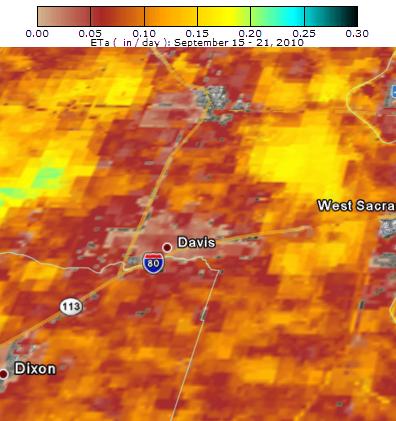
According to a recent press release, scientists at SEBAL North America, located in Davis, California, are tracking real-time consumption of water by crops, cities, and natural ecosystems using satellites.

This new technology, applicable to water management needs globally, reduces substantial uncertainties in traditional approaches, greatly increasing confidence in water management decisions. Grant Davids, the company’s president, notes the broad range of applications of SEBAL for water managers. “Water consumption is usually the most important yet often most poorly quantified water management parameter. More accurate and spatially discrete estimates of consumptive use lead to improved water management over a wide range of conditions, from local to basin scales and from historical analysis for planning to real-time operations decision support.”

The company will be providing weekly maps showing water use for the Central Valley. The company also makes image overlays that can be opened in Google Earth to allow users to look more closely at water use in specific areas. Maps and data can be found on the SEBAL website.

– – –

Luxury or Necessity?

2

A study by the Pew Research Center’s Social & Demographic Trends project from April 2009 reveals that Americans are paring down the list of familiar household appliances they say they can’t live without.

No longer do substantial majorities of the public say a microwave oven, a television set or even home air conditioning is a necessity. Instead, nearly half or more now see each of these items as a luxury. Similarly, the proportion that considers a dishwasher or a clothes dryer to be essential has dropped sharply since 2006.

These recession-era reevaluations are all the more striking because the public’s luxury-versus-necessity perceptual boundaries had been moving in the other direction for the previous decade. For example, the share of adults who consider a microwave a necessity was just 32% in 1996. By 2006, it had shot up to 68%. Now it has retreated to 47%. Similarly, just 52% of the public in the latest poll say a television set is a necessity — down 12 percentage points from 2006 and the smallest share to call a TV a necessity since this question was first asked more than 35 years ago.

Read an overview of the 2009 study here, with graphs!

Read the full report here.

Read an overview of the 2006 study here.

– – –

Water Footprint Calculator

2

The National Geographic website has a water footprint calculator that walks you through very basic aspects of your lifestyle and give you a sense of how much water you use at home, to produce your diet, to produce the stuff you buy, and to produce the fuel you need to travel. And it compares your use to the American average for each category. Check it out here!

– – –

The Next Million Acre Feet of Water

2


Image credit: Wikimedia Commons

The Pacific Institute has released a report on how to find the next million acre feet of water in California.  As with energy in California, which now has the “loading order”, the conclusion is that conservation and efficiency efforts can achieve water savings for less cost than building new or expanding existing supplies.

An overview of some of the water-efficient practices discussed in the report:

Water savings are available through a wide variety of water-efficient practices in the urban and agricultural sectors. In the urban sector this includes replacing old, inefficient devices with high-efficiency models, as well as lawn conversion, residential metering, and rate structures that better communicate the value of water. In the agricultural sector, best water management practices include weather-based irrigation scheduling, regulated deficit irrigation, and switching from gravity or flood irrigation to sprinkler or drip irrigation systems. Here, we focus on well documented, cost-effective approaches that are already being used in California. We emphasize efficiency improvements rather than behavioral changes because the latter are less easily quantified. Nonetheless, experience in Australia, Colorado, and California in recent years shows that changing water use behavior can also provide very fast and inexpensive savings in emergencies, with long-term benefits.

– – –

A  full copy of the report can be found here.

– – –

Links – Water and Energy

Alex Wilson, of BuildingGreen, has written two blogs posts recently that I think will be of interest to Zero Resource readers…I’ve posted snippets, but I recommend reading the entire original posts.

– – –

Saving Energy by Conserving Water

Averaged statewide , roughly 5% of California’s electricity is used for moving and treating water and wastewater. (The oft-quoted figure of 19% includes water heating and other things we do with water in homes, businesses, and farms.) But these figures vary widely in different parts of the state. A 2005 report from the California Energy Commission found supply and conveyance of water to range in intensity from 0 to 16,000 kilowatt-hours per million gallons (kWh/MG), while filtration and treatment varied from 100 to 1,500 kWh/MG, distribution varied from 700 to 1,200 kWh/MG, and wastewater collection and treatment varied from 1,100 to 5,000 kWh/MG. Not surprisingly, average totals are far higher in southern California (12,700 kWh/MG) than in northern California (3,950 kWh/MG).

Saving Water by Conserving Energy

By weighting thermoelectric and hydroelectric power generation sources, the NREL report calculated an average water-intensity of electricity in the U.S. to be 2.0 gal/kWh. So if you use 500 kWh per month, that’s requiring, on average, 1,000 gallons of water.

– – –

The Hidden Costs of California’s Water Supply

1

The Natural Resources Defense Council (NRDC) released a report in 2004 titled “Energy Down the Drain: The Hidden Costs of California’s Water Supply.” Especially in the western part of the United States, there is a tight connection between water and energy resources, as energy is needed to reliably treat and distribute water.

Because energy and water decision-making is often siloed, water planners are not generally taking into consideration the energy-related consequences of their planning.

The full report is available here as a pdf.

The authors carefully quantified the link between water and energy for three specific case studies – San Diego County’s future supply, the Westlands Water District, and the Columbia River basin (in the the Pacific Northwest). According to the report, the Westlands Water District is one of the largest agricultural users of water in the western United States.

The overarching message of the report is that decision makers should integrate energy issues in to water planning and decision-making. It also suggests a methodology for incorporating energy impacts into water planning.

The report contains numerous interesting tidbits:

  • “The more than 60,000 water systems and 15,000 wastewater systems in the United States are among the country’s largest energy consumers, using 75 billion kWh/year nationally – 3 percent of annual U.S. electricity consumption.”
  • “According to the Association of California Water Agencies, water agencies account for 7 percent of California’s energy consumption and 5 percent of the summer peak demand.”
  • “Ninety percent of all electricity used on farms is devoted to pumping groundwater for irrigation.”
  • “End use of water – especially energy intensive uses like washing clothes and taking showers – consumes more energy than any other part of the urban water conveyance and treatment cycle.”
  • “When water is diverted for irrigation before it reaches a dam, an enormous amount of energy – the foregone energy production – is lost.”

California’s “Air Basins”

1

The state of California is divided geographically into 15 different “air basins” in order to regulate air emissions on a regional, rather than a local basis. The divisions were decided upon based on both geographically like features (in some cases “air basins” are literally geographic basins surrounded by mountains) and by political boundaries, such as counties. While air quality can vary from basin to basin, emissions and pollution are obviously not confined to air basin boundaries.

The nine county Bay Area makes up its own designated air basin, the “San Francisco Bay” air basin. This basin is home to the second largest metro population in the state and is characterized by high vehicle miles traveled, several regional airports and industrial activity. Being a coastal region, wind and weather patterns can have a dramatic effect in transporting the pollution from the region into inland areas.

To find out more about the San Franciso Bay air basin and the 14 other air basins in California, visit the Air Resource Board’s interactive map here, get the latest air quality reports for your region from the annual California Almanac of Air Quality and Emissionsand check out a list of 50 things you can do to improve California’s air quality, here.

– – –

California – 20th in Beach Water Quality

1

photo credit: Alan Cleaver 2000

According to the National Resource Defense Council’s annual water quality report for the nation’s beaches, this year had the sixth highest levels of contamination in the 20 year history of the study. The NRDC reports that a range of causes are contributing to dirtier coastlines, including stormwater runoff and aging sanitation and combined sewer systems that may overflow into coastal waters during storm events.

Although contaminated waters can pass pathogens along to swimmers, the water tests currently employed take up to 24 hours to reveal problems, and so warranted beach closures are often delayed.

How does California fare in all of this? Of the 30 states with coastal waters, the cleanliness of California beaches rank at a sad #20. The top 3 polluted beaches include North Avalon beach in Los Angeles County where 82% of sampled water exceeded national pollution standards; Mendocino County’s Pudding Creek beach where 65% of samples exceeded national standards; and Poche County beach in Orange County that had an excessive pollution rate of 62%.  The county that received the dubious honor of  having the highest percentage of  beach water samples that  exceeded national pollution standards was San Francisco County at 17%. However, on a more positive note, the level of pollution in California beach water has trended downward in the last five years.

Read the report on California’s coastal waters, hereand the full Testing the Waters NRDC report, here.

NRDC Report on Climate Change, Water and Risk

Image: NRDC

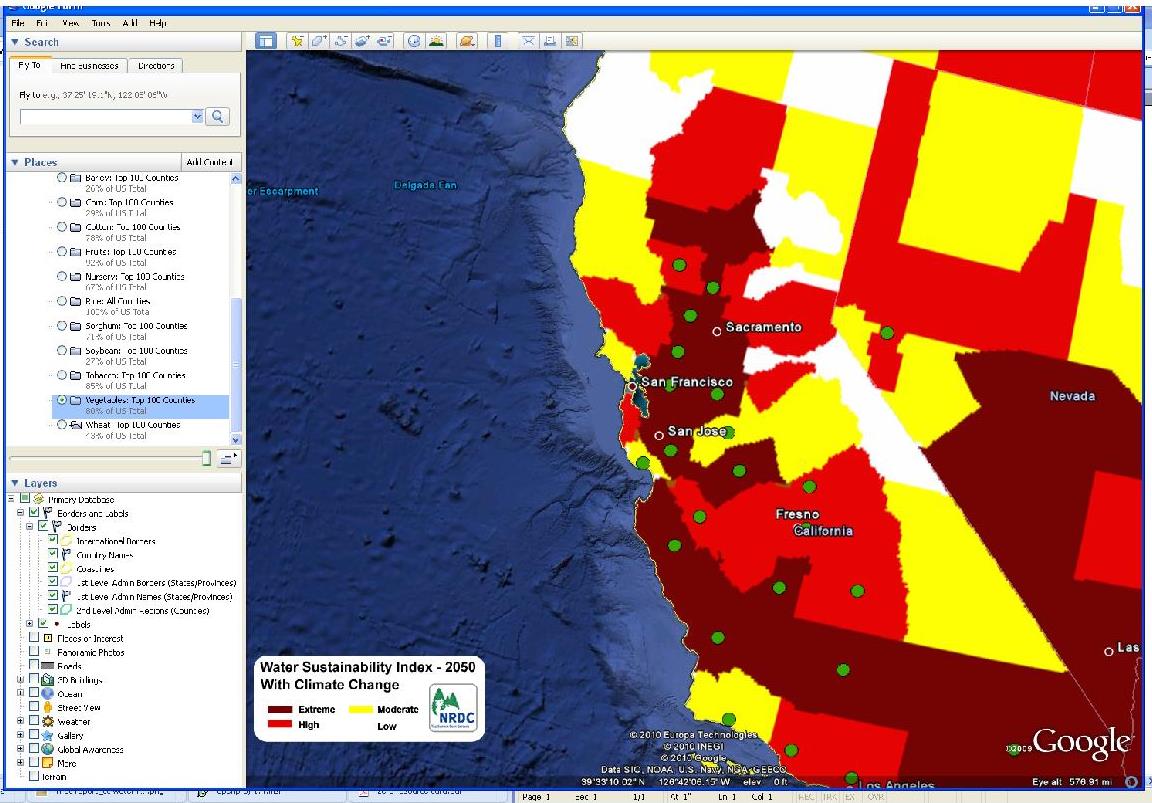
The Natural Resource Defense Council (NRDC) has released a study, conducted on their behalf by Tetra Tech, which examined the effects of climate change on probable future water supply and demand in the United States. One of the main findings of the study is that one-third of the U.S. counties (> 1,100 counties) will likely face water shortages by 2050.

The full report is available as a PDF here.

The Water Supply Sustainbility Index developed by Tetra Tech for the report can be viewed interactively in Google Earth – a link to the data can be found on the NRDC’s website here. You can also turn on and off markers for which counties are top producers of different crops to get a sense of the potential impact of the water shortages. It looks like this (the green dots indicate that the county is one of the top 100 counties for producing vegetables):

The NRDC also released a one-page overview of water shortage risk and crop value in at-risk counties by state (as a PDF here). According to the overview of California’s risk due to climate change:

Percent of CA counties at risk of water shortages: 83%

Total number of CA counties at risk: 48

Total number of CA counties at extreme risk: 19

Total number of CA counties at high risk: 17

Total number of CA counties at moderate risk: 12

The value of all the crops being producing in at-risk CA counties (in $1,000s): $21,585,354

– – –