Gigaton Throwdown

2

photo: Wikimedia Commons

While attending the two-day “Pathways to a Clean Energy Future” symposium put on by the Philomathia Foundation and U.C. Berkeley last week, I made a note to look up a recent initiative called the “Gigaton Throwdown” that was mentioned by Professor and Senior Energy and Climate Partnership of the Americas Fellow Dan Kammen, during his talk.

The Gigaton Throwdown Initiative is essentially a collaboration of a diverse group of academics and business/investment professionals, that spent 18 months looking at what it would take to bring nine clean energy technologies up to a gigaton threshold of power generation (one billion metric tons) by the year 2020. The nine technologies include biofuels, building efficiency, concentrated solar power, construction materials, geothermal, nuclear, plug-in hybrid cars, solar pv and wind. The technologies were selected for the capacity-building study because they already have a market presence and are able to attract investors.

The aim of this exercise, according to the Gigaton Throwdown website, is “to educate and inspire investors, entrepreneurs, business leaders, and policy makers to “think big” and understand what it would take to scale up clean energy massively over the next 10 years.” And really, in the face of the daunting challenges for the future of energy industries and policy, who can’t use the inspiration?

The GTI issued a report documenting the findings of their process. Key points center around the critical need for a cross-collaborative policy and investment framework to assist in the transition to a cleaner energy future.

Read the full report here.

– – –

A few weeks ago, Dan Kammen, who leads the Renewable and Appropriate Energy Laboratory at UC Berkeley, was appointed by the World Bank to be its first Clean-Energy Czar. At the time, we pointed readers to a couple interviews, which you can read here.

– – –

Full List of AC Transit Cuts

The full list of night and weekend buses with service being cut has now been posted on the AC Transit website here.

Weekend lines that will continue to operate include: Lines 1, 1R, 18, 20, 22, 26, 40, 45, 51A, 51B, 57, 60, 72, 72M, 73, 76, 88, 97, 99, 210 and 217.

Lines that will be cut include: Lines 7, 11, 12, 14, 21, 25, 31, 32, 49, 52, 54, 62, 65, 67, 68, 70, 71, 74, 85, 86, 89, 93, 95, 98, 242, 251, 275, 332, 345, 350, 376, 386, F, NL and O.

The discontinued All-Nighter service includes Lines 802, 805, 840 and 851. Lines 800 and 801 will not be affected.

– – –

Update on AC Transit Cuts

2

Image Credit: Wikimedia Commons

Last night, AC Transit’s board of directors voted unanimously to slash night and weekend bus service in an effort to reduce the projected $40 million budget deficit.

Thirty-nine “minor” weekend routes are on the chopping block, but most major weekend routes will be left intact.

Four of the six all night buses will disappear. The only surviving lines will be the 800 and the 801.

According to Berkeleyside, 9 weekend services will be eliminated in Berkeley – the 1R, 7, 12, 25, 49, 52, 65, 67 and the Transbay F.

Another decision on paratransit services was postponed.

The full set of cuts should be posted on the AC Transit site soon.

– – –

Noelle has previously written about the challenges facing AC Transit – AC Transit Cuts (5/25/10), AC Transit Cuts, Part 2 (6/2/10), and AC Transit Cuts, Part 3 (7/8/2010).

– – –

High Speed Rail

1

News and perspectives from around the web on the status of high speed rail in California…

Daniel Curtin for the SF Examiner:

“Without a hint of irony, critics warn that moving forward with California’s high-speed rail project risks financial disaster for the state.  That train has left the station. There’s no need to predict disaster — we’re already living through one.”

Read the article here.

– – –

From Business Review USA:

“Thinking Ahead: High-Speed Rail in Southern California is a new report released by the Center for Urban Infrastructure that discusses the benefits of a fast, convenient and efficient intercity high-speed rail system on southern California’s economy.”

Read the article here.

– – –

Jonathan Weber for the NY Times:

“The Bay Area has a reputation as a place where it’s hard to get things done, but you’d never know it from all the recent progress on transformative megaprojects.”

Read the article here.

– – –

For a counterpoint, try James Janz’s opinion piece for the San Jose Mercury News:

“When California voters approved Proposition 1A for development of a “safe, convenient, affordable, and reliable” high-speed rail system, I am certain they expected it to be a boon to the state because it would be done right…the High-Speed Rail Authority has done little right and much that is wrong.”

Read the article here.

– – –

San Francisco Finds Parking…On the Web

1

photo: Cawi2001

These are the days of traffic snarls, extended rush hours, bridge toll increases and scarce parking in many areas of the city.

However, there are some San Franciscans besides cyclists and public transit boosters taking matters into their own hands. I am talking about parking space brokers.

Its no surprise that established garages should have an online presence; many people opt to park in such lots everyday to go to work, so it’s nearly a given that such lots will allow reservations and payments via the web. But you can also arrange a ready space in a random private driveway, church parking lot or off-hour establishment.

Gottapark has been around for several years, bringing  the “haves” of parking together with the “have-nots”. Anyone will a parking space to rent, or a parking hopeful looking for a spot can log on and make a match.

Then there is ParkingCarma, a similar service that ups the ante by providing “real-time” monitoring for parking sites with high-tech gadgets. The company states in its online profile: “ParkingCarma is pioneering new ground by using technology to improve quality of life and the environment, while solving one of today’s largest metropolitan issues: Parking. SmartParking is the application of information technology to improve parking, thereby mitigating the environmental impact of vehicles.”

Um, okay.  I’ll go along with quality of life thing, but I doubt if lack of parking is the biggest environmental impact of vehicles.

But on further examination of the ParkingCarma site, they do make some persuasive points. Namely, pre-arranged parking could help ease traffic congestion and prevent people from driving around and around aimlessly looking for a spot- which would of course help to curtail greenhouse gas emissions. This model also is predicated upon the activation of under-utilized space, potentially preventing the need for (as many) new parking structures.

_ _ _

City Rankings – Energy, Walkability, and Transit

1

This Friday’s links highlight a few examples of city rankings…

– – –

The Natural Resources Defense Council (NRDC) has released a list of 22 American cities named “2010 Smarter Cities” for their investment in green power, energy efficiency measures and conservation – Oakland, San Francisco, Berkeley, and Santa Cruz are the Northern California cities that made the list and have profiles on the NRDC website.

– – –

Walk Score has ranked 2,508 neighborhoods in the largest 40 U.S. cities to help you find walkable neighborhoods – San Francisco is ranked #1!

– – –

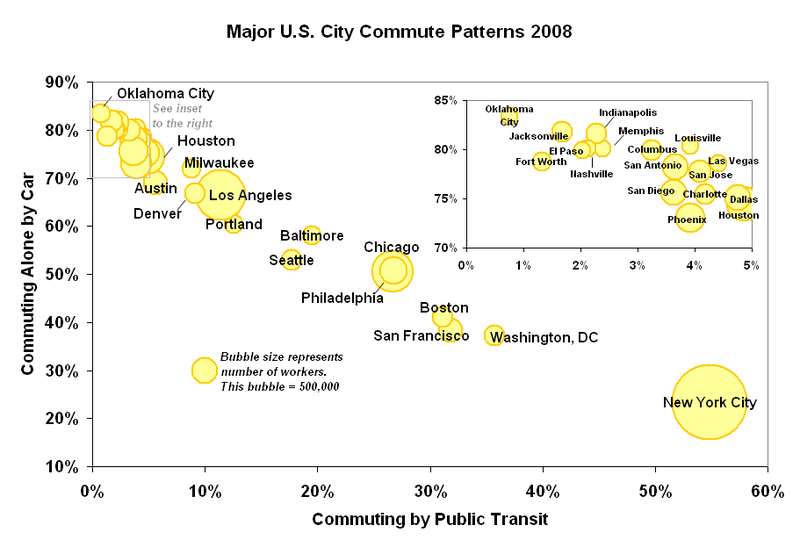
The 2006 American Community Survey measured the percentage of commuters who take public transit, as opposed to walking, driving, riding a bicycle, or other ways of getting to work. In the top 50 are the Bay Area cities of San Francisco, Berkeley, Oakland, Richmond, and Concord.

Image Credit: Wikimedia Commons

– – –

Bus Rapid Transit (BRT)

1

This post is part of our definitions series on “eco-lingo” and technical terms.

– – –

If you have read articles about urban transit in recent years, chances are you have run across the phrase “BRT” or “bus rapid transit”. BRT refers to a mode of bus travel that is characterized by streamlined operations on heavily traveled routes to reduce travel and wait times and/or increase average daily trips. Elements of BRT may be any combination of dedicated bus lanes, limited stop “express” buses, increased coordination for “signal priority” at stop lights, quick-boarding platform placement and configuration , curb cuts and turn-abouts for faster maneuvering of buses and pre-board fare collection.

The argument for BRT is generally that there is an increasing need for fast and efficient public transit in cities spurred by factors such as population growth and greenhouse gas reduction goals. However, rail systems are extremely costly to build and maintain, and many of America’s cities lack even basic public rail infrastructure. BRT can bridge this gap and provide the efficiency and effectiveness of a rail system while utilizing the already existing roadways.
Visit AC Transit’s BRT page here, and visit the National Bus Rapid Transit Institute here.

– – –

What exactly does “sustainability” mean? How about “green”, “eco” or “environmentally friendly”? The truth is that these terms are just vague enough to mean many different things to many different people. With the staggering array of “green” products, ‘lifestyles’ and concepts being promoted by marketers and environmentalists alike (as well as the necessary coining of new terms to match new ideas) our definition series aims to make sense of the rising tide of “eco-lingo” and technical terms.

– – –

Berkeley’s New Bike Station

1

Bike Station is an outfit that seeks to help municipalities and transit agencies reach their goals for transit oriented development by providing spacious, secure bike parking and bicycle rentals and repair services at key points along public transit routes. After months of anticipation, Berkeley’s new Bike Station opened to the public this month. The Berkeley Bike Station is the second largest in the country and expands the capacity for Downtown Berkeley BART friendly bicycle parking four-fold.

Funded in partnership by the City of Berkeley and BART, the Bike Station is located at 2208 Shattuck Avenue, just a half block from the BART entrance, and provides free bike parking to commuters from 9 a.m. to 5 p.m. For the cost of a few pennies an hour, commuter memberships are also available for those who want off-hour cardkey access.

As Climate Bill Falters, California is Crucial

1

AB32? Prop. 23? National climate bill? Keep it straight.

It seems that California is going to lead by example when it comes to climate change legislation in more ways than one. In 2006, California passed the historic Assembly Bill 32 (AB32), becoming the first state in the nation to address climate change broadly through a suite of emissions reductions and land use  regulation. Leading the charge, California’s legislation helped pave the way for the national climate bill. While the climate bill squeaked through the House of Representatives in the summer of 2009, the full bill was abandoned in the Senate this week, indefinitely. Because of an obvious lack of  Republican support to get the full bill through, Democrats offered a pared-down proposal on Tuesday. The new proposal has taken several distancing steps from a comprehensive “global warming bill”, and has the significant raising of a $75 million liability cap on oil spill damages as its focal point. With the aim of ushering the slimmed-down bill through before the August recess, its passage appears tenuous.

Meanwhile, California’s climate legislation, AB32 is meeting with similar opposition that will come to a head in the form of Proposition 23 on the November ballot that would effectively halt the implementation of AB32. How California reacts to the challenge will likely prove to the testing ground for climate change policy nationwide, for years to come.

We will be following this issue very closely, as well as the progress of local Bay Area implementation of AB32.

Bay Area Public Meeting to Set SB375 Targets

Photographer: Manfred Werner Tsui at de.wikipedia.org

Passed in 2008, SB 375 is the nation’s first law to link greenhouse gas emissions with urban sprawl.  The thrust of AB 375 is to require not only emissions reduction targets, but also to require land use planning strategies and interagency collaboration in the process. In practice, this requires each region in the state to adopt a Sustainable Communities Strategy, or SCS, that is in line with regional emissions targets set by regional Air Resource Boards.

As SB 375 moves foward in its implementation, the time has come this August for the ARBs to annouce their emissions targets.

The California Air Resources Board has been holding workshops throughout California this month to accept public comment on the draft regional targets for reducing greenhouse gas emissions (GHG) from cars and light trucks.  The public comments will be taken into consideration before the Metro Planning Organizations (MPOs) announce their proposed targets in August. On Wednesday, July 21, the Bay Area gets to put in its two cents. The meeting information is as follows:

July 21, 2010     10:30 a.m. to 1:30 p.m

Caltrans Oakland Building, Auditorium, 111 Grand Ave, Oakland, CA 94612

For those unable to attend, the meeting will be webcast.

For more information on Senate Bill 375, see Urban Land Institute’s Summary and Key Findings report here, and the Governor’s Office factsheet here.

A list of all of the California ARB meetings in July can be found here.

– – –