Today is PARK(ing) Day!

1

You can find events in your area through the map on the Parkingday.org site.

– – –

What is PARK(ing) Day, you ask? According to Parkingday.org,

PARK(ing) Day is a annual open-source global event where citizens, artists and activists collaborate to temporarily transform metered parking spaces into “PARK(ing)” spaces: temporary public places. The project began in 2005 when Rebar, a San Francisco art and design studio, converted a single metered parking space into a temporary public park in downtown San Francisco. Since 2005, PARK(ing) Day has evolved into a global movement, with organizations and individuals (operating independently of Rebar but following an established set of guidelines) creating new forms of temporary public space in urban contexts around the world. The mission of PARK(ing) Day is to call attention to the need for more urban open space, to generate critical debate around how public space is created and allocated, and to improve the quality of urban human habitat … at least until the meter runs out!

– – –

You can find out more about PARK(ing) Day by reading an article in Smithsonian magazine. Some highlights:

The genesis of Park(ing) Day began in 2005, while Passmore was working in a downtown building, watching cars going in and out of metered spaces. “I had a vision of time-lapse photography, and started thinking: What if an art gallery came in for two hours, or a park came in for two hours? I looked into the law and found that, in San Francisco, it’s technically legal to do something with a metered parking space, apart from storing your car there.” … …

“We did it on November 16, 2005, on Mission Street,” Passmore recalls. “It lasted two hours: the maximum time offered on the meter.” Despite his legal research, Rebar’s foray into guerilla landscape architecture was filled with trepidation. “We actually had speeches prepared for the police: speeches about how we were acting in the public interest, planned to clean up after ourselves and so on. Because we were sure we were going to be arrested.” But nothing happened. “A few meter maids scooted by,” Passmore says with a laugh. “They must have assumed we had a permit—because no one in their right mind would try to do something like this otherwise.”

The event swept through the blogosphere. Suddenly, people all over the country wanted to turn parking spaces into parks. “People were asking us to replicate our project in their cities—which was difficult to do. We were just three guys with day jobs. Rebar was something we did on weekends. So we decided to make a how-to manual and let people do it on their own.”

– – –

Tiny Houses on TV!

1

This week’s episode of HGTV Design Star challenges the designers to decorate a tiny house. Which means that those of us who have admired (and secretly coveted) a tiny house such as the Tumbleweed Tiny Houses, can get a sense of how much space they have inside and how they could potentially be configured to fit different lifestyles. You can watch the episode online here.

– – –

(Image credit: Wikimedia Commons)

– – –

FTC To Issue Revised Guidelines for “Green” Product Claims

1
image: Wikimedia Commons

Many products these days make claims on their labels that place them somewhere on the nebulous spectrum of “green”. These endorsements range from “all natural”, to  “environmentally friendly”, “biodegradable”, or “eco”  just to name a few.

But what do these labels really mean? “Environmentally friendly” compared to what? “Biodegradable” how, and under what conditions?

The fact is, many manufacturers in recent years have taken note of strong consumer appetite for safer products and have responded– but not always with meaningful changes. Products and services that gratuitously toss around vague environmental claims have come to be known as “greenwashing“.

For example, many product labels feature environmental seals – little pictoral “stamps” with a tagline; while there are some legitimate third party verification seals that attest to a products’ safety, environmental performance and/or the manufacturing process, some may be nothing more than ornament. Other examples of deceptive advertising practices may include misleading claims, or overstatement of environmental benefits of a product during its manufacture, use or disposal.

The Federal Trade Commission (FTC) first  adopted its “Green Guide” in 1998 to help provide a baseline of clarity for both consumers and the manufacturers making environmental claims about their products; the revisions that are in the works now will be the first since 1998.

The new revisions will be based on research done by the FTC to gauge consumer understanding of various “green” labeling terms and practices. However, the FTC stops short of providing legal definitions to terms and the guidelines will still be voluntary and self-implemented by manufacturers.

Listen to the KQED Forum “An End to Greenwashing” that provides a discussion of the new FTC guidelines, here

Visit the Good Guide, a group that helps you find “healthy, green, ethical products according to scientific ratings”

– – –


Another Fiscal Emergency for AC Transit?

1

– – –

AC Transit will hold a public hearing on May 25 at 5:00 pm at the offices at 1600 Franklin Street in Downtown Oakland to discuss declaring a fiscal emergency for the third consecutive year.

According to California Beat:

Calling a fiscal emergency would allow AC Transit to cut costs by eliminating service, implementing hiring freezes and reorganize administrative expenses without undergoing environmental reviews that would delay the process.

The agency is facing a $14.9 million shortfall in the coming fiscal year and warns it will face a steeper funding shortage by the end of 2012.

In October, the agency cut 13 percent of bus service to nearly all East Bay communities and hiked fares for riders. This month, the Board approved a ten-year fare increase plan that will increase the base fare incrementally to meet inflation rates.

You can read the entire story here.

– – –

The AC Transit Board voted last week to raise basic bus fares from $2.00 to $2.10, to take effect August 1.

According to Mercury News:

The increase, however, is a tiny fraction of what is needed, district officials said. It will raise just $2.4 million annually to reduce a projected deficit of $21 million in the next fiscal year, according to a district staff report.

As a result, another round of service cuts are likely to be needed within the next 12 to 18 months, King said. AC Transit cut service twice last year.

You can read the entire story here.

– – –

Battle of the Buildings

2

Early this month the U.S. EPA launched its 2011 National Building Competition, “Battle of the Buildings“. 245 buildings from across the country will be battling it out “head to head” to see how much each can reduce energy consumption by a given deadline.

The buildings represent a mix of  buildings including 26 different commercial building types and a range of building ages up to 100+. The Competitors will be using EPA’s online tracking tool Energy Star Portfolio Manager to keep track of results.

With the building sector contributing near 20 percent of the country’s energy use and emissions according to the EPA, this competition will help raise awareness and provide practical case studies for a variety of real-world situations.

the competition site even features a tweet stream to follow along with participants’ progress.

The top scoring buildings move on to the finals in July, with an overall winner announced in November.

More Bad News – EIA Faces a Funding Cut

1

In addition to the bad news about CBECS 2007, the U.S. Energy Information Administation is facing an immediate 14% funding cut. This means there will be less information and analysis about energy.

The following is from an EIA press release:

“The lower FY 2011 funding level will require significant cuts in EIA’s data, analysis, and forecasting activities,” said EIA Administrator Richard Newell. “EIA had already taken a number of decisive steps in recent years to streamline operations and enhance overall efficiency, and we will continue to do so in order to minimize the impact of these cuts at a time when both policymaker and public interest in energy issues is high,” he said… …

Initial adjustments to EIA’s data, analysis, and forecasting programs include the following:

Oil and Natural Gas Information

  • Do not prepare or publish 2011 edition of the annual data release on U.S. proved oil and natural gas reserves.
  • Curtail efforts to understand linkages between physical energy markets and financial trading.
  • Suspend analysis and reporting on the market impacts of planned refinery outages.
  • Curtail collection and dissemination of monthly state-level data on wholesale petroleum product prices, including gasoline, diesel, heating oil, propane, residual fuel oil, and kerosene. Also, terminate the preparation and publication of the annual petroleum marketing data report and the fuel oil and kerosene sales report.
  • Suspend auditing of data submitted by major oil and natural gas companies and reporting on their 2010 financial performance through EIA’s Financial Reporting System.
  • Reduce collection of data from natural gas marketing companies.
  • Cancel the planned increase in resources to be applied to petroleum data quality issues.
  • Reduce data collection from smaller entities across a range of EIA oil and natural gas surveys.

Electricity, Renewables, and Coal Information

  • Reduce data on electricity exports and imports.
  • Terminate annual data collection and report on geothermal space heating (heat pump) systems.
  • Terminate annual data collection and report on solar thermal systems.
  • Reduce data collection from smaller entities across a range of EIA electricity and coal surveys.

Consumption, Efficiency, and International Energy Information

  • Suspend work on EIA’s 2011 Commercial Buildings Energy Consumption Survey (CBECS), the Nation’s only source of statistical data for energy consumption and related characteristics of commercial buildings.
  • Terminate updates to EIA’s International Energy Statistics.

Energy Analysis Capacity

  • Halt preparation of the 2012 edition of EIA’s International Energy Outlook.
  • Suspend further upgrades to the National Energy Modeling System (NEMS). NEMS is the country’s preeminent tool for developing projections of U.S. energy production, consumption, prices, and technologies and its results are widely used by policymakers, industry, and others in making energy-related decisions. A multiyear project to replace aging NEMS components will be halted.
  • Eliminate annual published inventory of Emissions of Greenhouse Gases in the United States.
  • Limit responses to requests from policymakers for special analyses.
– – –

Bad News About CBECS 2007

3

I just got an email pointing me towards the following press release from the U.S. Energy Information Administration:

CBECS Status

EIA regrets to report that the 2007 Commercial Buildings Energy Consumption Survey (CBECS) has not yielded valid statistical estimates of building counts, energy characteristics, consumption, and expenditures.  Because the data do not meet EIA standards for quality, credible energy information, neither data tables nor a public use file will be released.  In the interim, EIA will develop key energy indicators for commercial buildings in collaboration with EIA’s forecasting staff for the Annual Energy Outlook.

Factors contributing to the failure of the 2007 survey include the use of a cheaper but experimental survey frame and sampling method by EIA’s prime contractor, design errors in the construction of the method and selection of common building types, and an inability to monitor and manage its use in a production survey environment.  EIA has reviewed and introduced significant changes in its procurement and project management standards that will prevent this type of loss in the future.

As reported in the EIA Press Release, “Immediate Reductions in EIA’s Energy Data and Analysis Programs Necessitated by FY 2011 Funding Cut” (http://www.eia.gov/pressroom/releases/press362.cfm), work on the 2011 CBECS has been suspended at this time.

The Commercial Buildings Energy Consumption Survey (CBECS) is a national sample survey that collects information on the stock of U.S. commercial buildings, their energy-related building characteristics, and their energy consumption and expenditures. Commercial buildings include all buildings in which at least half of the floorspace is used for a purpose that is not residential, industrial, or agricultural, so they include building types that might not traditionally be considered “commercial,” such as schools, correctional institutions, and buildings used for religious worship.

The CBECS was first conducted in 1979; the eighth, and most recent survey, was conducted in 2003. CBECS is currently conducted on a quadrennial basis.

– – –

Bay Area Plan/YouChoose Bay Area

2


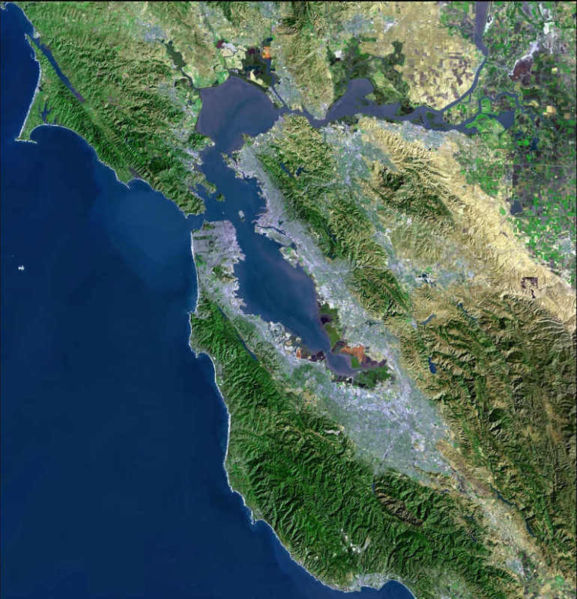
Image: USGS

A bevy of  Bay Area planning agencies have joined together for a series of interactive public workshops all over the Bay Area this month and next.

Using a web-based simulation tool workshop participants can consider different transit, land use and other policy choices for their region and see the implications. Participants will also be able to and voice their opinions and give direct feedback to the agencies.

The events are being sponsored by the Association of Bay Area Governments (ABAG) and the Metropolitan Transportation Commission (MTC) in conjunction with the Bay Area Air Quality Management District,  the Bay Conservation and Development Commission (BCDC) and a group of nonprofits.

But why wait for a workshop? Check out the YouChoose tool here

Register for an event and make your voice heard here

Read more about the comprehensive regional planning process and the “One Bay Area” kick-off report here

– – – –

The San Francisco Federal Building…at 2 AM

2

Yes, it’s true. While I was waiting for a TransBay bus near Civic Center at 2 am a couple weeks ago (not something I do often), I was thinking about energy efficiency.

I took the following (terrible) cell phone photo of the Federal Building from Market Street:

And I wondered, “Why are all those lights on?”

– – –

There are a number of reasons that entire floors of lights might be on in a building in the middle of the night. Reasons could include:

  • Cleaning crews come in after workers leave and turn all the lights on a floor on
  • A few folks are working really, really late and can only control large areas of lights
  • Sensors or timers that turn off the lights are not functioning properly
  • Nobody knows how to turn off the lights

But the San Francisco Federal Building is touted as a high-performance low-energy building. And someone else has previously noticed lights on late at night. So what’s going on?

I’m going to see what I can find out in the next week or two and will write a follow-up post.

– – –

More information on the San Francisco Federal Building is available from the architects (Morphosis),  Flex Your Power, the San Francisco Chronicle, and a case study by Rocky Mountain Institute.

– – –

Finding Data – WRI EarthTrends Delivered

3

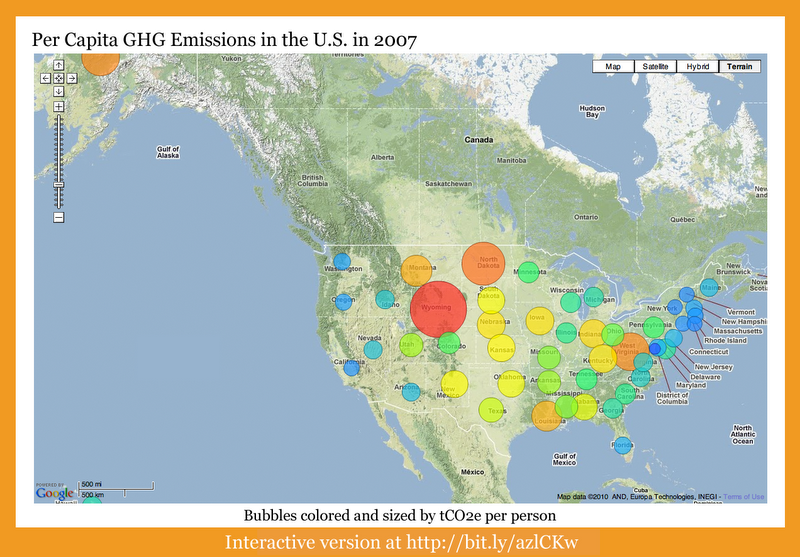
Image from: WRI EarthTrends

World Resources Institute has a useful and interesting service called EarthTrends Delivered. By signing up for this free service you can explore dozens of data charts and maps online and receive email digests of new data as it is produced by WRI in any of the following:

-Greenhouse Gas Emission Sources and Trends

-U.S. Climate Policy

-Energy and Electricity

-Adapting to Climate Change Impacts

Upon signing up you also get a dashboard to manage your subscriptions, save data, and share data via facebook, email or tweet.