Pecha Kucha Rundown: Denser, Part 3

1

Noelle and I had fun at Pecha Kucha in San Francisco at the SPUR Urban Center on June 21.  For those unfamiliar with the Pecha Kucha format, each speaker has 20 slides and 20 seconds per slide. The format makes for a fun but focused look at what a wide range of professionals is working on and thinking about. Presentations are loosely organized around a theme. The theme this time was “Denser.”

Using my notes, I am putting together a set of posts that lists the presenters in order, along with links to their website (if I could find them) and any major thoughts I jotted down. For some presentations, I took a number of notes. Other presentations have fewer notes (maybe I was looking at the images more carefully?). All of the presentations were more interesting and beautiful than revealed by my notes and these posts.

– – –

Julie KimHot Studio

essay – “Why We Lie to Kids” – Paul Graham

suburban existence – capsule to capsule

organized chaos – systems for sharing space in dense areas

suburban promise – control enables freedom

2 symbols – house + car

urban reality – loss of control enables freedom

worlds colliding in “meatspace”, the real, physical, non-virtual world

– – –

David Baker – Architect – David Baker + Partners Architects

crowded

hot & dirty

green

looking at density per square mile and the carbon footprint per person

Portland Pearl District full of 300 x 300 blocks

poem – “Lines in Potentis” – Ben Okri

– – –

Gabriel TanOut of Stock Design, Singapore

members of the firm are from different countries, but find a way to work together online

umbrellas in internal gutter to drain

mix of handcrafts and mass production

very focused on flatpack furniture

– – –

Antonio Roman-Alcalá – SF Urban Agriculture Alliance and Alemany Farm

“The Political Economy of Urban Land, and Its Relation to an Urban Agricultural Future”

farming and cities have co-evolved

our population is no longer “mostly farmers” – not directly tied to the land

what society values – highest-earning college majors vs lowest-earning college majors

can’t urban plan our way out of mining and destruction of rainforests

17th & Folsom = “future park” – park for kinds + urban garden

who gets to decide the best use of the land? the owner of the land or the community?

– – –

Part 1 is posted here. Part 2 is posted here.

– – –
Pecha Kucha Rundown: Denser, Part 2

2

Noelle and I had fun at Pecha Kucha in San Francisco at the SPUR Urban Center on June 21.  For those unfamiliar with the Pecha Kucha format, each speaker has 20 slides and 20 seconds per slide. The format makes for a fun but focused look at what a wide range of professionals is working on and thinking about. Presentations are loosely organized around a theme. The theme this time was “Denser.”

Using my notes, I am putting together a set of posts that lists the presenters in order, along with links to their website (if I could find them) and any major thoughts I jotted down. For some presentations, I took a number of notes. Other presentations have fewer notes (maybe I was looking at the images more carefully?). All of the presentations were more interesting and beautiful than revealed by my notes and these posts.

– – –

Elizabeth Shreeve – Principal – SWA Group

looking at what vertical cities and high density mean for the ground plane

high tower in Dubai – a building becomes a city district by itself

65% of the firm’s work is in China right now

– – –

Paul Jamtgaard – Architect, Urbanist – Group 4 Architecture

“Intensity in 10 Cities”

density x uniformity = monotony = DEATH

density x diversity = intensity = VITALITY

diagram of density in cities

density of people per square km in Portland, Mumbai, New York City, Tokyo, Singapore, Rio de Janeiro, Hong Kong, Istanbul, Copenhagen…

housing = human storage? or urban living

– – –

Ben Grant – Public Realm + Urban Design Manager – SPUR

city skylines as a bar graph of property values

looking at historical increasing density of use of same lot in NYC – eventual mandating of air shafts

density / setbacks – effect above the ground plane

residential density vs auto ownership [looked at 2 maps]

green architecture in the 1970s was away from the city

aesthetic integration of greenery + verticality

Donald Appleyard – Livable Streets (1981)

SFPUC looking at how to manage stormwater

– – –

Part 1 is posted here. Part 3 will be posted tomorrow.

– – –

Pecha Kucha Rundown: Denser, Part 1

3

Noelle and I had fun at Pecha Kucha in San Francisco at the SPUR Urban Center on Tuesday.  For those unfamiliar with the Pecha Kucha format, each speaker has 20 slides and 20 seconds per slide. The format makes for a fun but focused look at what a wide range of professionals is working on and thinking about. Presentations are loosely organized around a theme. The theme this time was “Denser.”

Using my notes, I am putting together a set of posts that lists the presenters in order, along with links to their website (if I could find them) and any major thoughts I jotted down. For some presentations, I took a number of notes. Other presentations have fewer notes (maybe I was looking at the images more carefully?). All of the presentations were more interesting and beautiful than revealed by my notes and these posts.

– – –

Grady Gillies – Architect – UCLA, Suprastudio

DENSE city

dense buildings

dense population

dense space

dense community

Looked at 8 cities as part of the studio, including:

Cleveland, OH – transforming access and landscape

Flint, MI – advantage of a shrinking city’s migration is SPACE

New Orleans – blighted property presents an opportunity

Tucson, AZ – relentless expansion of the city edge

Merced, CA – looking at potential impact of high-speed rail

Toledo, OH – city’s solar industry as a new urban identity

More information on the studio and work:

http://www.suprastudio.aud.ucla.edu/

– – –

Craig Scott – Architect – IwamotoScott

DENSER

environmental / technological performance

spatial / material geometry

urban / architectural experiences

3 focuses of firm’s practice – buildings, installations, and digital fabrications

– – –

Robin Levitt – Detroit

(Anna’s note – his entire introduction was “Robin Levitt, Detroit” but there is a little info on the ever-helpful Wikipedia)

Talking about the de-densification of a city

Birthplace of the automobile

Detroit was the Silicon Valley of its day

1950s saw Detroit’s population peak just under 2 million

[Image of reduction in building density in the downtown district]

Detroit could geographically fit San Francisco, Boston, and Manhattan, but has a much lower population density

Population decline over the years

But actual geographical area of the city was expanding

Ruins now dominate the Detroit landscape

Neighborhoods have been cleared

City looking at a strategy of controlled abandonment

City of Detroit began as farmland, and in many neighborhoods it is returning to farmland

– – –

Parts 2, 3, and maybe 4 coming soon!

– – –

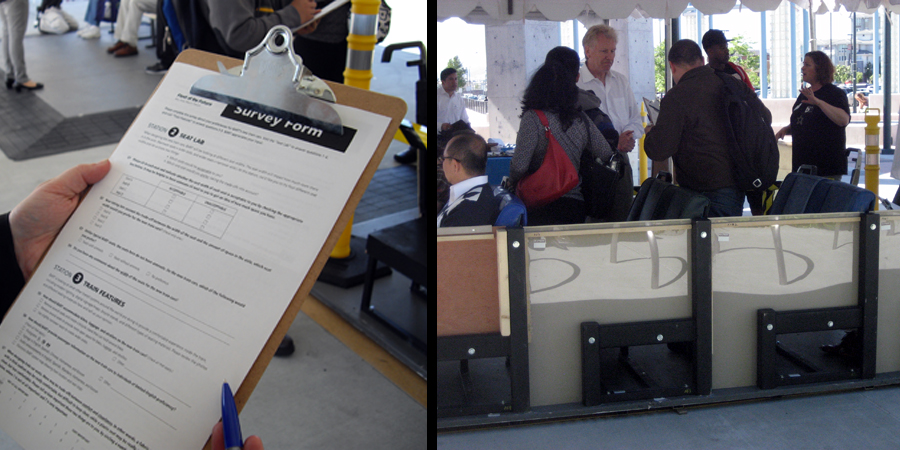
BART Seat Lab

1

Bay Area Rapid Transit, or BART is a common fixture in the lives of Bay Area  California residents. The above-and-underground train network spans northward to Richmond, southward to Fremont, and regularly ferries passengers between San Francisco and points to the east.

Despite their centrality to Bay Area daily life, BART cars have not seen a replacement since the 1970s when the system opened; and that is about to change. BART is actively seeking feedback on its ‘Fleet of the Future’, a long-range plan to replace its cars.

This estimated $3 billion project will be the single largest upgrade expenditure that the BART has ever seen—that could be why BART is enlisting the help of the public to get it right.

A series of ‘seat labs’ are taking place at BART station near you! There, you can try out several configurations of seats and aisle widths, and give feedback on materials, lighting, signage and more. What is most important to you on your commute?

– – –

Remaining BART seat lab schedule and locations

Read more:

Seat lab early feedback: Majority of riders want wider aisles in Fleet of the Future

Snippets

Are suburban corporate campuses falling out of fashion? NRDC staff blog predicts an increase in smart growth.  Lonely Planet surveyed travelers to find a list of the top 20 walking cities.  Grist readers nominated 10 additional cities that didn’t make the original Lonely Planet list. A study commissioned by the Food and Agriculture Organization of the United Nations finds that roughly one third of the food produced for human consumption every year gets lost or wasted.

FTC To Issue Revised Guidelines for “Green” Product Claims

1
image: Wikimedia Commons

Many products these days make claims on their labels that place them somewhere on the nebulous spectrum of “green”. These endorsements range from “all natural”, to  “environmentally friendly”, “biodegradable”, or “eco”  just to name a few.

But what do these labels really mean? “Environmentally friendly” compared to what? “Biodegradable” how, and under what conditions?

The fact is, many manufacturers in recent years have taken note of strong consumer appetite for safer products and have responded– but not always with meaningful changes. Products and services that gratuitously toss around vague environmental claims have come to be known as “greenwashing“.

For example, many product labels feature environmental seals – little pictoral “stamps” with a tagline; while there are some legitimate third party verification seals that attest to a products’ safety, environmental performance and/or the manufacturing process, some may be nothing more than ornament. Other examples of deceptive advertising practices may include misleading claims, or overstatement of environmental benefits of a product during its manufacture, use or disposal.

The Federal Trade Commission (FTC) first  adopted its “Green Guide” in 1998 to help provide a baseline of clarity for both consumers and the manufacturers making environmental claims about their products; the revisions that are in the works now will be the first since 1998.

The new revisions will be based on research done by the FTC to gauge consumer understanding of various “green” labeling terms and practices. However, the FTC stops short of providing legal definitions to terms and the guidelines will still be voluntary and self-implemented by manufacturers.

Listen to the KQED Forum “An End to Greenwashing” that provides a discussion of the new FTC guidelines, here

Visit the Good Guide, a group that helps you find “healthy, green, ethical products according to scientific ratings”

– – –


Photos of BART Under Construction

1

The San Francisco Chronicle website has a gallery of photos from when the BART system was originally under construction in the 1960s and 1970s. You can see the photos here.

There is a photo of people on a walking tour through the Transbay Tube.

Also, there is a photo of then-President Nixon riding BART in 1972.

Go. Look.

– – –

(Image credit: Wikimedia Commons)

The Dublin Pleasanton BART Station under construction, much later, in 2009.

– – –

Another Fiscal Emergency for AC Transit?

1

– – –

AC Transit will hold a public hearing on May 25 at 5:00 pm at the offices at 1600 Franklin Street in Downtown Oakland to discuss declaring a fiscal emergency for the third consecutive year.

According to California Beat:

Calling a fiscal emergency would allow AC Transit to cut costs by eliminating service, implementing hiring freezes and reorganize administrative expenses without undergoing environmental reviews that would delay the process.

The agency is facing a $14.9 million shortfall in the coming fiscal year and warns it will face a steeper funding shortage by the end of 2012.

In October, the agency cut 13 percent of bus service to nearly all East Bay communities and hiked fares for riders. This month, the Board approved a ten-year fare increase plan that will increase the base fare incrementally to meet inflation rates.

You can read the entire story here.

– – –

The AC Transit Board voted last week to raise basic bus fares from $2.00 to $2.10, to take effect August 1.

According to Mercury News:

The increase, however, is a tiny fraction of what is needed, district officials said. It will raise just $2.4 million annually to reduce a projected deficit of $21 million in the next fiscal year, according to a district staff report.

As a result, another round of service cuts are likely to be needed within the next 12 to 18 months, King said. AC Transit cut service twice last year.

You can read the entire story here.

– – –

Tour A Tiny Apartment in Spain

3

Our previous posts on tiny houses (here and here) are consistently among our most-viewed posts here at Zero Resource. As I find more interesting tiny dwellings, I will post them. Today, I am posting a video tour of a tiny apartment in Spain, converted from a rooftop pigeon coop. Enjoy!

If the embedded video above does not appear, you can also find the video on YouTube here.

There are a number of other video tours of tiny houses and apartments on YouTube. I’ll post some of them over the next couple weeks.

Climate Change Hits Home

1

(Image credit: flickr user heidi.nutters, via SPUR)

A recent report by SPUR entitled “Climate change hits home” addresses how we should plan to adapt to climate change in the Bay Area. The report includes a number of strategies to help local communities to be more resilient to the impacts of climate change. Some of the key impacts discussed in the report include:

  1. Higher average temperatures,
  2. Increased number of heat waves,
  3. Water uncertainty: droughts, extreme storms, flooding,
  4. An increased risk of wildfire, and
  5. Sea level rise.

The SPUR task force responsible for the report then considered how these impacts would affect various areas of planning in the Bay Area and proposed strategies to adapt to them.

The goal of the report is to get local agencies to begin to talk to one another to coordinate responses to climate change. Many of the adaptation strategies proposed in the report will also help to reduce greenhouse gas emissions – a real “win-win” overall.

A copy of the report is available for download from the SPUR website.

– – –
