Tiny “Spite” Houses

2

Continuing my interest in tiny houses, here’s a post about tiny “spite” houses.

– – –

I came across this blog post about spite houses, which are

A building constructed or modified to irritate neighbors or other parties with land stakes. Spite houses often serve as obstructions, blocking out light or access to neighboring buildings, or as flamboyant symbols of defiance. Because long-term occupation is at best a secondary consideration, spite houses frequently sport strange and impractical structures.

A couple of the highlighted spite houses are tiny!

– – –

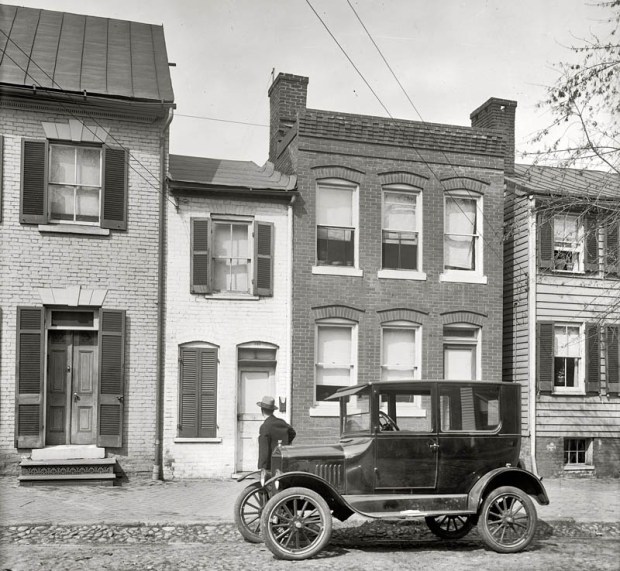
The Hollensbury Spite House:
John Hollensbury vs Horse-drawn Wagons in Alexandria, Virginia 1830

More info here.

– – –

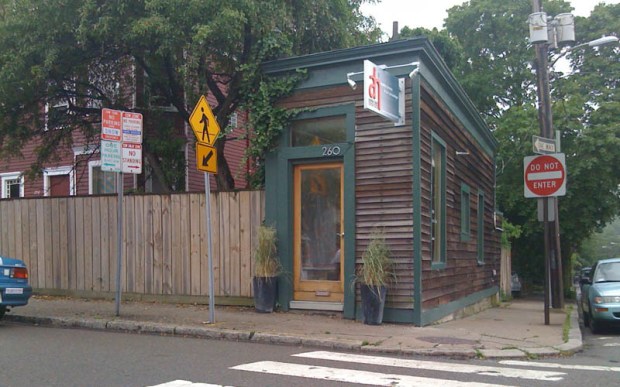
The Skinny House: Sibling Rivalry in Boston, Massachusetts 1874

More info here.

– – –

The Alameda Spite House:
Charles Froling vs Neighbour & the City of Alameda, California 1900s

More info here.

– – –

The O’Reilly Spite House:
Francis O’Reilly vs Neighbour West Cambridge, Massachusetts 1908

More info here.

– – –

The Montlake Spite House:
Typical Neighbourly Clash in Seattle, Washington 1925

More info here.

– – –

ZETA Communities on NPR

1

As I was listening to the radio this morning, I heard a story about Bay Area company ZETA Communities…

– – –

As Population, Consumption Rise, Builder Goes Small

The planet may not feel any different today, but there are now 7 billion people on it, according to the United Nations.

That number will continue to rise, of course, and global incomes are likely to rise as well. That means more cars and computers, and bigger homes: the kinds of things Americans take for granted. It’s that rise in consumption that has population experts worried…

In an industrial park outside of Sacramento, Calif., there’s a factory inside what looks like an old airplane hangar.

Zeta Communities builds modular homes here. Project manager Scott Wade says they’re not like “stick-built” homes — “stick-built meaning they build it one piece at a time,” Wade says, “whereas we build it an assembly at a time.”

In cities, modules can be stacked to make a new generation of efficient buildings. At Zeta headquarters, architect Taeka Takagi rolls out a blueprints with one of Zeta’s prototypes.

“It is a micro studio,” she says. “The units are under 300 square feet.”

You can read or listen to the entire story on the NPR website.

– – –

You can also watch videos of a unit being built in the ZETA factory and a unit being installed on our website here.

– – –


2011 State Energy Efficiency Scorecard

– – –

The American Council for an Energy Efficient Economy (ACEEE) has posted its 2011 State Energy Efficiency Scorecard. California is ranked #2, behind Massachusetts.

You can see the California information here.

The full scorecard ranking can be found online here.

A Year Ago on Zero Resource – October 2010

The Rundown: 2011 BERC Energy Symposium

1

Last week, I attended the 2011 BERC Energy Symposium, on the UC Berkeley campus. There were a number of interesting folks both speaking and attending, so I’d like to give you all a sense of what was covered.

I attended a panel on energy and behavior on Friday morning – I will post some thoughts on it in the next few days.

– – –

Coverage from The Berkeley Science Review:

– – –

You can find more information about BERC and this year’s expo and symposium here.

– – –

The Future of Energy

1


– – –

The most recent Planet Money podcast is a discussion of the future of energy with Daniel Yergin, an influential thinker and author on energy issues.

The podcast is online here (with a transcript). The energy part of the discussion starts between 3.5-4 minutes in.

– – –

A Year Ago on Zero Resource – September 2010

– – – 

Oaklavia

1

Thousands Play in Oakland’s Streets at the First-Ever ‘Oaklavia’ fromStreetfilms on Vimeo.

On October 2, Oakland will hold an event called Oaklavia, closing a few miles of roads to cars to let people experience car-free city streets. Today’s video is the community reaction to the first time Walk Oakland Bike Oakland organized Oaklavia, last year.

– – –

You can learn more about Oaklavia at its website, oaklavia.org, or at walkoaklandbikeoakland.org.

See you there?

THIS POST IS PART OF OUR FRIDAY VIDEO SERIES.

Today is PARK(ing) Day!

1

You can find events in your area through the map on the Parkingday.org site.

– – –

What is PARK(ing) Day, you ask? According to Parkingday.org,

PARK(ing) Day is a annual open-source global event where citizens, artists and activists collaborate to temporarily transform metered parking spaces into “PARK(ing)” spaces: temporary public places. The project began in 2005 when Rebar, a San Francisco art and design studio, converted a single metered parking space into a temporary public park in downtown San Francisco. Since 2005, PARK(ing) Day has evolved into a global movement, with organizations and individuals (operating independently of Rebar but following an established set of guidelines) creating new forms of temporary public space in urban contexts around the world. The mission of PARK(ing) Day is to call attention to the need for more urban open space, to generate critical debate around how public space is created and allocated, and to improve the quality of urban human habitat … at least until the meter runs out!

– – –

You can find out more about PARK(ing) Day by reading an article in Smithsonian magazine. Some highlights:

The genesis of Park(ing) Day began in 2005, while Passmore was working in a downtown building, watching cars going in and out of metered spaces. “I had a vision of time-lapse photography, and started thinking: What if an art gallery came in for two hours, or a park came in for two hours? I looked into the law and found that, in San Francisco, it’s technically legal to do something with a metered parking space, apart from storing your car there.” … …

“We did it on November 16, 2005, on Mission Street,” Passmore recalls. “It lasted two hours: the maximum time offered on the meter.” Despite his legal research, Rebar’s foray into guerilla landscape architecture was filled with trepidation. “We actually had speeches prepared for the police: speeches about how we were acting in the public interest, planned to clean up after ourselves and so on. Because we were sure we were going to be arrested.” But nothing happened. “A few meter maids scooted by,” Passmore says with a laugh. “They must have assumed we had a permit—because no one in their right mind would try to do something like this otherwise.”

The event swept through the blogosphere. Suddenly, people all over the country wanted to turn parking spaces into parks. “People were asking us to replicate our project in their cities—which was difficult to do. We were just three guys with day jobs. Rebar was something we did on weekends. So we decided to make a how-to manual and let people do it on their own.”

– – –

Seattle’s 2030 District

1

This video highlights the first high-performance building district. The Seattle 2030 District is a district in downtown Seattle that aims to dramatically reduce the environmental impacts of facility construction and operations. It just announced it’s formal launch. Check it out – maybe we can do this in other cities!

If you do not see the video embedded above, click here to watch it on YouTube.

– – –

You can find out more about the Seattle 2030 District here.

THIS POST IS PART OF OUR FRIDAY VIDEO SERIES.